Pakistan’s telecom regulator may soon be able to look inside the pricing of the country’s largest mobile operators before they move. Draft telecom competition rules circulated by the Ministry of Information Technology and Telecommunication would let the Pakistan Telecommunication Authority redefine market boundaries, run periodic competition reviews and impose tariff obligations on any operator it designates as holding significant market power.
The Telecommunication Competition Rules 2026 are still a proposal. Nothing in them sets a price, and nothing in them authorises an increase. What they do is build the machinery through which a future increase — or a future cap — would have to pass.
What the draft rules would let PTA do
The core of the framework is a periodic market review. PTA would be empowered to reassess the telecom sector as technology and market conditions change, and to redraw the definition of a “relevant market” when the old boundaries stop describing how people actually buy service.
In carrying out that review, the regulator would weigh consumer demand, the availability of alternative services, supply-side substitution, pricing behaviour and technological developments. That list matters because it puts pricing patterns inside the evidence base for a competition finding, rather than leaving them as a separate consumer-protection matter.
The 25 percent market-share trigger
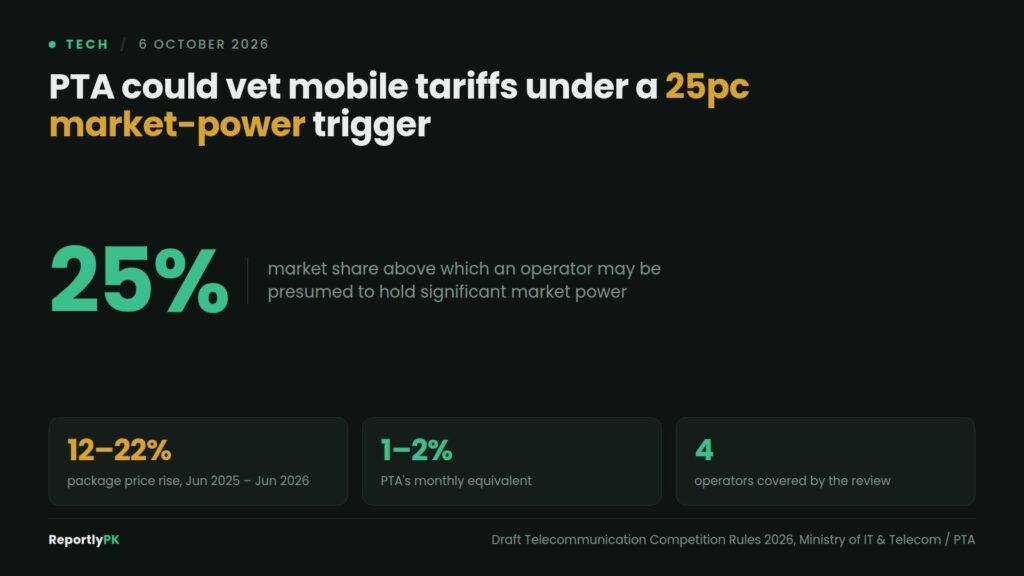
The most concrete number in the draft is a threshold. An operator holding more than 25 percent of a relevant market may be presumed to have significant market power, or SMP.
The presumption is not meant to be automatic. The draft requires PTA to go further and examine sectoral revenues, overall market concentration, control over essential infrastructure, spectrum holdings, financial resources, network effects and barriers to entry. It also allows the regulator to consider whether operators are behaving in a coordinated way rather than competing.
An operator found to hold SMP could then be subjected to obligations spanning tariffs and pricing, non-discrimination, transparency, interconnection and access services, infrastructure access, accounting separation and cost accounting. In practice, that is the toolkit a regulator uses when it has concluded a market will not discipline itself.
What consumers have already paid
PTA has published its own account of recent movement. Reviewing major packages offered by Jazz, Telenor, Zong and Ufone between June 2025 and June 2026, the regulator found increases of 12 percent to 22 percent across that twelve-month window.
PTA framed the figure deliberately. Spread across a year, it said, the rise works out to roughly 1 percent to 2 percent a month — a response to claims circulating that monthly package costs were climbing far faster than that.
- Price movement reviewed: June 2025 to June 2026
- Range of increase across major packages: 12 percent to 22 percent
- PTA’s monthly equivalent: about 1 percent to 2 percent
- Operators covered: Jazz, Telenor, Zong, Ufone
Both readings of the same number are accurate. Which one feels true depends on whether a household budgets by the month or by the year, and the gap between those two experiences is part of why the pricing question has stayed politically live.
Operators already need a sign-off
The draft does not arrive into an unregulated market. In February 2026 telecom operators were instructed to seek PTA approval before revising mobile tariffs, which means package changes already pass through the regulator.
What the Competition Rules 2026 would add is a standing structure rather than a case-by-case clearance: a defined market, a named set of dominant players and a continuing obligation attached to that designation. That is a different kind of oversight, and a harder one for an operator to argue around each time it files.
Related: Pakistan’s 5G runs at 127.74 Mbps but reaches users only 3.95pc of the time
What has not been decided
No operator has been designated as holding significant market power. No tariff obligation has been imposed. No consultation outcome has been published, and the draft does not carry a stated effective date in the version reported.
The coverage that has followed the draft, including headlines suggesting packages will get more expensive, is reading forward from a framework that could cut either way. A tariff obligation imposed on a dominant operator is as likely to hold prices down as to let them rise; the framework’s direction depends entirely on what PTA concludes when it runs the review.
Why the market definition is the real question
Pakistan’s mobile market has four operators, and a 25 percent threshold in a four-player market is low enough that more than one of them could cross it depending on how the market is drawn. Define the relevant market as mobile data and the shares look one way; define it as all retail connectivity, including fixed broadband, and they look different again.
That is why the power to redefine markets sits at the top of the draft rather than buried in it. The designation follows the definition, and the obligations follow the designation. Until PTA publishes how it intends to draw those boundaries, the practical effect of the rules on what a user pays each month remains unknowable — which is the honest answer to the question the headlines are asking.