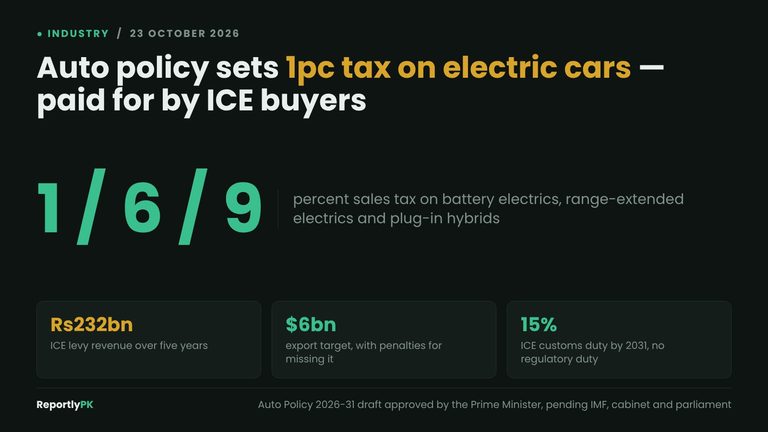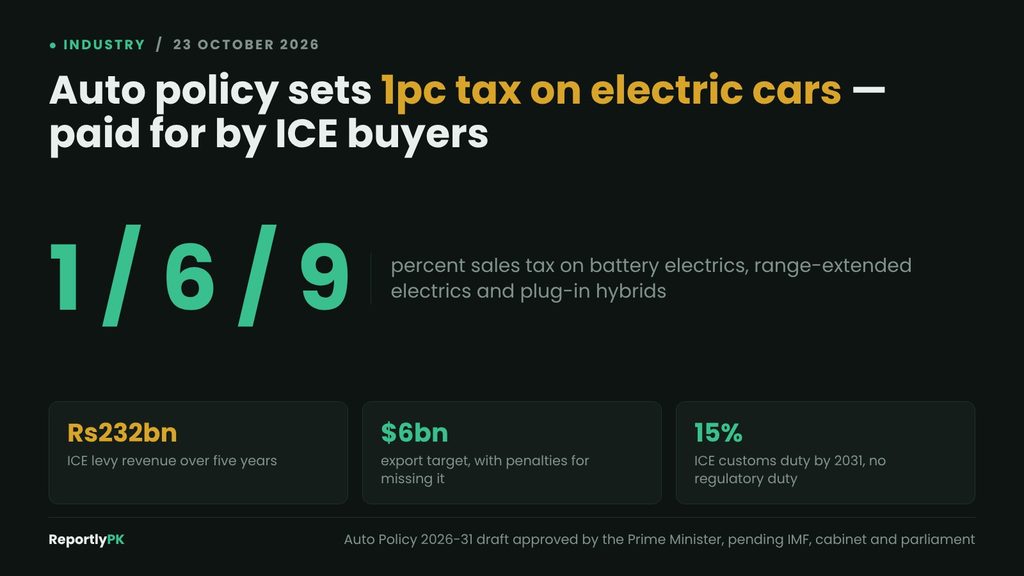
The tax uncertainty that froze car invoicing in September now has an answer. Prime Minister Shehbaz Sharif has approved the final draft of the auto policy for 2026-31, which sets sales tax on battery electric vehicles at 1 percent, range-extended electrics at 6 percent and plug-in hybrids at 9 percent.
Conventional hybrids are to be treated identically to internal combustion vehicles for duties and taxes — the single decision that most changes the competitive landscape for assemblers. The draft now goes to the IMF, then the federal cabinet, then parliament.
The new tax structure
- Battery electric vehicles: 1 percent sales tax
- Range-extended electric vehicles: 6 percent
- Plug-in hybrids: 9 percent
- Conventional hybrids and ICE vehicles: treated equally
- Rates apply to both locally assembled and imported vehicles
- Higher federal excise duty on ICE vehicles above 2,000cc and on NEVs valued above $75,000
The nine-point spread between a battery electric and a conventional car is the policy’s central instrument. It is also why the September sales figures looked the way they did — assemblers could not invoice hybrids while the treatment was unresolved, which is the explanation Topline Securities gave for a month in which Pak Suzuki fell 46 percent year on year while Indus Motor grew 31 percent.
Prices, as projected in the draft
The draft carries indicative price effects. A Suzuki Alto falls from Rs3.2 million to Rs2.845 million in the first year; a Cultus from Rs4.3 million to Rs3.8 million; a Toyota Yaris from Rs6 million to Rs5.3 million.
Electric models move further. A Wuling Bingo BEV is projected at Rs2.7 million against Rs4 million now, and a Toyota RAV plug-in hybrid at Rs18.3 million against Rs23.3 million.
One vehicle gets more expensive. The Toyota Fortuner rises from Rs20.5 million to Rs21.7 million under the new excise duty and ICE levy, which is the policy working as designed: large-engine conventional vehicles are meant to pay for the incentives offered elsewhere.
These are projections in a draft that has not cleared the IMF, the cabinet or parliament. No buyer should treat them as prices.
Related: Car sales up 43pc or 19pc? Both are right
Who pays for the export scheme
The policy sets a $6 billion export target and backs it with both reward and sanction. Exporters receive 5 percent compensation on the net value of exports, rising to 10 percent on incremental exports. Manufacturers missing minimum export targets face penalties of 1 to 3 percent of annual production value, and missing targets for two consecutive years means cancellation of the manufacturing certificate.
Funding comes from an ICE levy of 2 to 10 percent, estimated to raise Rs232 billion over five years, with a proposed automotive development levy on ICE vehicles above 1,000cc financing a revenue-neutral export incentive scheme.
Revenue-neutral describes the government’s books, not the buyer’s. The cost of subsidising exports falls on Pakistanis purchasing new conventional cars, and the policy document is explicit about that. Whether the transfer is justified depends on an assembler base that has spent two decades producing for a protected domestic market now reaching $6 billion in exports — a target with no precedent in the sector’s history.
The tariff path is the real commitment
Customs duty on ICE cars and SUVs is to fall to 15 percent by 2031, with no additional or regulatory duty on top. Small EVs under $15,000 get a 5 percent tariff for the policy’s first two years, and EV-specific non-localised parts imported in CKD form attract 1 percent.
A five-year glide path to 15 percent with no regulatory duty is the most consequential line in the document. Pakistani assemblers have operated behind tariff walls that made local assembly viable at low volumes and low localisation; removing that protection on a published schedule is what forces either genuine competitiveness or exit.
It is also the commitment most likely to be eroded. Regulatory duties have historically been the instrument through which headline tariff reductions are quietly reversed, and the policy’s credibility rests on the promise that none will be added.
Three approvals still stand between this and a price
The draft goes to the IMF before the cabinet, and only then to parliament for the legislation that gives the tax rates effect. That ordering is itself informative about where authority over Pakistani tax policy currently sits.
The Fund’s likely concern is revenue. A 1 percent sales tax on battery electrics against the standard rate on conventional cars is a substantial concession, and the Fund has spent this year pressing Pakistan to broaden the tax base and withdraw support schemes — it objected to the fuel payments for motorcyclists on exactly the ground that they were broad-based and costly.
The counter-argument available to the government is that the package is designed to be revenue-neutral, with the ICE levy funding the incentives. Whether the Fund accepts an internal transfer as neutral, or reads the Rs232 billion as revenue that should have gone to the exchequer, is the question that will determine whether these rates survive to reach parliament.
Financing, and what is still missing
The NEV credit limit rises from Rs3 million to Rs10 million and the tenor from three to five years, which addresses the gap between electric vehicle prices and what auto financing rules previously allowed buyers to borrow.
What the draft does not appear to set out is a localisation schedule — the requirement that has historically determined whether assembly creates a parts industry or simply screwdriver operations. Parts manufacturers have spent this year arguing that local content, worth up to 60 percent of a locally built car’s value, is what makes domestic assembly worth protecting.
A policy that cuts tariffs, taxes electrics lightly and penalises non-exporters, without specifying localisation, could produce lower car prices and a smaller domestic supply chain at the same time. The bill that reaches parliament is where that will be settled.