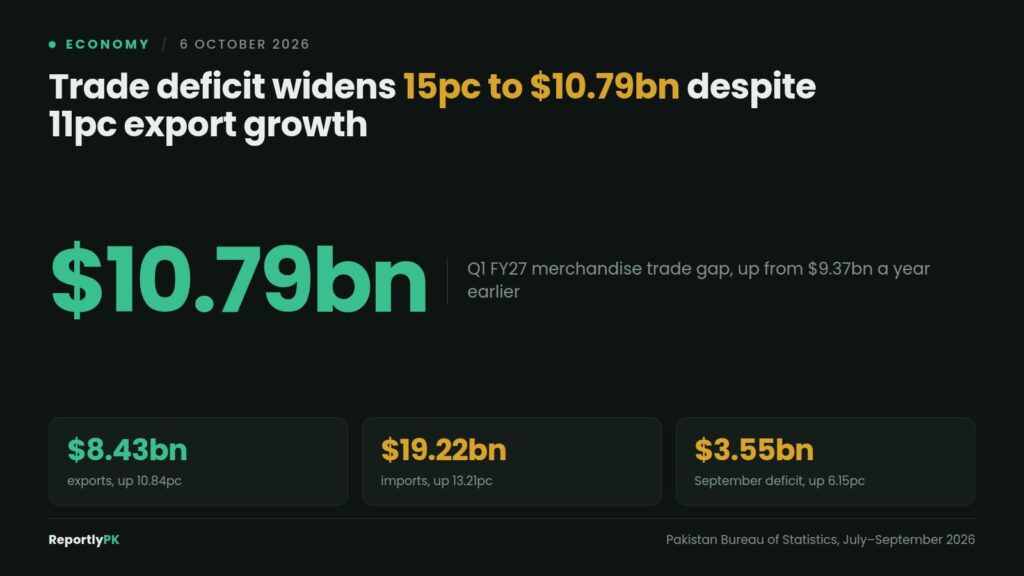
Exports grew by double digits in the first quarter of the new fiscal year. The Pakistan trade deficit grew faster. Figures released by the Pakistan Bureau of Statistics put the merchandise trade gap at $10.79 billion for July-September 2026, up 15.13 percent from $9.37 billion in the same quarter last year.
That is the arithmetic that keeps catching Pakistan out. An 11 percent export gain is a genuinely good quarter by the standards of the last decade. It is not enough when the import bill is both larger and growing at a similar rate.
The quarter in numbers
- Exports: $8.43 billion, up 10.84 percent from $7.59 billion
- Imports: $19.22 billion, up 13.21 percent from $16.97 billion
- Trade deficit: $10.79 billion, up 15.13 percent from $9.37 billion
- September exports: $2.94 billion, up 17.61 percent year on year
- September deficit: $3.55 billion, up 6.15 percent on August
The base effect is what does the damage. Imports started the quarter $9.38 billion larger than exports, so a 13.21 percent rise on imports adds roughly $2.25 billion of new spending while a 10.84 percent rise on exports adds about $834 million of new earnings. The percentages look comparable. The dollars are not.
September was the strongest export month
Within the quarter, September carried the export performance. Shipments reached $2.94 billion, a 17.61 percent year-on-year increase and well above the quarterly average run rate of $2.81 billion a month.
The deficit still widened that month, to $3.55 billion, 6.15 percent above August. A month in which exports accelerate and the gap still grows is the clearest single illustration of the structural point: the import side is not responding to the same cycle.
Industry blames the cost of production
The Federation of Pakistan Chambers of Commerce and Industry responded to the release by pointing at domestic costs rather than external demand. FPCCI President Atif Ikram Sheikh cited the “exceptionally high cost of doing business in Pakistan, which severely hampers the competitiveness of local manufacturers.”
Sheikh identified three cost lines in particular, warning that “prohibitive interest rates, massive capacity charges on electricity, and elevated petroleum levies act as immense barriers to industrial productivity.” He cautioned that the trend “will further exhaust the national exchequer and trigger a balance of payments crisis.”
His three recommendations were a policy rate cut to single digits, electricity and gas tariffs rationalised against regional competitors, and targeted relief on inland logistics. All three move money toward exporters and away from either the exchequer or the power sector’s capacity payments, so each would need a funding source that the current fiscal position does not obviously contain. FPCCI represents the businesses that would receive the relief, which is worth holding in mind alongside the diagnosis.
Related: Pakistan’s income tax returns rose 45pc to 5.77 million
Two external pressures exporters did not create
Exporters’ representatives also pointed to factors outside the domestic cost base. Shipping costs remain elevated because of Middle East disruption, which raises the landed price of Pakistani goods without any change in the factory gate.
Trade with Afghanistan has been suspended since October 2025, removing a land-border market that absorbed Pakistani food, cement and pharmaceutical exports. Neither of those is reversible through tariff policy, and both sit in the export column rather than the import one — meaning the 10.84 percent growth was achieved with two headwinds already running.
The targets are moving the wrong way
Against this quarter, the official export ambition has been revised upward rather than down. A target of $60 billion in exports by 2030 was recently replaced with $100 billion by 2035.
Annualising the current quarter gives roughly $33.7 billion. Reaching $100 billion by 2035 from that base requires sustained compound growth of about 12.5 percent a year for nine consecutive years — slightly above the growth rate just delivered, held without interruption for the better part of a decade. The quarter proves that rate is attainable. Nothing in the quarter proves it is sustainable.
Where the deficit gets financed
A merchandise gap of $10.79 billion in a single quarter has to be covered from somewhere, and the merchandise account is only part of the external picture. Remittances, services exports and financial inflows together determine whether a widening trade gap translates into pressure on reserves or is absorbed without incident.
That is why the FPCCI warning about a balance of payments crisis is a conditional claim rather than a forecast. The trade number alone does not establish it. Remittance inflows have been the swing factor in recent years, and the current account rather than the trade account is the measure that triggers external stress.
Two other figures from the same week point in opposite directions. Seafood exports reached $125 million in the quarter, a small but growing line. Industrialists, meanwhile, flagged the 15 percent deficit surge as the headline risk to the economy. Both readings come from the same quarter, and reconciling them requires the State Bank’s current account data, which lands later in the month.
What to watch next
The import composition is the number that will settle the argument. If the $19.22 billion is weighted toward machinery and industrial raw material, the deficit is the cost of a manufacturing recovery and will narrow as that capacity starts exporting. If it is weighted toward energy and consumer goods, it is consumption financed by borrowing.
PBS has not yet published the commodity-level breakdown for the quarter. Until it does, both readings of the same $10.79 billion remain available, and every party to the debate will pick the one that suits its ask.