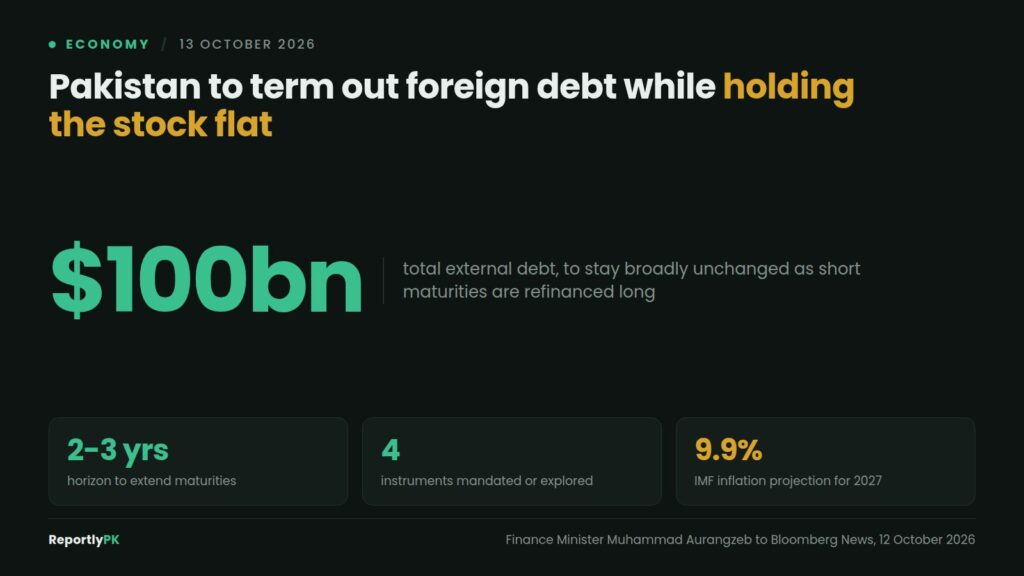
Pakistan intends to change the shape of its foreign borrowing without changing its size. Finance Minister Muhammad Aurangzeb said the country will pursue external debt refinancing over the next two to three years, moving short-term obligations into longer maturities while holding the total stock roughly where it is.
“We want to keep the overall quantum of our external debt, which is close to $100 billion,” he told Bloomberg News on Monday, describing the programme as replacement, diversification and longer maturities rather than net new borrowing.
What is being proposed
- Total external debt: about $100 billion, to remain broadly unchanged
- Horizon: two to three years to term out short-dated obligations
- Bond issuance: no rush this fiscal year
- Islamic sukuk: a mandate has been given
- Dollar-settled, rupee-denominated bonds: a mandate given for the first time
- Panda bonds: RFPs to be issued for the remaining tranches
- Eurobonds: the government will explore tokenising existing issues
The stated objective is narrow and legitimate. Aurangzeb said Pakistan does not absolutely need to cover its external financing gap this year, but wants to refinance short-dated debt into longer tenors “so [the] country does not have to go into this rollover risk of short-term debt.”
Terming out is insurance, and insurance has a price
Rollover risk is the danger that debt falls due at a moment when markets will not refinance it on acceptable terms. For a sovereign with Pakistan’s rating history, that risk is real and has bitten before. Extending maturities removes it.
It is not free. Lenders charge a term premium for committing money for longer, so the same quantum of debt at longer maturity generally costs more in coupon. The trade is a higher running cost in exchange for fewer moments of vulnerability — usually a sensible one, but it should be described as a cost rather than as a saving.
Holding the stock flat at $100 billion also means this is a liability-management exercise, not deleveraging. The debt burden does not shrink; its timing profile improves.
Related: IMF staff-level agreement unlocks $1.2bn for Pakistan
The instrument that carries a real shift
Of the four instruments named, the dollar-settled, rupee-denominated bond is the one that changes who bears what. The obligation is sized in rupees and paid in dollars, which means the investor absorbs the consequences of rupee depreciation rather than the sovereign.
That is a genuine reduction in Pakistan’s currency mismatch, and it is the first time the structure has been mandated. Investors will price it accordingly: a buyer taking rupee risk on a frontier credit will want compensating yield, so the saving on currency exposure arrives as a higher coupon. Aurangzeb said reverse inquiries are already coming in, which suggests there is a bid at some price.
Panda bonds — renminbi-denominated paper sold into China’s domestic market — diversify the investor base away from dollar funding, and RFPs are to be issued for the remaining tranches. The sukuk mandate serves the same purpose for Gulf and Islamic-finance investors.
Tokenisation is the outlier
“For the first time, you are also going to see if we can go for tokenisation of our existing Eurobonds,” Aurangzeb said. The careful phrasing — see if we can — is doing work, and it should be read as exploration rather than as a plan.
Tokenising an existing bond does not create new money or reduce what is owed. It changes how the instrument is held and transferred, with the theoretical benefits being faster settlement, smaller minimum denominations and access to buyers who do not operate through conventional custody chains.
Whether any of that translates into lower borrowing costs for a sovereign is unproven. A handful of issuers have tested tokenised bonds; none has demonstrated a durable pricing advantage, and the investors who would value the feature are not generally the ones who move a yield curve. It is worth watching as an experiment and not worth counting as a funding strategy.
The privatisation number is small against the debt
Alongside the refinancing plan, the government expects to raise more than $1 billion from privatising five or six entities, and sees growth above 4 percent.
Set against $100 billion of external debt, a billion dollars of sale proceeds is about 1 percent — which is the right way to read privatisation in this context. Its value is not the cash. It is removing loss-making entities from the budget, and in the power sector specifically, attacking the distribution losses that feed circular debt. The IMF pressed on exactly that point in the review concluded last week.
The GEPCO transaction is the furthest advanced, with nine bidders prequalified and in the data room. Three of them are Turkish, which is the only meaningful foreign participation on that shortlist and a reminder that the investor base for Pakistani assets remains narrow — the same constraint the bond diversification programme is trying to address from the other direction.
The week this was said in
The remarks came at the start of the World Bank Group and IMF Annual Meetings in Bangkok, running 12 to 18 October, where Aurangzeb is leading Pakistan’s delegation through more than 60 high-level engagements with finance ministers, investors, banks, rating agencies and media. He has also assumed the chairmanship of the Borrowers’ Platform.
Timing matters for how the message should be read. A finance minister saying his country is in no rush to issue is speaking to the market as much as describing a plan — scarcity is a negotiating position, and the statement costs nothing if the issuance window is genuinely open later.
The same week brought an IMF projection that Pakistani inflation will rise to 9.9 percent in 2027 as growth slows. A refinancing programme executed into rising inflation and slowing growth is harder than one executed into the reverse, and the coupon Pakistan ends up paying for longer maturities will reflect which of those conditions prevails when the mandates are actually exercised.