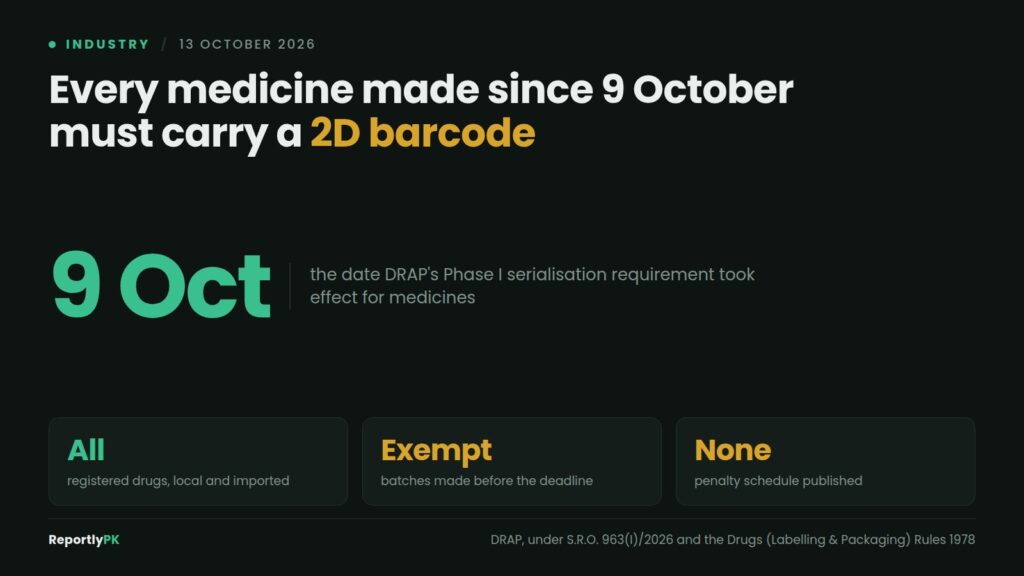
Every medicine manufactured in or imported into Pakistan since 9 October must now carry a unique serial number and a scannable 2D Data Matrix code. The Drug Regulatory Authority of Pakistan has confirmed that Phase I of its 2D barcoding and serialisation regime is in force.
The stated purposes are to curb spurious, falsified, counterfeit and unregistered medicines, to make product recalls work as a single integrated operation, and to give the regulator real-time visibility of the supply chain.
What Phase I requires
- A unique 2D Data Matrix barcode and serial number on the pack
- Applies to all registered drug products, locally made and imported
- Binding on every manufacturer and importer
- Trigger: products manufactured or imported on or after 9 October 2026
- Legal basis: the DRAP Act 2012 and the amended Drugs (Labelling & Packaging) Rules 1978, via S.R.O. 963(I)/2026
- Non-compliance: legal action under the relevant legislation, with no specific penalty schedule published
One administrative detail is unclear in the published accounts: the enabling notification is dated 9 June 2026 in one place and 9 July 2026 in another. The requirement and its commencement date are not in doubt; the notification date should be confirmed against the gazette before anyone relies on it.
The grandfathering clause is the soft spot
Batches with a manufacturing date before 9 October are exempt. They may continue to be imported, distributed and sold without a barcode or serial number.
That exemption is unavoidable — ordering the destruction of existing stock would be both wasteful and a supply risk — but it creates a transition of real length. Medicines commonly carry shelf lives of two to three years, so unserialised packs will circulate legitimately well into 2029.
During that window an unserialised pack is not evidence of anything. A counterfeiter’s simplest response to a serialisation mandate is to print a pre-deadline manufacturing date, and the honest answer is that verifying such a claim requires exactly the traceability the system was introduced to provide. The regime becomes genuinely enforceable only once the exempt stock has worked through.
A code is only as good as the scan
The announcement describes what must be printed. It says much less about what happens when someone reads it.
Track-and-trace systems deliver their benefit at the point of verification — a pharmacist, a hospital store or a patient scanning a pack and receiving an authoritative answer about whether that serial number is genuine, already dispensed, recalled or expired. Without an accessible lookup, serialisation is a printing cost that produces a database only the regulator can query.
DRAP has referenced integration with its e-Services portal, and the technical parameters sit in the cited rules rather than in the announcement. What has not been set out publicly is whether a consumer-facing check will exist, who may query the database, and what a scan returns. Those details decide whether this works.
Related: Pharmaceutical exports hit a three-year low of $319m
The cost lands in a difficult year
Serialisation is not a label redesign. It requires printing and vision-inspection equipment on each packaging line, software to generate and manage serial numbers without collision, and integration with the regulator’s portal. For a mid-sized manufacturer running several lines, that is meaningful capital expenditure.
It arrives in the same quarter that FY26 pharmaceutical exports were reported at a three-year low of $319.01 million, and in which the industry has been asking the state for help rather than for new obligations.
The counter-argument is strong, though, and it runs through exports. Serialisation to international standards is a precondition for selling into the European Union and the United States, both of which require it. Pakistani manufacturers have identified slow foreign registration and delayed facility inspections as the barrier to reaching regulated markets; a compliant serialisation system removes one objection an importing regulator would otherwise raise. The spending is a market-access investment as much as a compliance cost.
Phase I implies later phases
Labelling the requirement Phase I signals more to come, and the announcement does not describe what. In comparable systems elsewhere, the sequence runs from marking packs, to aggregating them into cartons and pallets so a whole shipment can be tracked by one scan, to recording each change of custody down the distribution chain.
Each step raises the cost and each step raises the value. Marking alone proves a pack was made by whoever claims to have made it; custody recording is what reveals where in the chain genuine stock is being diverted or counterfeit stock inserted, which is where the counterfeiting problem actually lives.
Pakistan’s distribution network runs through a large number of small wholesalers and retail pharmacies, which is where later phases will meet resistance. A manufacturer can absorb a packaging-line investment; a neighbourhood pharmacy scanning every pack it receives and dispenses is a different proposition, and no timeline or support mechanism for that stage has been published.
DRAP did the preparation
The rollout has not been abrupt. DRAP held policy dialogues with the Pakistan Pharmaceutical Manufacturers Association, the Pharma Bureau and importers, and ran nationwide sessions, workshops and hands-on training covering Data Matrix standards, serial generation logic, vendor readiness and portal integration.
It also published guidelines with video tutorials and user help modules. The requirement was notified months before it took effect, and this week’s statement reiterates an obligation rather than announcing a new one.
That matters for what comes next. An industry that was consulted, trained and given notice has limited grounds to seek an extension, and the absence of a published penalty schedule — rather than the absence of warning — is now the main uncertainty about how firmly Phase I will be enforced.