Pakistan’s GSP plus status is no longer something the country holds by default. It has to be reapplied for, and the European Union’s ambassador has told the textile industry that the European Commission will step up engagement with an action plan setting out measures, timelines and performance indicators.
Ambassador Raimundas Karoblis met the Pakistan Textile Council leadership in Karachi this week to discuss the next phase of the arrangement. The PTC pledged to support the government’s reapplication through policy engagement, technical input and industry coordination.
What is at stake
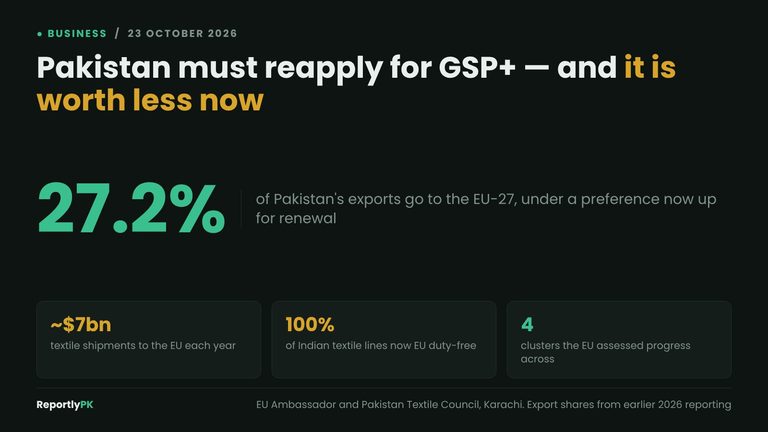
GSP+ gives Pakistani exports duty-free access to the EU across a large share of tariff lines, in exchange for commitments on human rights, labour, environment and governance. The EU’s assessment has recognised progress across all four of those clusters, PTC Vice Chairman Anees Khawaja said.
- EU-27 purchases: about $8.8 billion a year, roughly 27.2 percent of Pakistan’s total exports
- Textile shipments to the EU: nearly $7 billion a year, about 39 percent of Pakistan’s textile exports
- Tariff lines with duty-free access under GSP+: about 66 percent
- Clusters assessed: human rights, labour, environment, governance
Those export figures come from reporting earlier this year rather than from this week’s meeting, and should be read as the order of magnitude rather than as current data. On that basis, roughly a quarter of everything Pakistan sells abroad depends on a preference that now requires renewal.
The preference is worth less than it was
PTC Chairman Fawad Anwar made the point that matters most, and made it against his own sector’s interest in a simple renewal story: the EU-India free trade agreement will add competitive pressure on Pakistani exporters even if Pakistan keeps GSP+.
The arithmetic behind that is straightforward. A preference is worth the difference between what you pay and what your competitors pay. Indian textile and apparel products previously faced EU duties of up to 12 percent, and APTMA’s chairman has said India now has immediate duty-free access across all of its textile and apparel tariff lines. When a competitor’s tariff falls to zero, a Pakistani exporter’s zero stops being an advantage.
That reframes the whole exercise. Keeping GSP+ is now necessary to avoid a disadvantage rather than sufficient to maintain an edge, and the competitiveness argument moves to cost — where Pakistani producers have said industrial electricity tariffs run 25 to 30 percent above regional competitors’.
Related: PTEA says exports are negative at current costs of production
The compliance burden is moving down the supply chain
PTC chief executive Muhammad Hasan Shafqaat raised a second issue that will outlast the renewal: the EU’s Digital Product Passport and supply chain due diligence obligations, which he said could extend traceability requirements down to the farm level.
This is a different kind of requirement from the conventions GSP+ has traditionally turned on. Ratifying a treaty and reporting on it is a state obligation. Proving where a bale of cotton was grown, under what labour conditions and with what water use, is a firm-level obligation that reaches thousands of ginners and growers with no compliance infrastructure.
The PTC pointed to certified facilities, female workforce participation above 70 percent at some sites and established worker committees. Those are real, and they describe the organised mills at the top of the chain — which is precisely the part of the sector that was never the concern. The traceability question is about everything upstream of them.
Who is asking for what
The PTC set out its own role in the process: engaging the Prime Minister’s Office and the foreign affairs and commerce ministries, helping government coordination through a dedicated senior focal point, and contributing industry views to the government’s GSP+ reapplication committee. It called a time-bound implementation plan an immediate priority.
Notably, that list contains no ask for money. The Council is requesting coordination and clarity rather than subsidy, which is unusual among Pakistani trade bodies this year and makes the position harder to dismiss as rent-seeking — though the Council represents exporters who would lose most if the renewal failed, and its interest in a favourable outcome is total.
A preference is not a market strategy
GSP+ has shaped Pakistan’s export profile for more than a decade, and the shape it produced is the problem now surfacing. Roughly 39 percent of textile shipments go to a single bloc, under terms granted rather than earned, in product categories chosen because the duty saving made them viable.
Concentration of that order is a vulnerability whichever way the renewal goes. A preference that can be reviewed is a preference that can be withdrawn, and building a sector around one is a decision to accept political risk in exchange for margin.
The analysts quoted on the India agreement earlier this year converged on the same conclusion from different directions — that India’s advantage lies in higher value addition and stronger vertical integration, and that Pakistan needs regionally aligned energy tariffs and policy certainty. Neither of those is addressed by keeping GSP+, and both would matter if it were lost.
What has not been published
No date has been given for the reapplication, no deadline for the EU’s decision, and no detail on which areas the Commission considers to need progress. The ambassador referred to an action plan with measures, timelines and performance indicators; none of those has been made public.
Until they are, the honest position is that Pakistan’s exporters know their preference is under review, know a competitor has just been handed equivalent access, and do not know what they are being asked to demonstrate or by when. That is a difficult basis on which to plan the investment that the competitiveness argument requires.