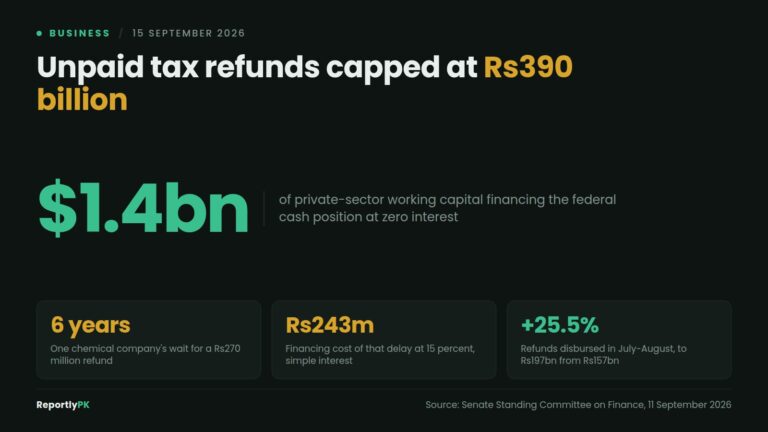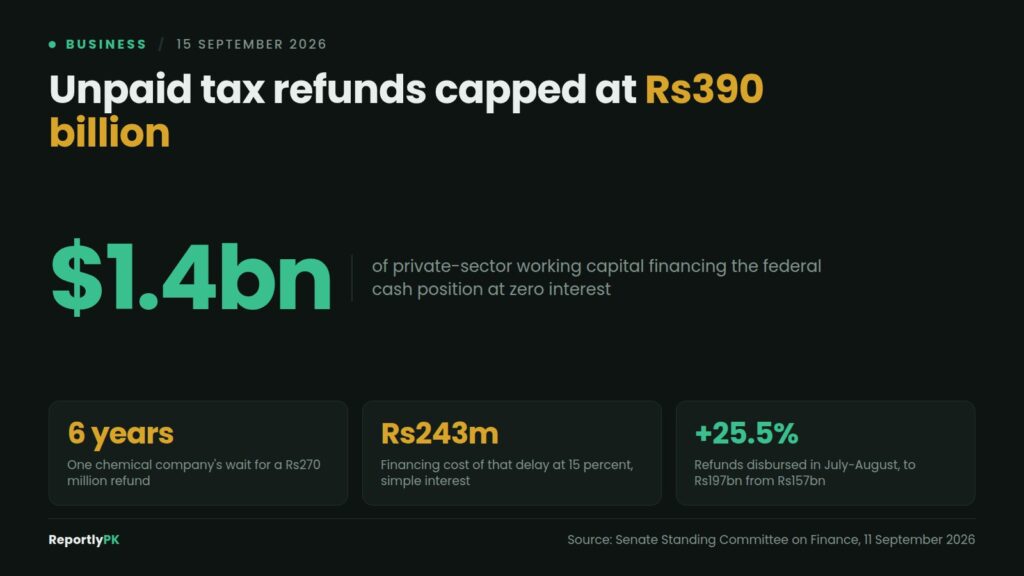
FBR tax refunds that remain unpaid are now subject to an agreed ceiling. Under an arrangement with the International Monetary Fund, Pakistan has committed to holding the Federal Board of Revenue’s outstanding refund stock at no more than Rs390 billion — a commitment disclosed to the Senate Standing Committee on Finance and Revenue on 11 September.
At the same sitting, a chemical company told the committee it had been waiting six years for a refund of more than Rs270 million.
What was actually agreed
The committee met under chairman Saleem Mandviwalla, with Minister of State for Finance Bilal Azhar Kiyani and senators including Talha Mahmood and Abdul Qadir present. FBR officials said refunds would be processed systematically and sequentially under a new system intended to reduce discretionary withholding, and the committee directed that long-pending cases be settled within 30 days.
The underlying commitment is narrower than the headline suggests. It is not an undertaking to pay refunds promptly. It is an undertaking not to let the unpaid pile exceed a number.
A cap is not a payment
Read plainly, the arrangement establishes Rs390 billion as an acceptable permanent balance of money the state has collected in excess of what it was owed and has not returned.
At current exchange rates that is roughly $1.4 billion of private-sector working capital financing the federal cash position, indefinitely, at an interest rate of zero. It is a loan from business to government that nobody agreed to make and nobody can call in.
Setting a ceiling is still an improvement on no ceiling. Before this, the stock could grow without limit whenever the FBR needed to flatter a monthly collection figure, and it did. But a ceiling converts an abuse into a budgeted facility. The question the arrangement does not answer is why the acceptable steady-state number is Rs390 billion rather than a declining path towards something closer to zero.
Six years, and what it cost
The chemical company’s case is the whole policy in one number. Rs270 million, withheld for six years.
Assume the company replaced that cash by borrowing at 15 percent, which is conservative against Pakistani corporate lending rates over the period. On simple interest, six years of financing Rs270 million costs about Rs243 million. The delay has therefore cost the business almost as much again as the refund itself — and it will not be compensated for it, because refunds are returned without meaningful interest.
That asymmetry is the core of the problem. A taxpayer who pays late owes the state a penalty. A state that pays late owes the taxpayer nothing.
The disbursement number is genuinely better
Credit where it is due. In the first two months of this fiscal year the FBR disbursed about Rs197 billion in refunds, against Rs157 billion in the same two months last year — an increase of Rs40 billion, or 25.5 percent.
That is a real change in behaviour and it should be acknowledged as one. It is also not sufficient on its own. The outstanding stock is a revolving balance: new claims accrue every month as fast as old ones are settled. Disbursements can rise 25 percent while the unpaid pile grows, if claims are rising faster. Nobody at the sitting published the stock figure alongside the disbursement figure, and without both the direction of travel cannot be established.
Discretion is the mechanism
The most important phrase in the FBR’s own account is the commitment to reduce discretionary withholding.
Refund delay in Pakistan has never primarily been a processing-capacity problem. It is a cash-management tool and, at the margin, a source of leverage over individual taxpayers. A six-year delay on a verified claim is not a queue. It is a decision, taken repeatedly, by someone with the authority to take it.
A sequential, rules-based system genuinely fixes that — if the sequence is published, if exceptions require recorded justification, and if a claimant can see their position in the queue. None of those three design features has been described.
What would make it binding
Three things would turn this from an undertaking into a constraint. A published monthly figure for the outstanding refund stock, so the Rs390 billion cap can be seen being observed or breached. Automatic compensation to the claimant at a market rate once a verified refund passes a stated number of days, which prices the delay for the institution causing it. And a visible queue position, which is what removes discretion in practice rather than in a press statement.
The Senate committee’s 30-day directive carries no enforcement mechanism; committees direct, they do not compel. The IMF ceiling does carry one, which is why it is the more consequential of the two. It just happens to bind at a level that leaves $1.4 billion of other people’s money in the till.
Related: Textile Exports Fell 12.71% in August. The Number That Matters Is 0.34%.