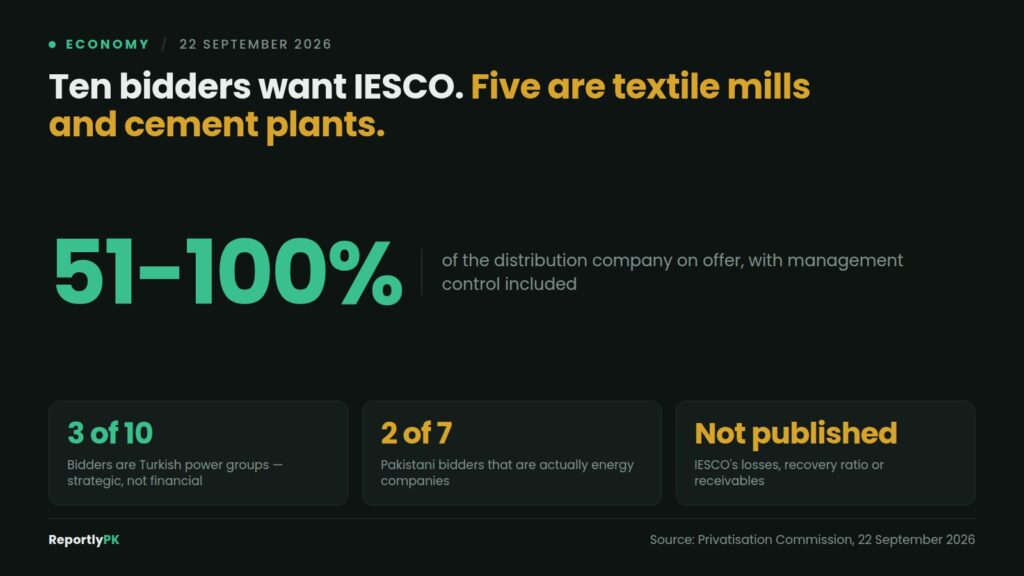
The IESCO privatisation has drawn ten expressions of interest for a 51 to 100 percent stake with management control, the Privatisation Commission confirmed on 22 September. Seven of the ten are Pakistani. Only two of those seven are energy companies.
The rest are textile mills, cement plants, a packaging manufacturer and a steel and construction group. That composition is the most interesting thing about this transaction and nobody has remarked on it.
Who put their hand up
- Turkish power groups — Aktor Elektrik Enerji Yatirimlari, Genvera Enerji, Cengiz Enerji
- Pakistani energy — Engro Energy; Hub Power Holding consortium, with Lucky Cement, Kohat Cement and Metro Ventures
- Textiles — Artistic Milliners consortium, with Lake City Holdings, Fatima Capital, Din Ventures and Fazal Cloth Mills; Sapphire Fibers
- Other industry — Novatex, Bestway Cement, and a Hasnaat Brothers construction consortium with Dhilal Holding, Pak Steel, Bio-Labs and Farid Steel Casting
Muhammad Ali, adviser to the prime minister on privatisation and chairman of the commission, said prequalified investors move next to due diligence through a virtual data room.
Why a textile mill wants an electricity company
Count the industrial bidders properly. Cement appears three times — Bestway directly, Lucky and Kohat inside the Hubco consortium. Textiles appear at least three times, through Artistic Milliners, Fazal Cloth Mills and Sapphire Fibers. Steel appears twice inside the Hasnaat consortium.
These are among the most electricity-intensive businesses in Pakistan, and electricity is the input they can neither substitute nor control. This site has argued that energy cost per unit of output is one of three binding constraints on Pakistani export competitiveness, alongside refund working capital and cotton supply. Textile exports grew 0.34 percent across the whole of FY2025-26 while those constraints sat where they sit.
Bidding to own the distribution company is the market’s response to that diagnosis. If you cannot get reliable power at a competitive tariff from the utility, you buy the utility. It is vertical integration against a supply risk, and it is a rational thing for a large industrial consumer to attempt.
Which creates an obvious problem
A distribution company owned by its own largest industrial customers has a conflict that needs managing rather than ignoring.
Tariffs are set by NEPRA, so the owner cannot simply price its own supply cheaply. But a great deal of what determines an industrial consumer’s experience is not the tariff. It is load management during a shortfall, the position of a new connection in the queue, the speed of a fault response, the sizing of a feeder, where the next capacity upgrade is built. All of that is operational discretion, and all of it can be exercised in favour of a plant the owner also owns.
The transaction documents should therefore contain ring-fencing terms, published service standards enforceable by other consumers, and a related-party supply disclosure regime. None of that has been described, and the time to write it is before the data room opens, not after the cheque clears.
Ten is a real number
Pakistani privatisation has failed more often for want of bidders than for want of buyers’ money. Against that record, ten expressions of interest — three of them foreign — is a genuine result and the commission deserves the credit.
Three Turkish power groups turning up matters for a second reason. They are strategic operators rather than financial buyers, which means someone believes a Pakistani distribution company can be run at a profit under the existing regulatory regime. That is a more informative signal than any statement from Islamabad.
The caution is that an expression of interest costs nothing. It is a letter. Prequalification, due diligence and a binding bid are three separate filters, and Pakistani transactions have historically lost most of their field at the second. Ten EOIs is not ten bidders.
The numbers that were not released
No financial information about IESCO accompanied the announcement. Not its transmission and distribution losses, not its recovery ratio, not its receivables, not its accumulated payable to the Central Power Purchasing Agency.
Those four figures are the transaction. A distribution company is essentially a loss percentage and a collection rate wrapped around a licence area, and the circular debt that runs through Pakistan’s power sector — which grew by Rs364 billion in FY26 — is the accumulated consequence of exactly those numbers across all the DISCOs.
Bidders will see them in the data room. The public, which owns the asset being sold, will not see them until someone chooses to publish. For a sale of a state utility conducted on the argument that private ownership will run it better, the baseline it is being run from ought to be on the record first.
Related: Circular Debt Grew Rs364 Billion. A Rs98 Billion Budget Cut Explains Part of It.