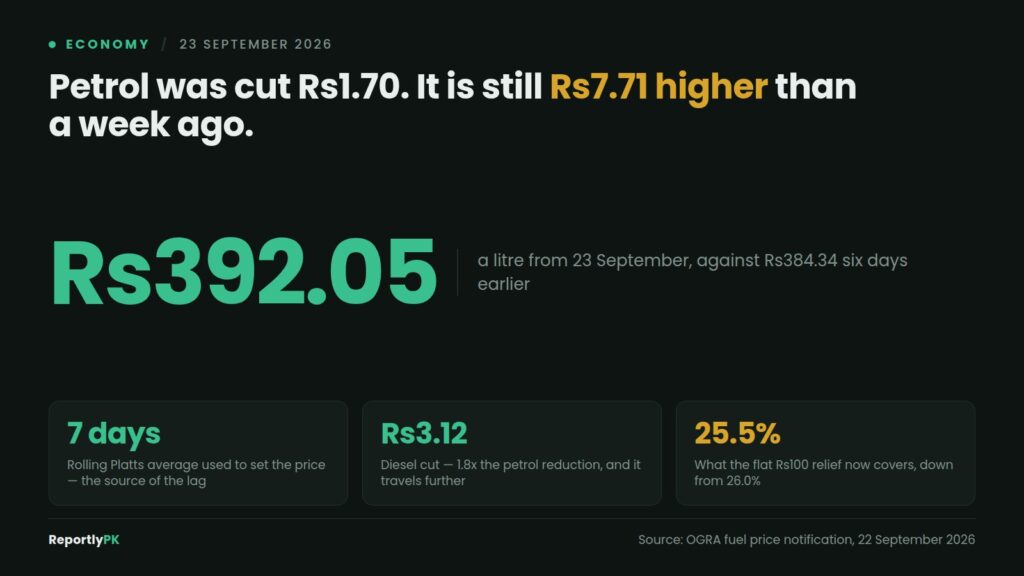
The Pakistan petrol price cut announced on 22 September takes petrol down Rs1.70 to Rs392.05 a litre and high-speed diesel down Rs3.12 to Rs418.96.
Six days earlier, on 16 September, petrol was Rs384.34. After this cut it is Rs7.71 higher than it was a week ago.
The week in full
- 16 September — petrol Rs384.34, diesel Rs415.83
- 21 September — petrol Rs393.75, diesel Rs422.08
- 22 September — petrol Rs392.05, diesel Rs418.96
Petrol rose Rs9.41 over five days and has given back Rs1.70. Diesel rose Rs6.25 and has given back Rs3.12, leaving it Rs3.13 above where it started.
This is exactly the arithmetic this site flagged when the daily pricing regime was examined a week ago. Sixty small adjustments do not register the way four large ones do, and a cut announced in isolation reads as relief when the net movement over the period is an increase.
Why falls arrive late
The mechanism explains most of it, and it is worth understanding rather than resenting.
The Petroleum Division does not price off spot crude. It uses a seven-working-day rolling average of international product prices, benchmarked to the Platts Arab Gulf assessment. Pakistan buys refined product, not crude, and it buys it on contracts priced against that benchmark.
A rolling average is a deliberate smoothing device. It stops a one-day spike from reaching the pump and it stops a one-day collapse from reaching it either. When Brent slipped below $100 this week, the seven-day window was still carrying the higher days behind it — which is why the cut is Rs1.70 rather than something that feels proportionate to the headlines about oil falling.
The same mechanism worked in consumers’ favour on the way up. It is symmetrical by construction, and the frustration it generates is a frustration with arithmetic rather than with policy.
The sequence the government has not addressed
One detail in the reporting deserves stating carefully. OGRA issued the reduction, according to ProPakistani, hours after Jamaat-e-Islami delayed a planned long march towards Islamabad. The report sets out the sequence and does not assert that one caused the other, and neither does this article.
But the fact that the question can be asked at all is a design problem rather than a political one. A price set by a published formula from published inputs should be incapable of attracting this suspicion, because anyone could recompute it.
Pakistan currently publishes the output and not the inputs. If OGRA released the seven-day Platts average it used, the exchange rate applied, and the levy and margin components, each daily price would be verifiable by any reader with a spreadsheet. That single change would retire an entire category of recurring allegation at no fiscal cost.
The levy nobody wants to own
Separately this week, the Finance Ministry rejected the characterisation of the Petroleum Development Levy as the central element of Pakistan’s IMF programme.
Its position is that petroleum pricing sits inside the agreed framework but is one revenue instrument among several, alongside FBR mobilisation, base broadening and expenditure rationalisation — and that inflation outcomes cannot be attributed to the levy alone, given commodity prices, the exchange rate and external financing constraints.
All of that is defensible. It is also a clarification about attribution rather than about quantum, and the quantum is the part consumers can feel. At the prices reported last week, taxes and duties came to Rs114 a litre on petrol and Rs100 on diesel. The ministry has explained that the levy is not the whole IMF programme. It has not explained why it is around 29 percent of a litre of petrol.
A fixed subsidy loses value as prices climb
The Rs75 billion fuel relief scheme pays a flat Rs100 a litre within monthly quotas. Flat is the operative word, and it has a consequence nobody stated when the scheme launched.
On 16 September, Rs100 off Rs384.34 was a 26.0 percent discount. At Monday’s Rs393.75 it was 25.4 percent. At today’s Rs392.05 it is 25.5 percent. The rupee amount is fixed; the proportion it covers shrinks as the pump price rises.
For a motorcyclist drawing the full 20-litre quota, the monthly bill at today’s price is about Rs5,841 against Rs7,841 without the scheme. That is still a substantial transfer and the scheme is doing real work. But it protects a quantity of rupees rather than a standard of living, and if fuel resumes climbing through the fourth quarter the relief quietly erodes without any decision being taken or announced.
A subsidy indexed to a percentage of the pump price would hold its value and blow the budget. A flat rupee subsidy holds the budget and loses its value. The government chose the second, which is the more defensible option — it simply should be described as what it is.
Diesel did the better of the two
The more useful number in this revision is the diesel cut. At Rs3.12 it is 1.8 times the petrol reduction, and diesel is the fuel that travels furthest into the price level — freight, tractors, and the generators small industry runs when the grid is short.
Last week the pattern ran the other way, with diesel rising by more than petrol and receiving no relief from the Rs75 billion fuel scheme, which covers petrol vehicles only. A larger diesel cut this week partially unwinds that, and it will reach more households indirectly than the petrol cut reaches directly.
Whether it holds depends on the next seven-day window, and therefore on whether the Gulf supply increase and the diplomatic track that pushed Brent down this week survive contact with October.
Related: Petrol Went Up Rs4.10 the Day the Rs100 Subsidy Reached the Whole Country.