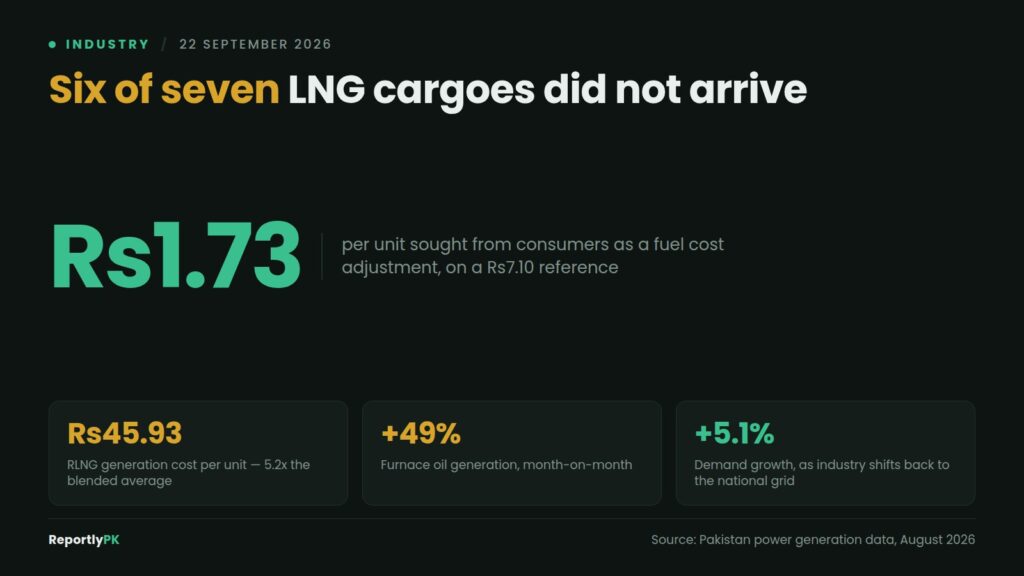
Pakistan power generation cost reached Rs8.83 per unit in August against a NEPRA reference of Rs7.10. Distribution companies are seeking the Rs1.73 difference from consumers as a fuel cost adjustment — 24.4 percent above the benchmark the tariff was built on.
The reason is a single line in the data. Of seven scheduled long-term LNG cargoes, one arrived.
What August actually cost
Generation averaged about 14,943 MW, up 5.1 percent on August last year and 1.4 percent above the seven-year average for the month. The system delivered more power than usual. It delivered it expensively.
- Blended fuel cost — Rs8.83/kWh against a Rs7.10 reference
- RLNG generation cost — Rs45.93/kWh, the second-highest level on record
- LNG-based generation — 1,052 GWh, down 51.7 percent year-on-year
- Furnace oil — 321 GWh, up 49 percent month-on-month
RLNG at Rs45.93 a unit is 5.2 times the blended average. That is what the marginal unit costs when the cheap contracted gas does not turn up and the system buys replacement fuel at whatever the spot market is charging.
Six cargoes that never came
One delivery out of seven is a 14 percent fulfilment rate on contracted volume. That is not a schedule slipping. That is a supply arrangement failing.
Long-term LNG contracts exist for precisely one purpose: to remove the buyer from spot-market exposure by fixing volume and price in advance. A country that signs them and then receives one cargo in seven has paid for insurance and been handed the risk anyway. LNG generation halving year-on-year is the direct consequence.
This site reported in June that a single late LNG cargo removed 4,000MW from the grid, weeks after load-shedding had been declared over. That was one cargo. This is six.
Why furnace oil came back
Furnace oil generation rising 49 percent in a month is the visible symptom of everything above. It is the dirtiest fuel in the Pakistani generation stack and among the most expensive, and it is dispatched when nothing better is available.
Pakistan spent the better part of a decade building LNG import capacity to retire exactly this. Two terminals, a regasification network and long-term supply contracts were the plan. In a month when six of seven contracted cargoes failed to arrive, the plan reverted to the fuel it was designed to replace.
It also strengthens an argument this site examined earlier this month. Parco’s proposal for deep-water mooring and bonded storage at Hub was pitched on exactly this failure mode — that Pakistan has almost no buffer between a missed delivery and a dispatch decision. The feasibility study is due to report in about two months. August is the case for it.
The demand number is genuinely good news
Buried under the cost story is the most encouraging power-sector development of the year. Consumption rose on lower tariffs, higher industrial and agricultural use, improved economic activity — and a shift of industrial consumers back toward the national grid.
That last one matters more than its billing suggests. Pakistani industry spent years leaving the grid for captive generation because grid power was unreliable and expensive. Every departure made things worse for everyone left, because the sector’s enormous fixed capacity payments then got spread across fewer units sold. It is the classic utility death spiral, and Pakistan has been in it.
Industrial load returning to the grid runs that mechanism backwards. More units over the same fixed costs is the only durable route out of the capacity-payment trap, and it is the one structural improvement in this data.
And the bill lands on the consumer who just arrived
Which is the difficult part. A manufacturer who reconnected to the grid in August on the strength of lower tariffs now receives a fuel cost adjustment of Rs1.73 a unit for a gas supply failure they had no part in.
The price signal that brought industry back punishes it on arrival, and the FCA mechanism is designed to pass fuel risk straight through to whoever is connected. A firm deciding whether to recommission its captive plant will read this month’s bill as the answer.
What nobody has explained
No explanation accompanied the cargo figure, and the explanation is the whole story.
If suppliers defaulted, there are contractual remedies and they should be pursued. If cargoes were diverted to markets paying more, the contracts have a pricing flaw that will recur every time global prices spike. If Pakistan deferred deliveries it could not pay for, this is a liquidity problem wearing a supply problem’s clothing — and worth reading alongside the Rs173.7 billion Sui Northern is owed by power plants.
Three different causes, three different remedies, one published number. Consumers are being asked for Rs1.73 a unit without being told which of the three they are paying for.
Related: One Late LNG Cargo Took 4,000MW Off the Grid. Load-Shedding Was Declared Over in June.