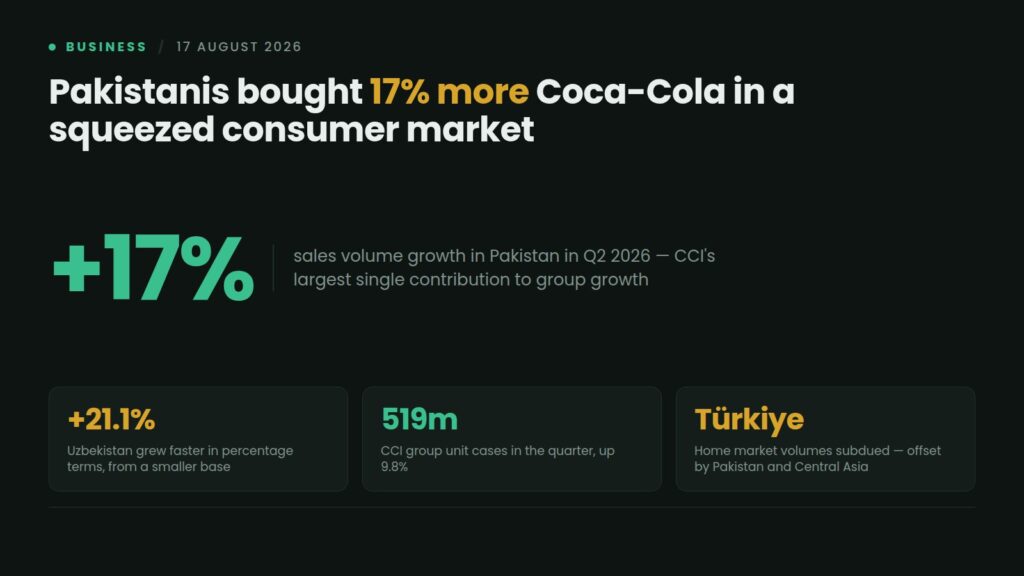
Coca-Cola İçecek, the Turkish bottler that holds the Coca-Cola franchise across a dozen markets, reported 17 percent sales volume growth in Pakistan for the second quarter of 2026.
Group volumes rose 9.8 percent to 519 million unit cases. Chief executive Ahmet Kürşad Ertin credited international operations as the key growth engine, singling out Pakistan and Central Asia as more than offsetting subdued volumes in Türkiye — CCI’s home market.
The story has been picked up locally as Pakistan becoming Coca-Cola’s top market. That framing needs one correction before the interesting part.
Fastest is not the same as biggest
By growth rate, Pakistan was not first. The quarter’s numbers across CCI’s major markets:
- Uzbekistan — 21.1%
- Pakistan — 17%
- Kazakhstan — 12.7%
- Iraq — 1.1%
Pakistan ranks first on contribution, not on rate. It is one of CCI’s largest markets by volume, so 17 percent growth on a large base adds more cases than 21.1 percent on a smaller one. That is what the chief executive’s comment is describing, and it is the meaningful measure for the company.
It is worth being precise about, because “Pakistan is Coca-Cola’s top market” and “Pakistan is where Coca-Cola added the most volume this quarter” are different claims, and only the second one is supported.
Why 17 percent is genuinely surprising
Now the part that matters.
Carbonated soft drinks are close to a pure discretionary purchase. Nobody needs one. In a market where inflation averaged 7.1 percent last year after a period in the high twenties, where real incomes have been compressed for three consecutive years, and where the same consumer is absorbing higher electricity tariffs and rising fuel prices, a 17 percent volume increase is not what the macro picture predicts.
Volume growth is also a harder number than revenue growth. Revenue can rise on price alone; volume means more physical cases sold. Pakistanis bought materially more soft drinks this quarter than last year, in a country where household budgets are supposedly at breaking point.
Three explanations are plausible, and they are not mutually exclusive.
Disinflation is being felt. Falling inflation eventually shows up as recovered discretionary spending, and beverages are among the first categories to move because the individual purchase is small. If so, this is one of the earliest real-economy signals that stabilisation is reaching households — well before it appears in GDP data.
Formalisation. Pakistan’s beverage market includes a substantial undocumented segment of local and counterfeit brands. Enforcement against unregistered producers shifts volume to documented players without the total market growing at all. Some of CCI’s gain may be share taken from the informal sector rather than new consumption.
Pack economics. The standard playbook in a squeezed market is smaller single-serve packs at accessible price points. That raises unit case volumes while keeping the per-purchase cost within reach. It is growth in units that may not translate proportionally into growth in litres or margin.
The demographic argument
Underneath the quarterly number is the reason multinationals keep investing in Pakistan despite everything.
CCI serves a combined population above 600 million across 12 markets from 36 bottling plants. Pakistan alone is more than 250 million people, overwhelmingly young, with per-capita beverage consumption far below regional norms.
For a consumer goods company, low per-capita consumption in a young, growing population is the definition of headroom. Türkiye is a mature market where volumes are subdued because there is limited room left to grow. Pakistan is the opposite problem, which is a better problem.
The distribution question
There is a practical reason beverage volumes are worth watching beyond what they say about thirst.
Selling 17 percent more cases means physically moving 17 percent more cases, through the same road network that has been partially seized up for the past fortnight by a goods transport strike. Beverages are heavy, low-value-per-tonne and time-sensitive in a hot climate — close to the worst possible freight profile when trucking capacity is constrained.
A bottler operating at that growth rate is running warehouses, a distributor network and a fleet across the country. The quarter being reported here ended before the current disruption, so it does not capture it. If volumes hold through the September quarter, that will say something about the resilience of consumer goods distribution that the current quarter cannot.
What it says about the wider economy
Fast-moving consumer goods volumes are one of the more honest indicators available for a market like Pakistan’s, precisely because they are not compiled by anyone with a stake in the result. A bottler counts cases because it has to fill trucks.
Reported by a Turkish-listed company under international accounting standards, this number was not produced to make anybody’s economic management look good.
Set it against CCI’s own headline financials — net sales revenue of TL67.2 billion, up 5.7 percent, or TL69.2 billion and 40.7 percent excluding inflation accounting effects — and the volume figure is the cleaner signal. Turkish lira revenue lines are distorted by hyperinflation adjustments. Cases sold are cases sold.
One quarter of beverage sales does not establish a consumer recovery. But it is a data point pointing the opposite way to most of the commentary, and it came from a source with no reason to flatter.
Related: The State Bank Expects 3.5–4.5% Growth in FY27. Pakistan Already Did 3.7%.