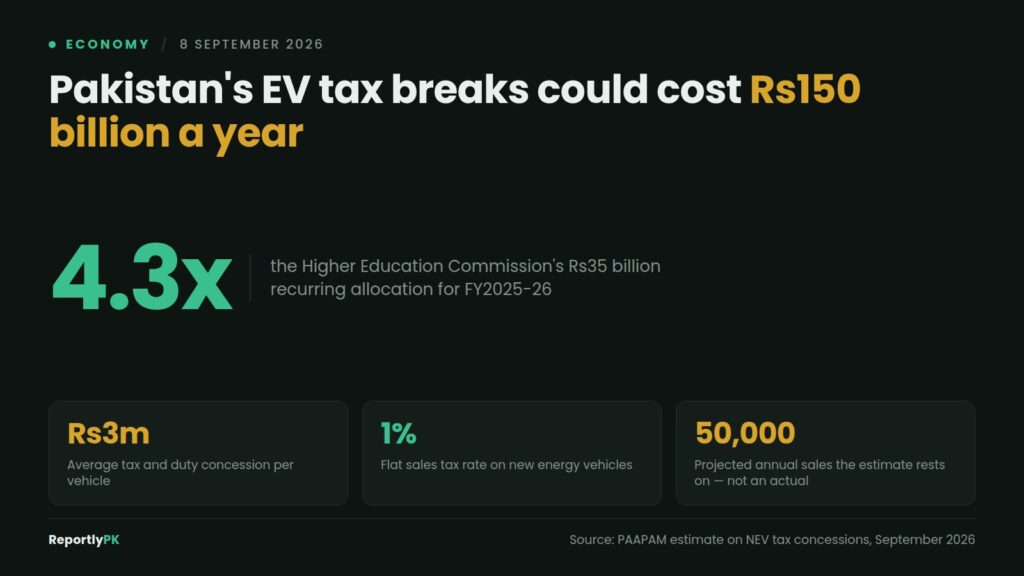
Pakistan’s EV tax breaks could cost the exchequer Rs150 billion a year in forgone revenue, according to an estimate circulating in the auto-parts industry this week. For scale, the entire recurring allocation to the Higher Education Commission in FY2025-26 was Rs35 billion. If the estimate holds, Pakistan would be spending more than four times as much subsidising new energy vehicles as it spends running its public universities.
That is a striking comparison. It is also an estimate built on a projection, produced by a party with an interest in the answer. Both things need saying before the number is used.
How the Rs150 billion is built
The arithmetic is simple and entirely transparent, which is a point in its favour. It has two inputs:
- 50,000 new energy vehicles sold annually — a projection of where the market lands, not a recorded figure
- Rs3 million in average tax and duty concession per vehicle, driven mainly by the flat 1 percent sales tax rate NEVs enjoy against the far higher rate on conventional cars
Multiply the two and you get Rs150 billion. The multiplication is right. Whether the inputs are right is the whole question, and the first one is doing most of the work. Pakistan is not currently selling 50,000 NEVs a year. If actual volumes come in at a fifth of that, the revenue cost is Rs30 billion — a materially different policy debate.
There is a structural oddity in the estimate too. A concession scheme only costs Rs150 billion if it succeeds. The scenario in which the number is large is the scenario in which the policy achieved its objective. That does not make the cost irrelevant, but it does mean the headline figure and the policy’s success move together.
Who is making the argument
The estimate comes from Abdul Rehman, a former chairperson of the Pakistan Association of Automotive Parts and Accessories Manufacturers. PAAPAM represents the localised components industry — the firms that supply engine parts, transmissions, exhaust systems and fuel components to Pakistani assemblers.
An electric vehicle has a fraction of the moving parts of an internal combustion car and eliminates several of the highest-value categories that sector supplies. A tax regime that accelerates the shift to imported or semi-knocked-down NEVs is, for that membership, a direct commercial threat. That does not make the arithmetic wrong. It does mean the estimate should be read as an interested submission rather than a neutral fiscal assessment, and the government has not published a competing tax-expenditure figure of its own.
What Rs3 million a vehicle actually tells you
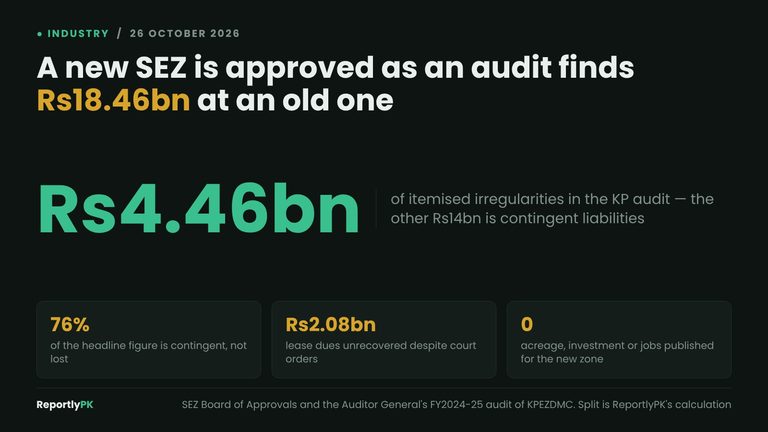
The more interesting number is not Rs150 billion. It is Rs3 million.
A concession of that size per unit implies a vehicle with a substantial pre-tax price. Tax relief is proportional: the more expensive the car, the larger the transfer to whoever buys it. A Rs3 million average concession is not being handed to buyers of Rs800,000 electric motorcycles. It is going to the upper end of the private car market.
This is the sharpest version of Rehman’s argument, and it does not depend on his industry’s interest at all. If the objective is cutting the oil import bill, the cost-effective targets are the vehicle classes that do the most kilometres per rupee of subsidy — buses, rickshaws and two-wheelers, which together account for the overwhelming majority of urban trips in Pakistan. A subsidy structured as a percentage of sale price systematically directs the largest amounts to the smallest number of users.
The case on the other side
Rehman does not argue for scrapping the incentives, and the case for them is real. Pakistan’s recurring balance-of-payments problem is substantially an energy import problem. Every litre of petrol displaced is foreign exchange retained, and the transition has to start somewhere. Early adopters at the top of the market are how charging networks become commercially viable for everyone else — the same sequence that played out in most markets that now have working EV infrastructure.
His recommendation is a redirection rather than a repeal: shift support towards electric buses, motorcycles, rickshaws, charging infrastructure and domestic battery manufacturing, and attach conditions — localisation commitments and employment undertakings — to whatever concessions remain. That last point is where the industry interest and the fiscal argument align, which is worth noting in both directions.
What has not been published
The gap this debate is being conducted across is an information gap. There is no published official estimate of the annual revenue forgone under the NEV concession regime, no published breakdown of concessions by vehicle class, and no published record of actual NEV registrations against the 50,000 projection.
Pakistan does publish a tax expenditure statement with the federal budget. Until the NEV concessions appear in it as a discrete line with an actual-versus-projected figure, the only number in circulation will be the one produced by the industry that stands to lose from the policy. That is a poor basis for a decision worth nine or ten figures either way.
Related: Auto Loans Hit a Record Rs386 Billion. Credit Cards Are the Line to Watch.