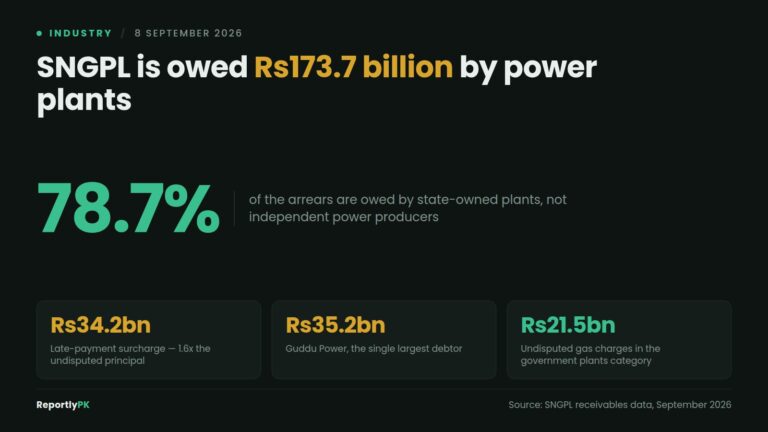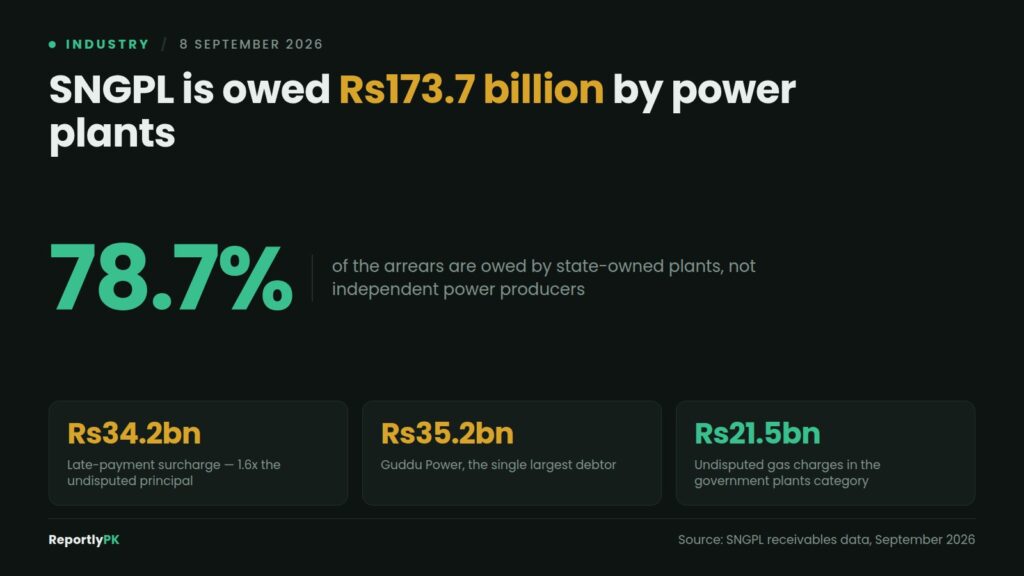
SNGPL power sector dues have reached Rs173.654 billion, according to the gas utility’s own receivables data, and the composition of that number is more revealing than its size. In the one category where SNGPL has broken the figure down by charge type, the late-payment surcharge is larger than the undisputed principal it penalises.
Sui Northern says the arrears have severely affected its liquidity and are preventing it from meeting commitments to its own upstream gas suppliers. Its General Manager Recovery has warned that the company may exercise its contractual rights to recover the outstanding amounts, and has asked the Director General Gas at the Petroleum Division to take the matter to the Power Division.
Who owes what
The Rs173.654 billion splits three ways:
- Rs75.696 billion from other government-owned plants — QATPL Rs32.228bn, Balloki Rs23.737bn, NPPMCL’s Haveli Bahadur Shah Rs18.379bn, PTPL Rs1.352bn, and Rs277 million from disconnected WAPDA rented units
- Rs60.989 billion from government power plants — Guddu Rs35.240bn, Nandipur Rs21.303bn, GTPS Faisalabad Rs2.330bn, TPS Muzaffargarh Rs1.482bn, with the rest spread across Shahdara, SPS Faisalabad, NGPS Multan and two rented units
- Rs36.969 billion from independent power producers — Liberty Power Rs20.840bn, KAPCO Rs5.118bn, Orient Rs3.189bn, Saif Rs2.341bn, Sapphire Rs2.327bn, FKPCL Rs1.680bn, Halmore Rs1.327bn
SNGPL attributes the delay to the non-release of funds by the Central Power Purchasing Agency Guaranteed — CPPA-G, the entity that buys electricity from generators and is meant to pay them from what the distribution companies collect.
The penalty is larger than the bill
Only the government power plants category has been broken out by charge type, and it is the most instructive part of the disclosure. Of that Rs60.989 billion:
- Rs21.497 billion is undisputed charges — gas actually delivered and billed without argument
- Rs34.173 billion is late-payment surcharge
- Rs4.465 billion is RLNG tariff charges
Those three components account for about Rs60.1 billion of the Rs61 billion. The late-payment surcharge is 1.6 times the undisputed principal. More than half of what SNGPL is claiming from these plants is not the cost of gas at all — it is the compounding cost of the state not having paid for gas on time.
The Rs34.173 billion is at minimum 19.7 percent of the entire Rs173.654 billion, and the real share is probably higher: the other two categories have not been broken down by charge type, and there is no reason to think penalties stop accruing there.
Four-fifths of it is the state owing the state
Add the two government categories together and you get Rs136.685 billion — 78.7 percent of the total. The IPPs, who take most of the public blame in Pakistan’s power sector disputes, account for the remaining 21.3 percent.
The five largest individual debtors are Guddu, QATPL, Balloki, Nandipur and Haveli Bahadur Shah. All five are state-owned. Together they owe Rs130.9 billion, or roughly three-quarters of everything SNGPL is chasing. Liberty Power, at Rs20.840 billion, is the largest private debtor and ranks sixth.
This is not a story about private generators refusing to pay a public utility. It is a state-owned gas company issuing penalty notices to state-owned power plants because a state-owned purchasing agency has not released funds, and then asking one federal division to escalate to another federal division about it.
What breaks downstream
The operational consequence is the part that reaches households and factories. SNGPL says it cannot meet its obligations to upstream gas suppliers — the exploration and production companies whose fields feed its network, and the terminals delivering imported LNG.
Those suppliers have their own cash cycles and their own investment programmes. When a utility stops paying them on schedule, drilling budgets get deferred and cargo procurement gets cautious, which shows up eighteen months later as less gas in the system. Pakistan already saw in June what a single delayed LNG cargo does to generation capacity. A structural payment problem at the country’s largest gas distributor is the same failure with a longer lead time.
The threat that cannot really be made
SNGPL’s warning that it may exercise its contractual rights is the standard language for disconnection. Two entries in the receivables list — Davis Energen at Rs88 million and the WAPDA rented units at Rs277 million — are already marked disconnected, so the utility clearly does use the tool.
But the amounts recovered from those disconnections are trivial against the total, and the plants that matter are not candidates. Cutting gas to Guddu, Balloki or Haveli Bahadur Shah would remove several thousand megawatts from the national grid to recover money the government owes itself. The leverage exists on paper and not in practice, which is why the actual request in the letter is not for payment but for escalation.
What is not in the disclosure
Three things would make this figure interpretable and none of them are public. There is no ageing profile, so it is impossible to tell whether Rs173.654 billion is a recent build-up or a decade of accumulation. There is no statement of how much of the late-payment surcharge SNGPL realistically expects to collect, as against how much sits on its books inflating a receivable that will eventually be written down or settled in a package. And there is no indication of what the debtor plants dispute, because a penalty of that scale is rarely accepted without argument.
Until those are published, the Rs173.654 billion should be read as one side’s ledger in an unresolved intra-government dispute rather than as a settled liability.
Related: Circular Debt Grew Rs364 Billion. A Rs98 Billion Budget Cut Explains Part of It.