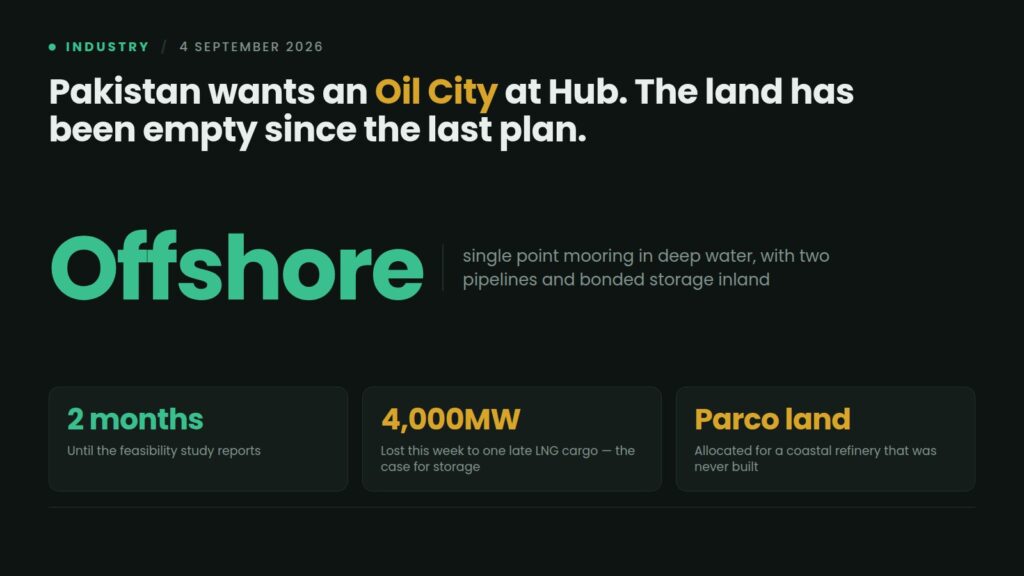
Pakistan is planning an integrated petroleum hub at Hub in Balochistan — an offshore Single Point Mooring facility in deep water, two pipelines to the mainland, and bonded storage for imported product.
The site is government land previously allocated to Parco for a coastal refinery that was never built. Parco has now put the Oil City proposal to the petroleum minister, and consultancy Technique has been hired for a feasibility study due within two months.
Why a deep-water mooring matters
The technical detail is the point of the project.
Large crude carriers need deep water. Karachi Port and Port Qasim have depth limits, which means the biggest and most economic vessels either cannot call at all or must lighten offshore — transferring cargo to smaller ships before berthing. Every additional handling step costs money and time on a commodity Pakistan imports in enormous volume.
A Single Point Mooring solves it by putting the connection point offshore. The tanker moors in deep water and pumps directly into a pipeline. No berth, no depth constraint, no lightering.
The proposed pipelines run to KPT’s Kemari facilities for crude and to Port Qasim for finished products, linking into the existing White Oil Pipeline network. Bonded storage is also being considered at Gwadar, Kot Addu, Machike and Faisalabad — which is the inland distribution spine rather than a coastal project alone.
The case for it just made itself
Pakistan spent the past week demonstrating exactly what this infrastructure is for.
A single delayed LNG cargo took roughly 4,000 megawatts off the national grid, forcing overnight load management three months after the government declared load-shedding over. The power minister apologised and said the cause was beyond the government’s immediate control.
The reason one ship could do that is storage. LNG is kept as a cryogenic liquid, it boils off continuously, and terminal capacity holds days rather than weeks. There was no buffer to draw on.
Crude and refined product store far more easily, which is precisely why storage capacity for them is worth building. Separately, the government has engaged Wood Mackenzie to study a Strategic Petroleum Reserves framework, covering technical, financial, commercial, legal and institutional requirements and possible public-private structures.
That is the more consequential of the two workstreams. A country importing most of its fuel, with reserves of $18.4 billion, facing a conflict that threatens a strait carrying a fifth of global oil, has no meaningful strategic stock.
The land has been waiting a long time
The detail worth pausing on is that this site was allocated to Parco for a coastal refinery that did not happen.
Pakistan has a long record of allocated industrial land sitting idle while the project it was granted for fails to reach financial close. Repurposing it for storage and marine infrastructure is a sensible use of an asset already in public hands — and it is also an admission that the refinery is not coming.
Which fits the wider picture. Five refineries have committed $4.5 to $5 billion to upgrade existing plants under the amended brownfield policy, with implementation agreements due within 45 days. Pakistan’s refining strategy is now modernising what exists rather than building new capacity, and the Hub land follows that logic.
Balochistan is the part with history
A major petroleum facility in Balochistan raises questions that a feasibility study does not answer.
Gwadar has been designated a transformative project for over a decade and remains substantially unrealised. The province supplies a large share of Pakistan’s natural gas and receives comparatively little back. Local employment, provincial revenue share and security are recurring disputes around exactly this class of infrastructure.
Nothing in the proposal as reported addresses any of it. That is not a reason to abandon the project. It is a reason to expect the questions.
What a strategic reserve would actually cost
The Wood Mackenzie study is the piece with the largest price tag attached, and it is worth being clear why countries hesitate.
A strategic petroleum reserve means buying fuel and not using it. The capital sits in tanks earning nothing, in dollars, in a country whose entire foreign exchange buffer is $18.4 billion. Ninety days of import cover — a common benchmark — would tie up a substantial share of that.
Which is why the study’s interest in public-private partnership structures matters more than it sounds. If commercial operators hold the stock under an obligation to release it in an emergency, the state gets the security without carrying the working capital.
Pakistan has run that model badly before. The Trading Corporation imported 300,000 tonnes of sugar last year and is now tendering 108,000 tonnes of it back out, having bought at the top of the price cycle and sold at the bottom. A reserve with published trigger rules is a different institution from a committee that buys when prices spike.
Two months to the first real test
No investment figure, capacity number or timeline has been disclosed, and none can be until the feasibility study reports.
What that study says about cost per tonne of storage, throughput and financing structure is what turns this from a proposal into a project. Marine infrastructure of this kind is capital-intensive and long-dated, and the question of who funds it — Parco, the state, or a private partner — has not been raised publicly.
Pakistan does not lack announced energy infrastructure. It lacks built energy infrastructure. The feasibility study lands in November.
Related: Five Refineries, $5 Billion, 45 Days to Sign. The Target Is Zero Furnace Oil.