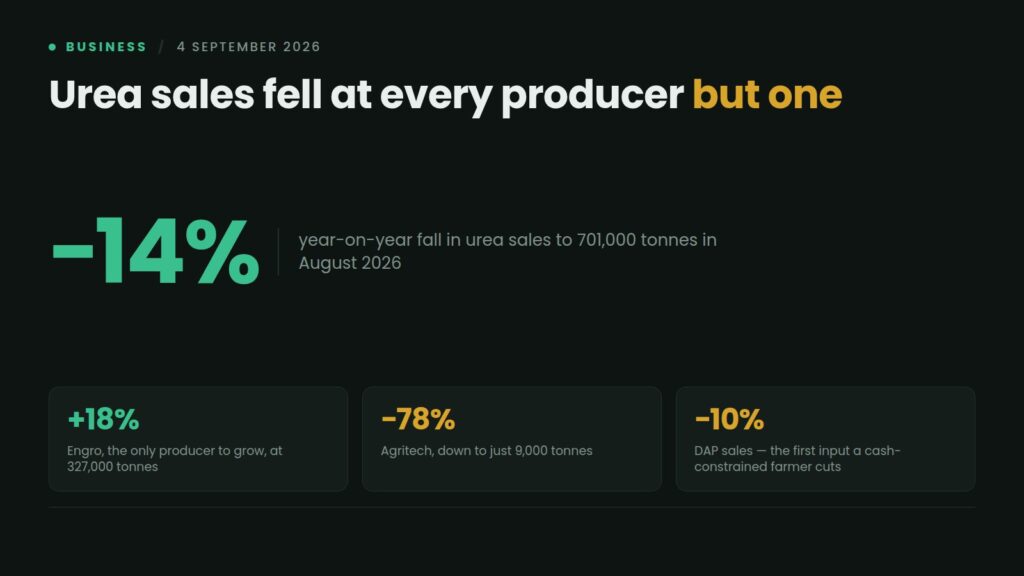
Pakistan’s urea sales fell 14 percent year-on-year in August, to 701,000 tonnes from 817,000. Every major producer went backwards except one.
Engro Fertilizers sold 327,000 tonnes, up 18 percent, and took the top position in the market.
The August numbers
- Engro — 327,000t, up 18%
- FFC and FFBL combined — 226,000t, down 30%
- Fatima Group — 140,000t, down 20%
- Agritech — 9,000t, down 78%
Total sales were still 21 percent higher than July’s 580,000 tonnes, and year-to-date volumes at 3.79 million tonnes are essentially flat against the same period in 2025.
That combination — down sharply on the year, up sharply on the month, flat over eight months — is the shape of a market moving inventory around rather than one where demand has collapsed.
Share shifted rather than shrank
The year-to-date figures make the point clearly. FFC leads eight-month sales at 1.90 million tonnes, up 11 percent. Engro is at 1.03 million tonnes, down 12 percent.
So the company that grew 18 percent in August is down 12 percent across the year, and the group that fell 30 percent in August is up 11 percent across the year. The two have essentially traded positions within a single month.
Urea is a commodity — chemically identical whoever makes it — so competition runs on price, dealer credit terms and availability at the right moment in the planting calendar. A producer holding stock through a slow month and releasing it into a strong one captures share that says more about inventory timing than about the underlying market.
Agritech at 9,000 tonnes is a different matter. A 78 percent fall to that level is not a share shift; it is a plant that has largely stopped selling. Pakistani urea production depends on subsidised feedstock gas, and smaller producers have historically been the first cut off when supply tightens.
What farmers are dealing with
The demand side is where this becomes a story about more than market share.
Fertiliser is a cash cost paid at planting against a return realised at harvest, which makes it the most deferrable input a farmer has. When cash is tight or the expected price is poor, the fertiliser bag is what gets reduced.
Pakistani growers have had a difficult season on exactly those terms. Cotton arrivals sit at roughly half their 2023 level. Tobacco growers in Khyber Pakhtunkhwa are being offered Rs350 per kilogram against an official rate of Rs740 that nobody enforces. Diesel for tube wells rose Rs72 a litre before a negotiated cut. Inflation returned to 11.2 percent in August.
DAP sales tell the same story more sharply. Diammonium phosphate fell 10 percent year-on-year to 123,000 tonnes. DAP is applied at sowing and is more expensive per bag than urea — it is the first thing a cash-constrained farmer cuts.
Why this shows up in next year’s harvest
Under-fertilised crops yield less. That is not a market opinion, it is agronomy, and the effect arrives months after the decision.
Pakistan has just recorded wheat prices up 87 percent year-on-year and wheat flour up 73 percent. Cotton is at half its 2023 arrivals. The country is importing raw cotton to keep textile mills running, with textile imports rising 14.8 percent year-on-year while exports grew 8 percent.
A season of reduced fertiliser application feeds directly into that. Weaker yields mean more imported wheat and cotton, paid in dollars, against reserves of $18.4 billion — and higher food prices for households already facing 13.2 percent rural food inflation.
Fertiliser offtake is one of the earliest available indicators of next year’s harvest, which is why a monthly sales table is worth more attention than it usually gets.
The gas subsidy underneath the industry
Pakistani urea is made from natural gas, and the industry runs on gas supplied below market rates. That subsidy is why domestic urea is cheaper than imported product, and it is the reason a fertiliser plant’s fortunes turn on gas allocation as much as on demand.
It also sits inside a gas system under visible strain. A delayed LNG cargo took roughly 4,000 megawatts off the grid this week, and OGDC has signed with Baker Hughes to raise recovery from 18 mature fields precisely because domestic gas output is declining.
Every cubic foot allocated to a fertiliser plant is one not allocated to a power station or an industrial user. That trade-off is made administratively rather than by price, which is why Agritech at 9,000 tonnes may say more about who got gas than about who found customers.
What would tell us more
Two figures are missing from the published data and both matter.
Inventory. Sales measure what left the factory, not what reached a field. Product sitting in dealer warehouses looks like a sale and is not yet an application.
Price. Whether volumes fell because farmers could not afford the bag or because they chose not to buy it is the difference between a demand problem and an affordability crisis, and only the price series separates them.
Related: Sindh Has Delivered Twice Punjab’s Cotton. The 2023 Number Is Twice Them Both.