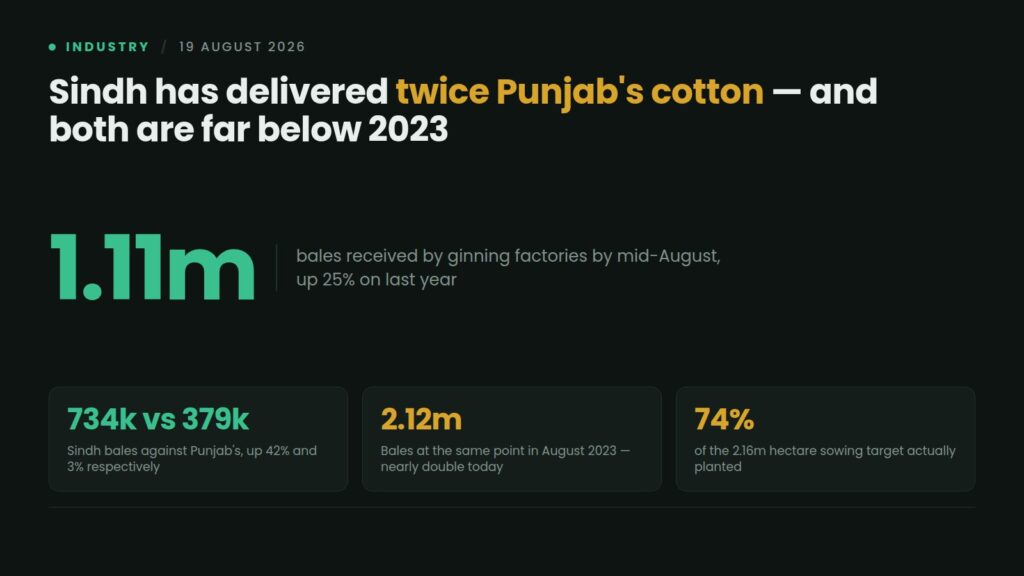
Pakistan’s ginning factories had received 1.11 million bales of cotton by mid-August, up 25 percent on the 887,000 bales recorded at the same point last year.
The split behind that total is the part worth looking at. Sindh delivered 734,000 bales, up 42 percent. Punjab delivered 379,000 bales, up 3 percent.
Sindh has produced nearly twice what Punjab has. In Pakistan’s cotton economy, that is an inversion of the historical order.
Part of this is the calendar
One qualification before drawing conclusions. Sindh’s cotton belt plants and harvests earlier than Punjab’s, so a mid-August snapshot always favours Sindh — a share of Punjab’s crop is still in the field rather than absent.
What the timing does not explain is the growth rate. Sindh is up 42 percent against its own performance a year ago; Punjab is up 3 percent against its own. Both are measured at the same point in the season as last year, so the seasonal offset cancels out.
Punjab is close to flat. That is the finding.
Why Punjab’s cotton keeps shrinking
Punjab’s cotton area has been contracting for years, and the reason is that farmers there have alternatives.
Cotton competes for the same land and the same season as sugarcane, maize and rice. Those crops offer something cotton in Pakistan does not: a buyer at a predictable price. Sugarcane has a support price and mills obliged to purchase. Cotton growers face open-market pricing against a ginning sector that buys when it suits.
Cotton is also the more fragile crop — vulnerable to pest pressure, to heat during flowering, and to the flooding that has repeatedly hit the belt. A farmer choosing between a crop that might fail and be sold at whatever a ginner offers, and one that is hardier with a guaranteed buyer, is not making a difficult decision.
Sindh’s growers have fewer alternatives. Some of its 42 percent is agronomic performance; some is simply that switching out of cotton is harder there.
The number that matters most
Set the provincial comparison against the historical one and the picture changes completely.
At this point in August 2023, ginning factories had received roughly 2.12 million bales. This year’s 1.11 million is close to half that.
A 25 percent improvement on a very poor year is still a crop about half the size of one three years ago. The recovery is real and the baseline is not.
Sowing tells the same story. Cotton has been planted on 1.60 million hectares against a government target of 2.16 million — roughly 74 percent. The FY2026-27 production target is 9.64 million bales, against 7.05 million produced last year.
Missing the area target by a quarter while aiming to lift output by 37 percent requires yield per hectare to do work that Pakistani cotton yields have not done in a decade.
What a short crop costs
This is not an agricultural story. It is a balance-of-payments story.
Textiles are Pakistan’s largest export industry, and when the domestic crop falls short, mills import cotton to keep spinning. Every bale imported is foreign exchange spent to produce goods that earn foreign exchange — which compresses the net contribution of the country’s main export sector.
A crop half the size of 2023’s means a substantial import bill in dollars, in a country holding reserves of $18.4 billion. It is the same structural trap as the coal import bill: a domestic input that could be produced locally, bought abroad instead, in currency Pakistan has to earn.
The government has sought Egyptian assistance on improving yields, which is a sensible acknowledgement that the problem is technical as well as economic.
The ginning sector is caught in the middle
Between the grower and the mill sits an industry nobody discusses, and it is being squeezed from both directions.
Ginning factories separate lint from seed, and they are capital equipment that only earns when cotton is moving through it. A plant sized for the crop volumes of a decade ago running at half capacity carries the same fixed costs — machinery, finance, a workforce that has to be retained between seasons — spread across far fewer bales.
That is why the geographic shift matters commercially and not just statistically. Ginning capacity was built where the cotton used to be. As the crop’s centre of gravity moves toward Sindh, Punjab’s ginners face declining throughput on assets they cannot relocate, while Sindh’s face volumes their installed capacity may not have been sized for.
What would actually reverse it
Yield research matters, but the binding constraint is the one visible in Punjab’s 3 percent.
Farmers are not failing to grow cotton because they lack seed. They are choosing not to, because the return does not justify the risk relative to what else that land can carry. Until cotton offers a comparable expected return — through price certainty, insurance against crop failure, or varieties resilient enough to reduce the risk — area will keep drifting to sugarcane and maize.
The tobacco growers of Khyber Pakhtunkhwa learned this month what an unenforceable support price is worth. Cotton growers already know.
Related: The Official Tobacco Price Is Rs740. Growers Are Being Offered Rs350.

One comment
[…] Sindh Has Delivered Twice Punjab’s Cotton. The 2023 Number Is Twice Them Both. […]
Comments are closed.