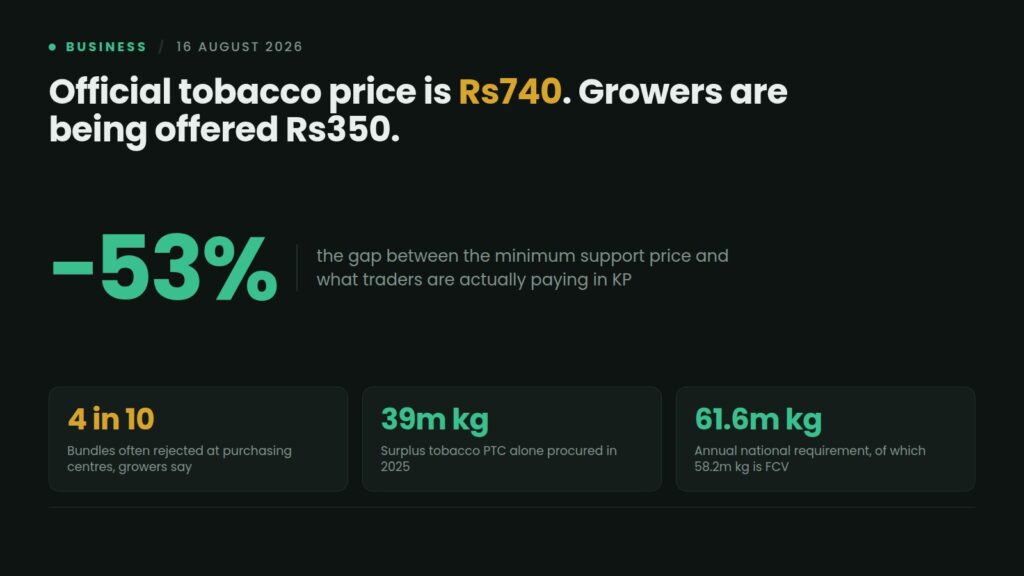
The government’s minimum support price for flue-cured Virginia tobacco is Rs740 per kilogram. Traders in Khyber Pakhtunkhwa are offering Rs350.
That is a 53 percent discount to the official rate, and it is being paid openly. In Swabi, a grower named Tamirz Khan burned five bundles of his own crop in protest, saying the price does not even cover his cost of production.
The interesting question is not why traders are offering less than the official price. It is why the official price exists at all if nobody has to pay it.
A support price with no enforcement behind it
The Ministry of National Food Security and Research sets the minimum rate. It has no mechanism to compel a buyer to honour it.
That is the whole story in one sentence. A support price that cannot be enforced is not a floor — it is a published opinion about what the crop ought to fetch. Growers plant against it, borrow against it and calculate their margins against it, and then discover at the purchasing centre that the number was never binding on anyone.
In practice only the two multinationals — Pakistan Tobacco Company and Philip Morris International Pakistan — pay the official rate, and only to growers holding current contracts. Many contracts have lapsed as procurement quotas were cut. A grower whose contract was not renewed keeps the same field and the same crop but loses access to the only buyers obliged to pay properly.
Rejection is a price mechanism
The second squeeze is quieter and does not appear in any price statistic.
Growers’ leader Muhammad Ali Dagiwal puts it plainly: bring ten bundles to a purchasing centre and four are often rejected.
Grading is inherently subjective — leaf quality is assessed by eye at the point of sale, by the buyer, with no independent arbiter. A 40 percent rejection rate cuts a grower’s realised income by 40 percent regardless of the headline rate paid on what is accepted. A farmer paid Rs740 on six bundles and nothing on four has effectively received Rs444 per bundle across his crop.
And rejected leaf does not vanish. It goes back into the market, where it becomes the surplus that small manufacturers are waiting for.
The strategy is to wait
Small manufacturers are reported to be deliberately holding off on purchases until a surplus emerges, then buying at depressed rates. This is not improvised — it repeats the pattern of 2025, when Pakistan Tobacco Company alone ended up procuring 39 million kg of surplus.
The economics of waiting are overwhelming, and they are structural rather than conspiratorial.
Cured tobacco degrades in storage. A grower has no warehouse, no working capital to carry the crop and a loan taken against the harvest. The buyer has storage, capital and no deadline. Every week that passes moves the price toward whatever the buyer is willing to pay, and both sides know it from the day the crop comes out of the barn.
Against annual national requirement of 61.627 million kg — of which 58.184 million kg is FCV — the quantity that ends up classified as surplus determines the clearing price for everyone.
Why growers cannot simply switch
The standard response is that farmers facing a bad price should plant something else. FCV tobacco makes that unusually hard.
It is not a crop you sell at a mandi. It requires curing barns — fixed capital built for tobacco and useful for nothing else — specific seed and inputs, and a licensed buyer at the end. The grower’s investment is sunk into an asset with one customer base, in districts where the whole local economy is organised around the same crop.
That asymmetry is what makes the Rs350 offer stick. It is not that growers accept the price is fair. It is that a barn cannot be replanted.
What would actually change it
Three things would matter more than announcing a higher support price next season.
Enforcement with a penalty. A minimum price is meaningless without a consequence for buying below it. This is a licensing question — buyers operate under regulatory permission, and permission can carry conditions.
Independent grading. While the buyer alone decides what counts as acceptable leaf, rejection will remain the route around any price floor that does get enforced.
Storage and credit. A grower who can hold the crop for six weeks negotiates on different terms. Warehousing plus lending against stored produce would do more for realised farmgate prices than any number on a notification.
None of this is unique to tobacco. Wheat, sugarcane and cotton growers have run into versions of the same problem: an announced price, a buyer who is not obliged to pay it, and a farmer who cannot wait. Tobacco is simply where the gap is currently widest and easiest to measure — Rs350 against Rs740, with the number published for anyone to check.
Related: SME Lending Crossed Rs1 Trillion for the First Time. Three Sectors Took Nearly Half.

2 Comments
[…] Related: The Official Tobacco Price Is Rs740. Growers Are Being Offered Rs350. […]
[…] Related: The Official Tobacco Price Is Rs740. Growers Are Being Offered Rs350. […]
Comments are closed.