Pakistan’s goods transport strike has entered its eighth day, containers are backing up at Karachi’s ports, and the federal government has escalated to a meeting at Governor House.
Federal Communications Minister Aleem Khan, Punjab Transport Minister Bilal Akbar and the Sindh governor are due to sit with representatives of the All Pakistan Goods Transport Ittehad. Truckers, container trailer operators and edible oil tanker operators are all now off the road.
There is a problem with these talks that no amount of goodwill in the room can solve. The transporters’ central demand cannot legally be granted this year.
The demand that needs a Finance Bill
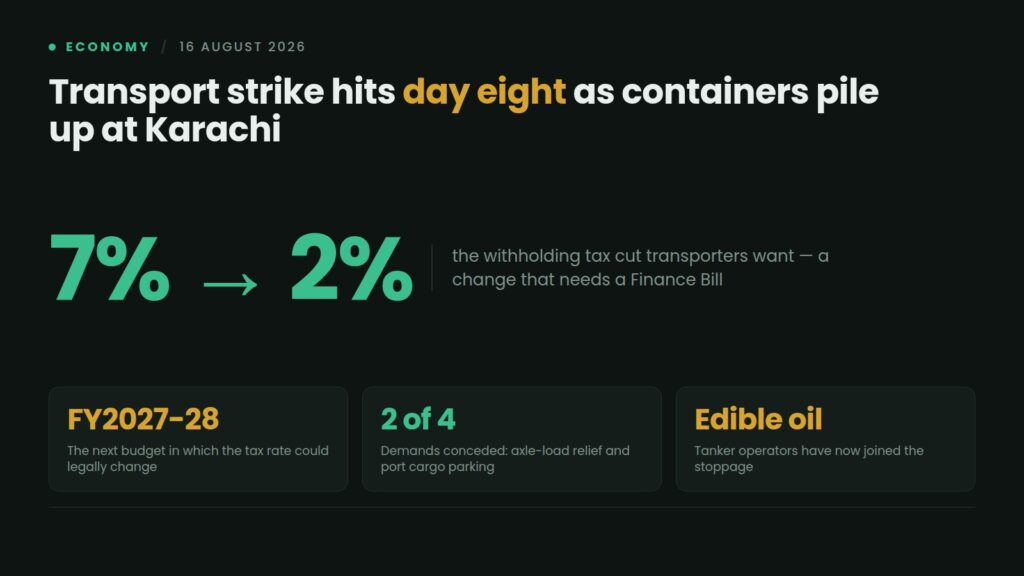
The headline ask is a cut in withholding tax on goods transport from 7 percent to 2 percent — the rate fuel tankers already pay.
On the merits, the disparity is hard to defend. Two operators moving freight by road on the same highways, taxed at rates differing by a factor of three and a half, is the kind of anomaly that accumulates in a tax code assembled sector by sector over years.
But a withholding rate is set in the Finance Act. Changing it requires the Finance Bill — and the next opportunity is the 2027-28 budget. No minister in that room, including the finance minister had he been present, can hand it over on a Sunday afternoon.
Which sets up the deadlock precisely. The transporters say they want practical progress and strong guarantors, and have explicitly rejected verbal assurances. The government’s most valuable concession is exactly the thing it can only promise.
What has been offered so far
Two of the four demands have moved:
- Axle-load relief for 10-wheeler trucks on highways and motorways — offered
- A dedicated parking facility for port cargo at Karachi — offered
- Withholding tax cut from 7% to 2% — requires the Finance Bill
- Vehicle impounding for smuggled goods carried unknowingly — unresolved
The axle-load concession is more significant than it sounds. Load limits determine how much a truck can legally carry, which determines revenue per trip against a fixed cost of fuel, driver and depreciation. Raising the limit for 10-wheelers improves operator economics on every single journey without costing the exchequer a rupee directly.
It costs something else. Axle load is the single largest determinant of road surface damage, and heavier limits accelerate the deterioration of the highways the government then has to rebuild. This is a concession that moves a cost from the transport sector to the roads budget, some years out.
The impounding grievance is the one most likely to be settled cheaply. A haulier who unknowingly carries smuggled cargo loses the vehicle — the asset the entire business depends on — for the duration of a case. A due-process fix costs nothing and would remove a genuine operating risk.
The ports are the pressure point
Officials describe container congestion as not yet critical. That framing is doing considerable work.
Port congestion is not linear. A terminal operates at high yard utilisation by design; the economics depend on containers clearing quickly. When they stop clearing, the yard fills, and once it is full, the terminal cannot discharge arriving vessels. Ships then wait at anchor, shipping lines apply congestion surcharges on Pakistan-bound cargo, and berthing schedules slip in a way that takes weeks to unwind after the underlying cause is fixed.
Eight days of accumulation is meaningful. The word “yet” is the important one in the official assessment.
The edible oil tankers joining is a separate escalation. Pakistan imports the overwhelming majority of the cooking oil it consumes, and it moves from port terminals to processing plants by tanker. A sustained halt there does not show up as a logistics statistic — it shows up as a shortage on shelves, in a category where prices move fast and are politically impossible to ignore.
Two settlements in one week
This is the second transport-sector confrontation the government has faced in a fortnight.
The oil tankers association dissociated itself from the strike after reaching its own agreement with regulators. Petroleum dealers threatened a nationwide shutdown from 15 August and called it off within days once the ECC approved a margin increase to Rs9.98 per litre.
Every one of those outcomes teaches the same lesson to anyone watching: a credible threat to stop the movement of goods produces a concession within days. The goods transporters have held out longer than either and have not yet been bought off, which tells you their central demand is the one the government genuinely cannot pay.
What a deal would have to look like
Since the tax cut cannot be delivered now, any settlement has to substitute something enforceable for a promise.
The plausible shape is a written commitment to include the withholding rate in the next Finance Bill, signed at a level that makes reneging costly, combined with immediate delivery on axle load, the parking facility and the impounding procedure. Whether that satisfies a group that has explicitly refused verbal assurances is the question the meeting turns on.
The wider point stands regardless of the outcome. Pakistan’s export machinery, its import chain and its ports all run on road freight operated by a sector that can withdraw it at a week’s notice. Two settlements this month have already demonstrated what that leverage is worth.
Related: 400,000 Trucks Are Parked. Pakistan’s Factories and Export Orders Are Next.