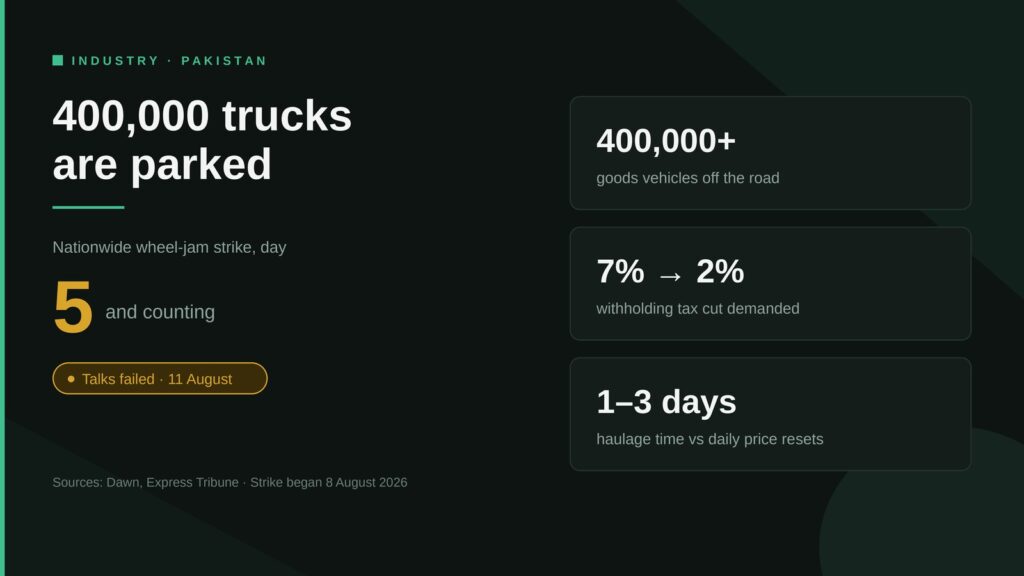
Update, 12 August: Talks between the federal government and the All Pakistan Goods Transport Itehad were held in Islamabad on Tuesday 11 August and ended without agreement. Communications Minister Abdul Aleem Khan assured transporters of the government’s cooperation, but no demands were formally accepted. Alliance president Malik Shehzad Awan told reporters that a deadlock persists and no concrete progress had been made, and that the nationwide wheel-jam strike will continue until the demands are met in practice. Operations at Port Qasim have been disrupted. The article below was written before that meeting.
A nationwide wheel-jam strike by goods transporters and oil tanker operators has brought cargo movement across Pakistan to a standstill, suspending more than 400,000 goods-carrying vehicles and cutting factories off from both raw materials and export routes.
The strike began on Saturday, 8 August. Containers have already been unloaded at the ports, and transporters say they will not resume operations until they see the outcome of talks with the federal government.
This is not a wage dispute. It is a fight over how Pakistan prices fuel — and the manufacturing sector is caught squarely in the middle.
The core grievance: daily fuel pricing
At the centre of the dispute is the government’s recently introduced daily fuel price mechanism, adopted in response to volatile global oil markets driven by renewed conflict in the Persian Gulf.
For an aviation-style commodity business, daily pricing makes sense. For road freight, it breaks the commercial model.
Pakistan Goods Transporters Alliance Chairman Nisar Hussain Jafry has explained the arithmetic plainly: intercity haulage takes between one and three days. When diesel prices reset every morning, neither transporters nor their industrial clients can quote a firm freight rate for a journey that spans multiple pricing cycles. A load quoted on Monday may be delivered on Wednesday at a materially different fuel cost, and someone has to absorb the gap.
The Alliance wants the monthly fuel price mechanism restored.
The full charter of demands
Fuel pricing is the headline, but the strike is carrying several accumulated grievances:
- Withholding tax reduction — transporters currently pay 7% and want it cut to 2%, matching what oil carriers pay on services. The disparity is already being challenged separately, with the Islamabad High Court seeking a government response to a petition arguing that the concessional treatment of oil tanker contractors is discriminatory.
- Unfulfilled commitments — a charter of demands was signed between the government and goods transporters in December 2025. Transporters say those commitments remain undelivered eight months later.
- Toll plaza density and rates — operators complain that plazas have been established at intervals of roughly 30km, with rates they consider excessive.
- Parking and licensing — unresolved issues around heavy-vehicle parking near port areas and driver licensing procedures.
What industry is saying
Manufacturers are describing the situation in stark terms.
SITE Association of Industry President Abdul Rehman Fudda has warned that production systems depend entirely on the timely arrival of raw materials and the timely dispatch of finished goods. When inputs stop arriving, production stalls. When finished goods cannot be shipped, financial stress compounds — and export consignments that miss buyer deadlines expose manufacturers to penalties, price cuts and damage claims.
That last point is the one that carries beyond this week. Pakistan’s export sector competes largely on reliability and price in textiles, and international buyers work to fixed delivery windows. Missed shipments do not simply delay revenue; they damage the buyer relationships that determine next season’s orders. A supplier that misses a window once negotiates from a weaker position thereafter.
Industry representatives have urged the government to intervene before the disruption escalates further, warning that prolonged stoppage would extend well past manufacturers to hit exports, employment and overall economic activity.
A sector already under strain
The strike lands on an industrial base that was already struggling before a single truck stopped moving. Manufacturers have been contending with:
- Escalating electricity and gas tariffs
- High financing costs, with the policy rate held at 11.5%
- Policy unpredictability that complicates medium-term investment planning
- Delayed refunds — the government has just cleared roughly Rs10 billion in decade-old export refunds, with about Rs1.94 billion still outstanding
Refunds a decade overdue tell their own story about working-capital conditions in Pakistani manufacturing. Money owed to exporters and held by the state for ten years is capital that could not be deployed into production, upgrades or hiring.
Layered on top is a broader energy transition: the government is simultaneously pushing an oil storage partnership with Saudi Arabia, Kuwait and Qatar, revamping refining policy, and preparing for offshore drilling operations. These are long-horizon initiatives. They do nothing for a factory that cannot get cotton through the gate this week.
What happens next
Talks between the Alliance leadership and the ministers responsible for petroleum, transport and ports took place in Islamabad on Tuesday 11 August. They ended without agreement, and the strike has continued into a second week.
The likely landing zone remains some form of hybrid fuel-pricing arrangement — perhaps a weekly reset, or a formal indexation clause that lets freight contracts adjust automatically without renegotiation. The withholding tax disparity may prove harder to resolve, given its fiscal implications and the parallel court proceedings.
What is clear is that the underlying issue will not disappear with a settlement. Pakistan’s logistics sector has been absorbing policy volatility for years without the contractual tools to pass it through. Until freight pricing can adjust to fuel costs in a structured way, every energy shock will keep arriving at the factory gate.
FAQs
Why are transporters striking in Pakistan?
Primarily over the government’s daily fuel price mechanism, which they say makes it impossible to quote fixed freight rates, alongside demands to cut withholding tax from 7% to 2% and address toll rates and unfulfilled commitments from a December 2025 charter.
How many vehicles are affected?
More than 400,000 goods-carrying vehicles, from small carriers to large haulage trucks, have suspended operations nationwide.
How does the strike affect exports?
Export consignments cannot reach ports on schedule, exposing manufacturers to contractual penalties, price reductions and damage claims from international buyers.
When will the strike end?
No end date has been set. Talks with the government on 11 August ended in deadlock, and the Alliance says the strike will continue until its demands are accepted in practice.
What is the daily fuel price mechanism?
A system introduced by the government in response to volatile global oil markets, under which fuel prices are revised daily rather than on the previous monthly schedule.
3 Comments
[…] Related: 400,000 Trucks Are Parked. Pakistan’s Factories and Export Orders Are Next. […]
[…] Related: 400,000 Trucks Are Parked. Pakistan’s Factories and Export Orders Are Next. […]
[…] Related: 400,000 Trucks Are Parked. Pakistan’s Factories and Export Orders Are Next. […]
Comments are closed.