Pakistan’s corporate regulator has escalated one of the year’s more uncomfortable investment cases. The Securities and Exchange Commission of Pakistan (SECP) has formally referred M/s Blink Capital Management (Pvt) Ltd to the Federal Investigation Agency (FIA) after concluding that the firm appears to have run a Ponzi-type scheme through funds it was never licensed to collect.
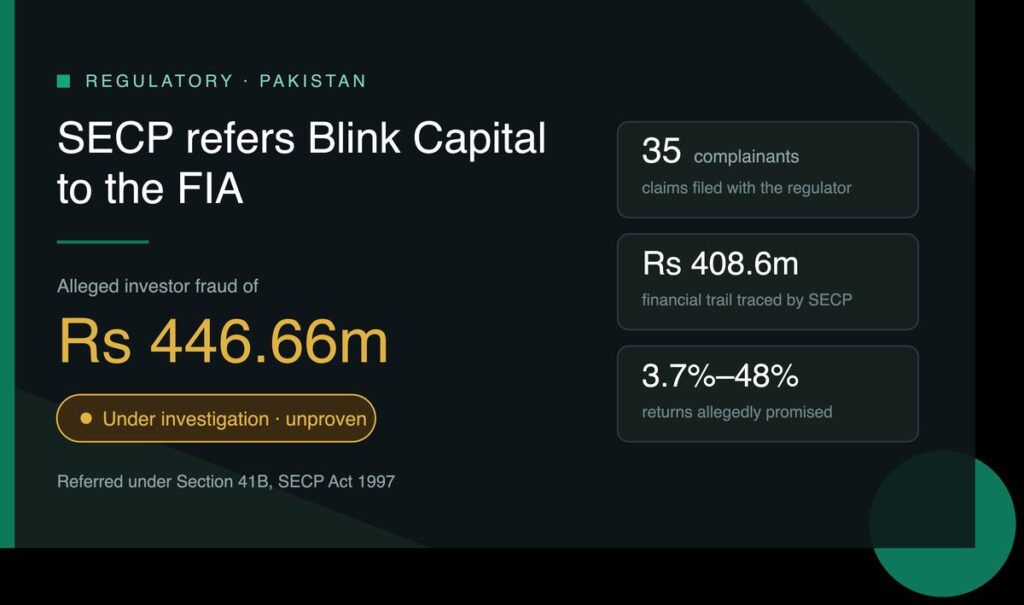
The referral followed an investigation into more than 35 investor complaints alleging misappropriation of roughly Rs446.66 million.
What the SECP found
Blink Capital was not operating in the shadows. It held a licence as a futures broker and market maker for the Pakistan Mercantile Exchange (PMEX) — a regulated status that gave it a level of credibility ordinary investors reasonably relied on.
The SECP opened its investigation under Section 83 of the Futures Market Act 2016 after investors reported that the firm had been collecting money on promises of fixed returns and guaranteed repayment of principal. Neither activity falls within the scope of a futures brokerage licence.
Investigators traced a financial trail covering 29 complainants and Rs408.6 million. According to the SECP’s findings, a substantial share of those funds moved into accounts belonging to Blink itself, its then-CEO and a director, along with accounts linked to certain employees and associated individuals. Sizeable amounts were also pulled out in cash — a pattern regulators typically treat as a red flag.
The returns that should have raised alarms
The agreements investors signed offered predetermined returns ranging from 3.7% per month to 48% per annum, secured with post-dated cheques.
That figure is worth pausing on. With the State Bank’s policy rate at 11.5% and government paper yielding in that broad vicinity, a guaranteed 48% annual return implies the firm was consistently generating four times the risk-free rate — with no downside risk to the investor. No legitimate futures brokerage operates that way. Post-dated cheques, meanwhile, offer far less protection than they appear to: they are only as good as the balance in the account when presented.
The SECP concluded that Blink was allegedly running a fraudulent investment scheme involving illegal deposit-taking and the offering of guaranteed returns outside the boundaries of its licensed activity.
The regulator’s message
SECP Chairman Dr Kabir Ahmed Sidhu has signalled that the commission intends to deal firmly with market abusers, manipulators and entities that exploit their regulated status to mislead investors, saying that protecting investor interests is the commission’s paramount concern and that it will pursue all necessary regulatory and enforcement measures to preserve market integrity.
The referral to the FIA matters procedurally. The SECP’s own powers are civil and administrative — licence cancellation, penalties, restrictions. Criminal prosecution, asset tracing and recovery of misappropriated funds require the FIA. Moving the case across is what converts a regulatory finding into a potential criminal proceeding.
Why this keeps happening
Blink Capital is not an isolated case. Pakistan has seen a steady run of investment scams over the past several years, spanning commodity trading, forex, crypto and unregistered “fixed return” funds. The FIA is separately probing a range of similar complaints.
The recurring pattern is consistent:
- A regulated licence used as a trust signal — investors verify the entity is registered, then assume everything it offers is covered by that registration.
- Fixed, guaranteed returns — the single most reliable warning sign in any investment pitch.
- Cash movement and personal accounts — legitimate client funds sit in segregated accounts, not in a CEO’s personal account.
- Word-of-mouth recruitment — early investors are paid from later deposits, which sustains momentum until inflows stall.
Persistently high inflation compounds the problem. When headline inflation runs near double digits and conventional savings products struggle to keep pace, the appeal of a 48% “guaranteed” return becomes psychologically powerful — particularly for savers watching real returns erode month after month.
How investors can protect themselves
- Verify the licence and the activity. A firm may be legitimately licensed for one thing while illegally offering another. Check the SECP register for the specific permission covering the product being sold.
- Treat guaranteed returns as disqualifying. Regulated investment products in Pakistan do not promise fixed profits. Market exposure means variable outcomes.
- Insist on segregated accounts. Client money should never be routed to a personal or company operating account.
- Compare against the risk-free rate. Anything meaningfully above prevailing T-bill yields carries proportionately higher risk, whatever the paperwork says.
- Report early. The 35 complaints that triggered this investigation are the reason it exists. Silence protects the scheme.
FAQs
What is Blink Capital Management?
A firm that held a licence as a futures broker and market maker for the Pakistan Mercantile Exchange (PMEX), now under FIA investigation following an SECP referral.
How much money is involved?
Complaints alleged misappropriation of about Rs446.66 million. The SECP traced a financial trail of Rs408.6 million involving 29 complainants.
What returns did Blink Capital promise?
Investors reportedly signed agreements offering between 3.7% per month and 48% per annum, backed by post-dated cheques.
What law did the SECP investigate under?
Section 83 of the Futures Market Act 2016.
How can I check if an investment firm is licensed in Pakistan?
Consult the SECP’s public register of licensed entities and confirm that the specific product being offered falls within that licence’s permitted activities.