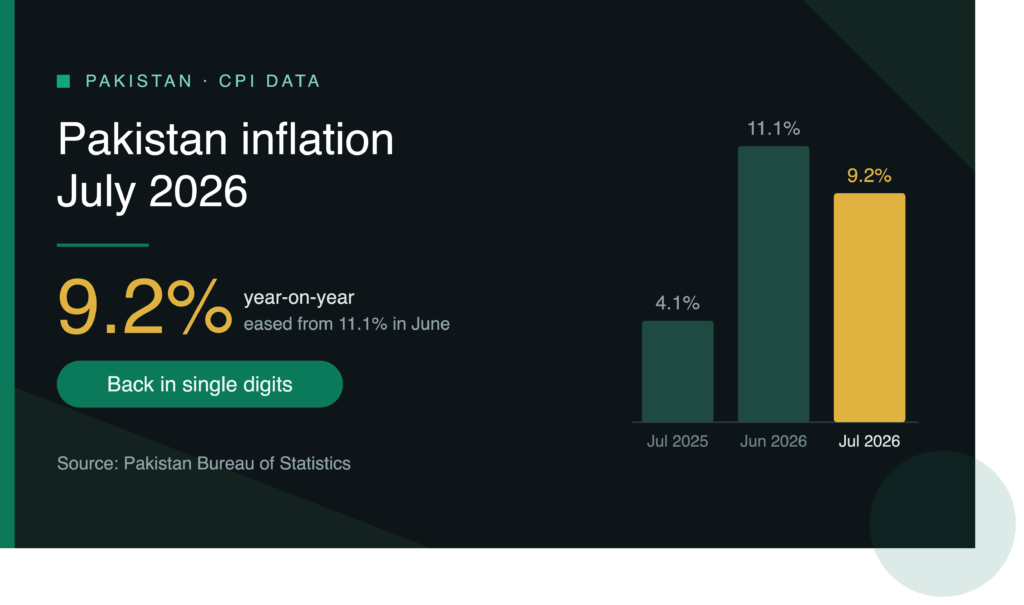
Pakistan’s headline inflation dropped back into single digits in July 2026, easing to 9.2% year-on-year from 11.1% in June, according to figures released by the Pakistan Bureau of Statistics (PBS). On paper, that is the best reading in months.
Look closer, though, and the picture is considerably more complicated. Prices did not actually fall in July — they rose 1.2% compared to June. And measured against July 2025, when inflation stood at just 4.1%, the cost of living is still climbing at more than double last year’s pace.
The headline number, and what sits underneath it
The improvement is real but narrower than it looks. Much of the decline is a base effect: July 2025 saw an unusually sharp 2.9% month-on-month price surge, which inflated the comparison base and mechanically pulls this year’s year-on-year figure down. Several analysts have flagged that the deceleration reflects statistical arithmetic more than genuine cooling in the economy.
The month-on-month data supports that reading. Consumer prices rose 1.2% in July after declining 0.3% in June — meaning prices are still moving upward, just from a higher starting point.
Urban vs rural: the gap persists
| Measure | July 2026 | June 2026 | July 2025 |
|---|---|---|---|
| National CPI (YoY) | 9.2% | 11.1% | 4.1% |
| Urban CPI (YoY) | 8.7% | 11.2% | 4.4% |
| Rural CPI (YoY) | 9.9% | 10.9% | 3.5% |
| Month-on-month | +1.2% | −0.3% | +2.9% |
Rural households continue to absorb the heavier burden at 9.9%, compared to 8.7% in cities — a gap driven largely by food, which carries greater weight in rural consumption baskets.
Two other indices tell a harsher story than the CPI. The Sensitive Price Indicator (SPI), which tracks essential daily-use items, rose 12.0% year-on-year. The Wholesale Price Index (WPI) climbed 9.4%. For households buying atta, cooking oil and vegetables weekly, the SPI is closer to lived experience than the headline number.
Where the pressure is concentrated
Food and non-alcoholic beverages were the single largest contributor to annual inflation, up 10.6%. Within that category, individual items moved dramatically:
- Tomatoes — up 174.7% year-on-year (urban)
- Wheat — up 77.7%
- Onions — up 75.9%
- Wheat flour — up 67.6%
- Sugar — down 21.0%
- Potatoes — down 34.4%
Wheat and flour prices near 70–80% annual growth are the most politically sensitive figures in the release, and they arrive as the government has yet to issue an import tender for the roughly one million tonnes of wheat it plans to bring in. Traders have warned that the delay is feeding further price escalation.
Outside food, transport costs rose 15.1%, reflecting elevated global oil prices and the government’s shift to a daily fuel price mechanism. Communication charges jumped 13.6%, a sharp acceleration from near-flat readings earlier in the year. Housing, water, electricity and gas rose a comparatively moderate 7.1%.
What the State Bank is doing about it
The State Bank of Pakistan’s Monetary Policy Committee — meeting for the first time in fiscal year 2026-27 — held the policy rate at 11.5%, extending a pause that began after the surprise 100-basis-point hike in April 2026.
SBP Governor Jameel Ahmad has expressed confidence that inflation will continue moderating and finish the fiscal year at the upper end of the central bank’s 5–7% target band. The Finance Division’s own Monthly Economic Update had projected July inflation in the 9–10% range, so the 9.2% print landed within official expectations.
The central bank’s caution is understandable. Its projections rest on assumptions about global energy prices, monsoon and weather outcomes, and fiscal discipline — and the government has itself flagged renewed geopolitical tension in the Middle East as a downside risk to both the inflation path and the external account.
The reform question nobody is answering
Beneath the monthly data lies a structural problem the numbers keep circling back to. Foreign direct investment fell 33.9% in FY2024-25, from $2.48 billion to $1.64 billion. Growth has been running in the 3.5–4.5% range — enough to keep the economy moving, not enough to absorb the roughly two million young Pakistanis entering the labour force each year.
Single-digit inflation is a milestone worth noting. It is not, on its own, a recovery. Until food supply chains, energy pricing and the tax base are addressed structurally, headline improvements will remain vulnerable to the next external shock.
FAQs
What is Pakistan’s current inflation rate?
9.2% year-on-year for July 2026, down from 11.1% in June 2026, per Pakistan Bureau of Statistics data.
Why did inflation fall if prices went up?
The year-on-year figure fell largely because of a base effect — July 2025 had an unusually large monthly price jump. Month-on-month, prices actually rose 1.2% in July 2026.
What is Pakistan’s policy rate right now?
The State Bank of Pakistan has held its benchmark policy rate at 11.5%.
Which items got most expensive in Pakistan in July 2026?
Tomatoes (+174.7%), wheat (+77.7%), onions (+75.9%) and wheat flour (+67.6%) recorded the sharpest annual increases.
When will inflation return to the SBP target range?
The SBP Governor expects CPI to reach the upper end of the 5–7% target band by the close of the current fiscal year, though this depends on oil prices, weather and fiscal outcomes.