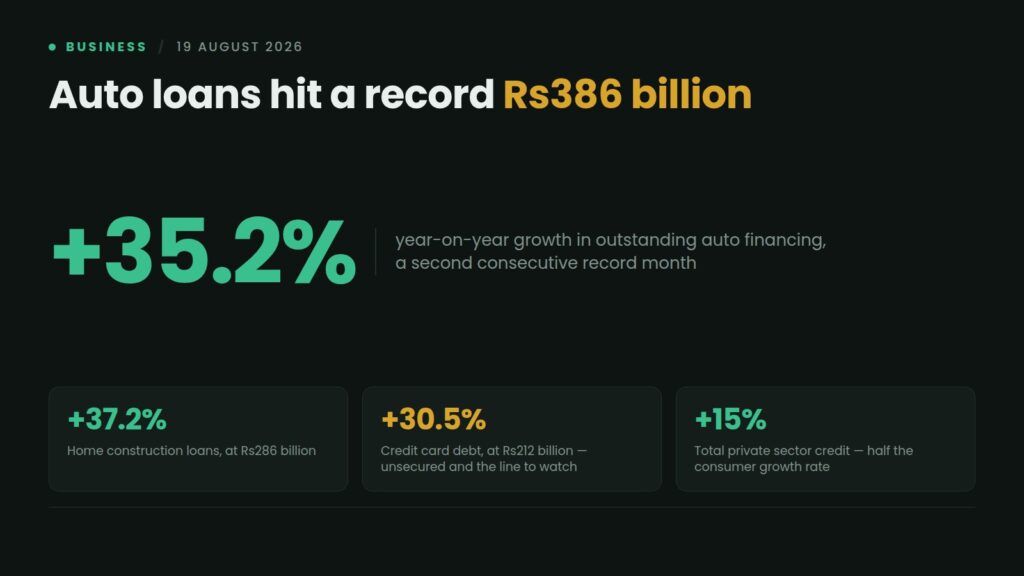
Outstanding auto loans in Pakistan reached Rs386 billion in July 2026 — the highest figure ever recorded, up 35.2 percent from Rs286 billion a year earlier.
It is the second consecutive record month. June’s Rs382 billion held the previous high.
Auto financing is not moving alone, and the pattern across the whole consumer book is the part worth examining.
Consumer credit is growing faster than everything else
State Bank data for the same period:
- Auto loans — Rs386 billion, up 35.2% year-on-year
- Home construction loans — Rs286 billion, up 37.2%
- Credit card loans — Rs212 billion, up 30.5%
- Total private sector loans — Rs10.9 trillion, up 15%
Every consumer category is growing at roughly twice the rate of overall private sector credit. That gap is the story.
Banks are not lending faster in general. They are lending faster to households specifically, and rebalancing toward the segment that was frozen for three years.
The rate cycle explains most of it
Consumer lending in Pakistan is a direct function of the policy rate, and the swing has been violent in both directions.
At the peak of the tightening cycle, an auto loan carried an instalment most salaried households simply could not service. Demand did not soften — it stopped. Banks were not competing for it either, because government paper was paying a risk-free return well above what a car loan yielded after provisioning.
Both conditions reversed together. Falling rates cut the monthly instalment enough to bring buyers back, and collapsing treasury yields sent banks looking for lending they had been ignoring. The same mechanism drove SME credit past Rs1 trillion for the first time this year.
So 35 percent growth is substantially a base effect — recovery from a period when the number was artificially suppressed, not evidence of new prosperity.
What it does and does not prove about incomes
A record loan book is not the same as households being better off.
Car prices in Pakistan have risen sharply — hybrid variants alone went up 15.2 percent this month, with some models adding over Rs2 million. When the price of the asset rises faster than incomes, the loan required to buy the same vehicle grows even if no additional buyers enter the market. Part of Rs386 billion is simply larger loans for the same cars.
Auto financing is also structurally a proxy for salaried formal employment. Banks lend against verifiable income, which in Pakistan means a documented job. A rising auto loan book indicates the formal salaried segment feels secure enough to take on multi-year commitments — a real signal, but one covering a small slice of the workforce. The same week produced 7.1 million applications against roughly 1,200 government job advertisements.
Both numbers are true. They describe different Pakistans.
Where the risk sits
Auto loans are among the safer consumer products a bank can write. The vehicle is collateral, it is registered, and it can be repossessed. Loss rates are consequently far below unsecured lending.
Two things still deserve watching.
Rate direction. Most Pakistani consumer lending is floating-rate, which means the borrower carries the interest risk, not the bank. Loans written at today’s rates were underwritten against today’s instalment. If inflation forces tightening — and with Brent back near three-week highs and fuel prices rising again, that is not remote — instalments rise on a book built when they were falling.
Credit cards. Rs212 billion growing at 30.5 percent is the line that should attract more scrutiny than the auto number. Card debt is unsecured, carries the highest effective rates in the market, and is the first place household stress appears. Nobody repossesses a credit card balance.
What it means for the assemblers
The other party with a stake in this number is Pakistan’s auto assembly industry, and financing availability has always driven its volumes more than consumer sentiment does.
A large share of new cars sold in Pakistan are bought on credit. When financing froze during the tightening cycle, assemblers cut production, ran plant shutdowns and shed shifts. Rs386 billion of outstanding auto credit is the demand side of the recovery those plants have been waiting for.
Whether it translates into local manufacturing is a separate question. Pakistani assembly is heavily dependent on imported kits and components, so a financing-led sales recovery pulls in imports alongside it — which is why the government has been pressing the sector toward exports and approved a 150-acre auto processing zone at Port Qasim this month. Credit growth that produces higher import bills rather than higher local value addition is a smaller win than the sales figures suggest.
The bigger picture
For a banking system that spent three years parking deposits in treasury bills rather than lending, credit reaching households and small businesses again is the correct direction. An economy where banks fund only the government does not grow.
The test is what survives the next tightening cycle. If this lending was driven by nothing more than the collapse in risk-free yields, it reverses when yields recover, and Rs386 billion turns out to have been a rate story rather than a structural one.
Related: SME Lending Crossed Rs1 Trillion for the First Time. Three Sectors Took Nearly Half.
One comment
[…] Related: Auto Loans Hit a Record Rs386 Billion. Credit Cards Are the Line to Watch. […]
Comments are closed.