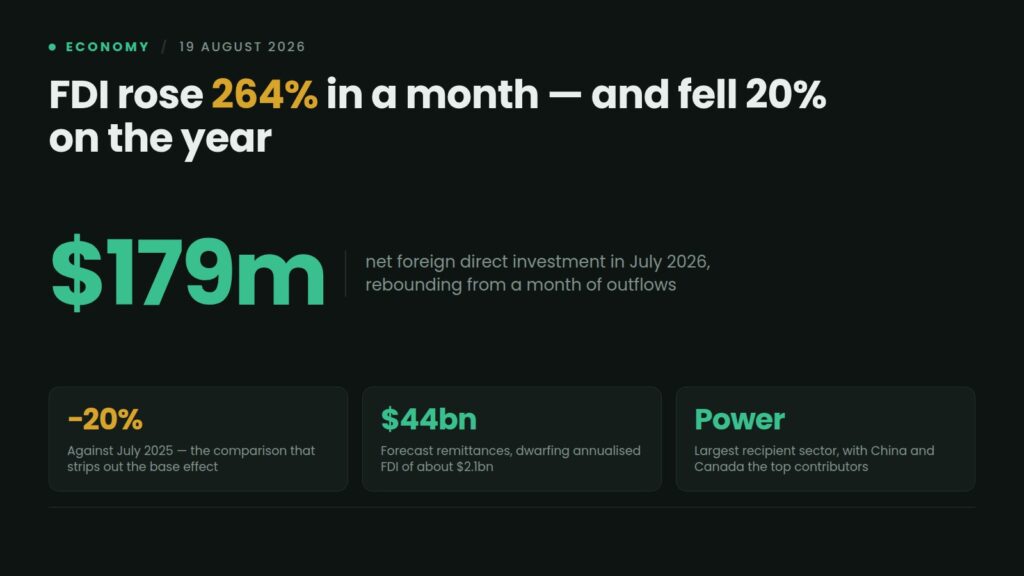
Net foreign direct investment into Pakistan was $179 million in July 2026 — 264 percent higher than June.
It was also 20 percent lower than July a year earlier.
Both statements come from the same State Bank data, compiled by Topline Securities. Only one of them has been widely reported.
Why the 264 percent is close to meaningless
The comparison month is the problem. June 2026 saw significant outflows, particularly from food and electronics — meaning foreign investors took more money out of those sectors than they put in.
When a month is artificially depressed by disinvestment, the following month’s percentage change measures the depth of the hole rather than the height of the recovery. A move from a very low base to a modest number produces a spectacular percentage and tells you almost nothing about direction.
The year-on-year figure exists precisely to strip that noise out, and it points the other way. Against the same month last year — a fair comparison, unaffected by whatever happened in June — foreign direct investment fell by a fifth.
Anyone reporting one number without the other is not reporting the data.
The absolute number is the real story
Set aside both percentages and look at $179 million.
Annualised, that is roughly $2.1 billion of net FDI into a country of more than 250 million people — a fraction of a percent of GDP, and a small fraction of what comparable economies attract. It is also dwarfed by the other foreign inflow Pakistan depends on: remittances exceeded $41 billion last year and are forecast at $44 billion.
Overseas Pakistanis send home in about six weeks what foreign companies invest in a year.
That ratio describes the structural position more accurately than any monthly movement. Pakistan’s external account is financed by its diaspora’s wages, not by foreign capital betting on its productive assets. Remittances are a transfer; FDI builds factories, transfers technology and creates employment. The country receives a great deal of the first and very little of the second.
Where the money went, and what that says
Power and financial services took the largest inflows. China and Canada were the biggest net contributors.
The sector mix is familiar and not encouraging. Power sector FDI in Pakistan has historically meant generation projects operating under guaranteed-return tariff structures — capital attracted by a sovereign guarantee rather than by market opportunity, and the same capacity payment obligations that feed the circular debt now standing at Rs1.675 trillion. Financial services investment is largely capital injected into existing institutions.
What is absent is the category that would matter most: export-oriented manufacturing. A foreign firm building a plant in Pakistan to make things and sell them abroad brings technology, trains workers and earns foreign exchange. Nothing in this month’s composition suggests that is happening at scale.
The June outflows are worth noting for the same reason. Food and electronics are exactly the consumer-facing sectors a foreign investor enters to serve a large domestic market. Money leaving them is a judgement about that market’s purchasing power.
Why monthly FDI figures mislead so reliably
There is a structural reason these numbers swing so violently, and it is worth understanding before reading the next month’s release.
Net FDI is inflows minus outflows. In an economy attracting a small absolute volume of foreign capital, a single transaction distorts the whole series. One multinational injecting equity into a subsidiary, or one foreign parent repatriating accumulated profit, can move a month by tens of millions of dollars — a rounding error in a large economy, a headline in this one.
That is exactly what appears to have happened here. June’s outflows from food and electronics were almost certainly a small number of specific corporate decisions rather than a broad withdrawal, and July’s rebound is their absence rather than any new commitment.
The practical rule is that monthly FDI in Pakistan carries almost no signal. Twelve-month rolling totals do, and they have been describing the same flat line for years.
The uncomfortable pairing
This lands in the same week Google opened a registered office in Islamabad and Coca-Cola’s bottler reported Pakistan as its largest single contributor to volume growth.
Those are genuine signals of corporate interest, and they sit awkwardly against FDI down 20 percent year-on-year. The resolution is that they measure different things. Selling into Pakistan and investing in Pakistan are separate decisions, and multinationals have long been comfortable doing the first while limiting the second.
The reason is the one every investor cites and no stabilisation programme has yet resolved: profits earned in rupees have to be converted into dollars to be repatriated, and confidence in being able to do that at a predictable rate is what actually determines whether capital commits. Pakistan has restricted profit repatriation during past balance-of-payments stress. Investors remember.
What would change it
Not marketing, and not another investment conference.
An uninterrupted multi-year record of profit repatriation processed without delay would do more than any incentive package, because the constraint is not the return on offer but the confidence of getting it out. Reserves above $21 billion, if the State Bank’s FY27 forecast holds, is the precondition for that record being possible.
Until then, monthly percentage swings from a low base will keep producing headlines like this one. The number to watch is the twelve-month total, and the trend it has been describing for years is flat.
Related: The State Bank Expects 3.5–4.5% Growth in FY27. Pakistan Already Did 3.7%.