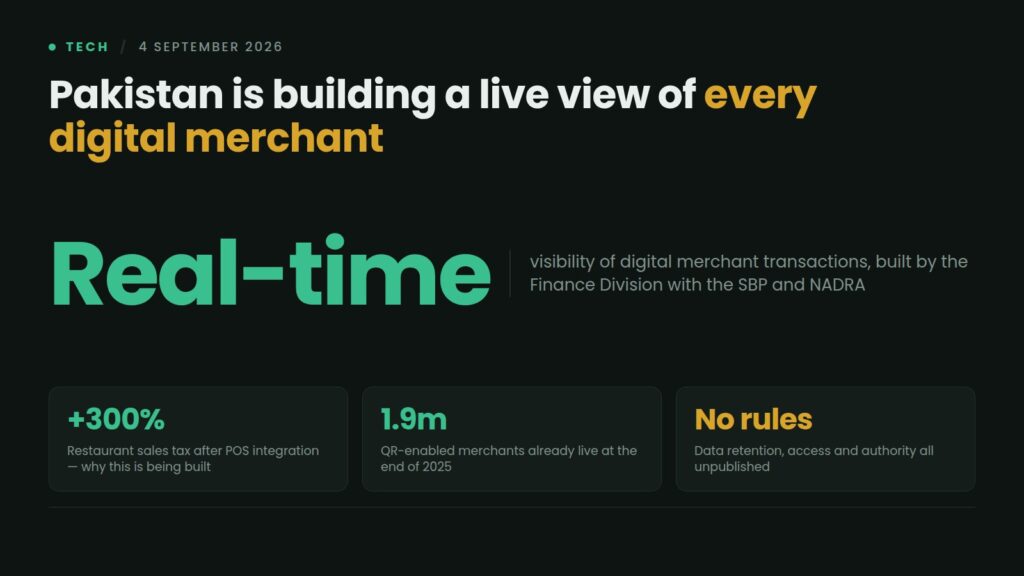
The Finance Division is building a centralised merchant database to give the state real-time visibility of digital transactions across the country.
The State Bank, NADRA, the CDA, the IT ministry and private sector participants are all involved. The stated purpose is a transparent, documented and inclusive economy, under the Prime Minister’s Cashless Initiative.
Two things are being described here at once, and they are not the same thing.
Merchant onboarding and transaction surveillance
A merchant registry is straightforward infrastructure. Knowing which businesses accept digital payments, where they are and what they do lets a regulator find the gaps, target acquiring efforts and measure adoption. Every payments market has one.
Real-time visibility of transactions is a different proposition. That is not a directory of who exists — it is a live view of what they are selling and to whom.
The announcement uses both descriptions without distinguishing between them, and the distinction determines everything: what data is held, who can query it, how long it is kept and what it may be used for. None of that has been published.
The tax purpose is unstated and obvious
Nothing in the announcement mentions the FBR. The evidence for why this is being built is sitting in the tax data anyway.
When restaurants were integrated with the FBR’s point-of-sale system, quarterly sales tax from them rose 300 percent — from Rs183.8 million to Rs729.4 million. Shopkeepers paid 78 percent more after registering. The same businesses, the same trade; what changed was that the transactions became visible.
That is the most compelling evidence in Pakistani public finance that the revenue problem is a collection problem. Only 17,337 large retailers are integrated, against an FBR that missed its IMF-agreed target by Rs975 billion.
A centralised merchant database with real-time transaction visibility is the tool that scales that result. Presenting it as a cashless-economy initiative rather than a tax measure is a choice about framing, not about function — and merchants will work out which it is.
Which is exactly why merchants may not join
Here is the tension the plan has to solve.
A small trader’s incentive to accept digital payments is convenience and access to customers. Their incentive to avoid it is that a recorded transaction is a taxable one. Where the second outweighs the first, adoption stalls regardless of how good the infrastructure is.
Pakistan has already legislated that trade-off in the other direction: a small trader scheme exempts businesses with annual sales up to Rs200 million from digital payment requirements. That is not a small trader by any ordinary reading, and it places most of the retail sector outside the regime this database would monitor.
The Pakistan Medical Association has refused electronic billing for private clinics outright, calling it bureaucratic overreach and warning that doctors may shut facilities.
Build the database and exempt everyone in it, and you have infrastructure watching an empty room.
The rails are already there
The payments side of this is genuinely built, and it is worth being clear that Pakistan’s digital infrastructure is not the constraint.
92 percent of 3.7 billion quarterly retail transactions run through digital channels. Raast moved Rs23.27 trillion in peer-to-peer transfers in a single quarter. QR-enabled merchants passed 1.9 million at the end of 2025, up from 516,000 in FY24. Digital transactions rose from 10 billion to 12 billion in FY26.
Tripling merchant acceptance points in eighteen months is the hardest part of any payments build, because it means persuading millions of small businesses one at a time. That work has largely been done.
What is missing is a single view across it, which is what this database supplies. The plan also covers digitising government vendor, employee and pension payments through state enterprises — the least controversial and most immediately achievable part, since the state controls both ends.
What should be published before it is built
Pakistan has no comprehensive data protection statute. A database aggregating merchant transaction data across the State Bank, NADRA and the IT ministry, with private sector participants involved, is being assembled without a legal framework governing what happens to it.
Three things would settle most concerns: what data is collected and retained, which agencies may query it and under what authority, and whether access requires a warrant or a login.
The case for the database is strong. Publishing those answers now costs nothing and is considerably easier than retrofitting them after the system is live.
Related: Restaurants Paid 300% More Tax Once They Were Visible. Nothing Else Changed.