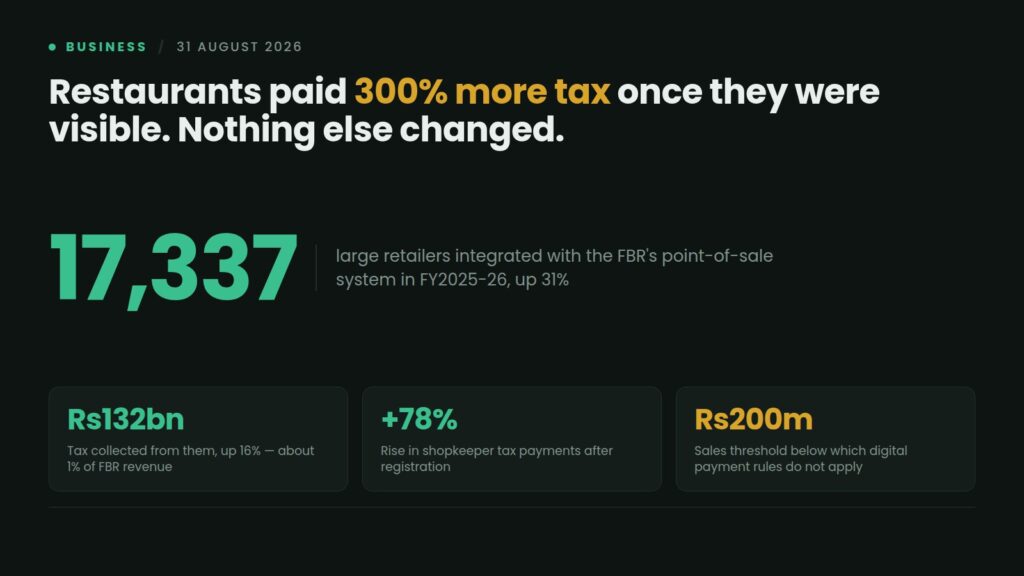
17,337 large retailers were integrated with the FBR’s point-of-sale system in FY2025-26 — 4,124 more than the year before, a 31 percent increase. Tax collected from them rose 16 percent to Rs132 billion.
By July 2026, 46,813 branches were connected to digital invoicing.
The scheme launched in December 2019 and sat dormant for years. The sector-level numbers are what make this worth reading.
Restaurants tripled their tax
After integration, quarterly sales tax from restaurants rose 300 percent — from Rs183.8 million to Rs729.4 million. Shopkeepers overall paid 78 percent more after registering.
Those figures deserve to be read precisely. Restaurants did not begin serving four times as many meals. The same business, doing roughly the same trade, remitted four times the sales tax once its transactions were recorded in a system the FBR could see.
Sales tax is collected from the customer at the point of purchase. It was already being charged. What integration changed is how much of it reached the exchequer rather than staying with the retailer.
That is the clearest available measure of how much of Pakistan’s revenue problem is a collection problem rather than a rate problem — and it is a large share of it. Every budget debate about raising rates on documented taxpayers happens against a backdrop where visibility alone quadruples the take from an undocumented one.
Growth on a base that is far too small
Now the proportions. 17,337 integrated retailers, in a country of more than 250 million people, with retail among its largest employers.
Rs132 billion sounds substantial until it is set against FBR collection of Rs13.010 trillion in FY26 — roughly one percent. And that collection missed its IMF-agreed target by Rs975 billion, a shortfall more than seven times the entire retail POS take.
Thirty-one percent growth on a very small base is genuine progress and does not yet move the aggregate. The FBR earning Rs871 million in commissions on POS receipts — up 17 percent — tells the same story: real, and small.
The doctors are refusing
The Pakistan Medical Association has refused to accept electronic billing for private clinics, calling it bureaucratic overreach and warning that doctors may shut down health facilities.
Private medical practice in Pakistan is overwhelmingly cash, and consultation fees are among the least documented professional incomes in the economy. It is precisely the kind of high-value service income the tax net has never reached.
The threat to close facilities is the same instrument that has worked repeatedly this month. Petroleum dealers threatened a nationwide shutdown and secured a margin increase to Rs9.98 a litre. Goods transporters kept vehicles off the road for over a week and won concessions on axle load and port parking. Each settlement teaches the next group what disruption is worth.
Withholding healthcare to avoid documentation is a harder position to defend than either of those. It is also more likely to work, for the same reason.
Why POS worked where earlier attempts did not
The scheme sat unused from December 2019 for years before the numbers started moving, and the reason it eventually worked is worth isolating.
Most attempts to widen Pakistan’s tax net have relied on the taxpayer declaring something — filing a return, registering a turnover, reporting an income. Each of those depends on voluntary accuracy, and each has produced the predictable result.
Point-of-sale integration works differently. It records the transaction at the moment it happens, in the retailer’s own till, before any decision about what to declare is taken. There is nothing to under-report because the reporting is automatic.
That is the same principle behind the shift in payments generally — 92 percent of Pakistan’s 3.7 billion quarterly retail transactions now run through digital channels, each one leaving a record. Documentation is turning out to be an infrastructure problem rather than a compliance one.
The exemption that undoes it
The most consequential detail is the quietest. A small trader scheme exempts businesses with annual sales up to Rs200 million from digital payment requirements.
Rs200 million a year is not a small trader by any ordinary reading. It is a substantial retail business, and drawing the exemption at that level places most of Pakistan’s retail sector outside the regime the rest of the policy is trying to build.
It also creates the incentive documentation drives always founder on: a business approaching the threshold has a powerful reason to stay below it, on paper. A rule that rewards appearing smaller than you are does not widen a tax net.
This is the recurring pattern in Pakistani tax policy. A measure that works is introduced, the affected sector resists, and an exemption is granted that leaves the measure technically in force and substantially hollow. The 300 percent restaurant figure shows what integration achieves. The Rs200 million threshold shows how few businesses will have to find out.
Related: Pakistan’s Fiscal Deficit Hit a 22-Year Low. Cheaper Debt Did Most of the Work.