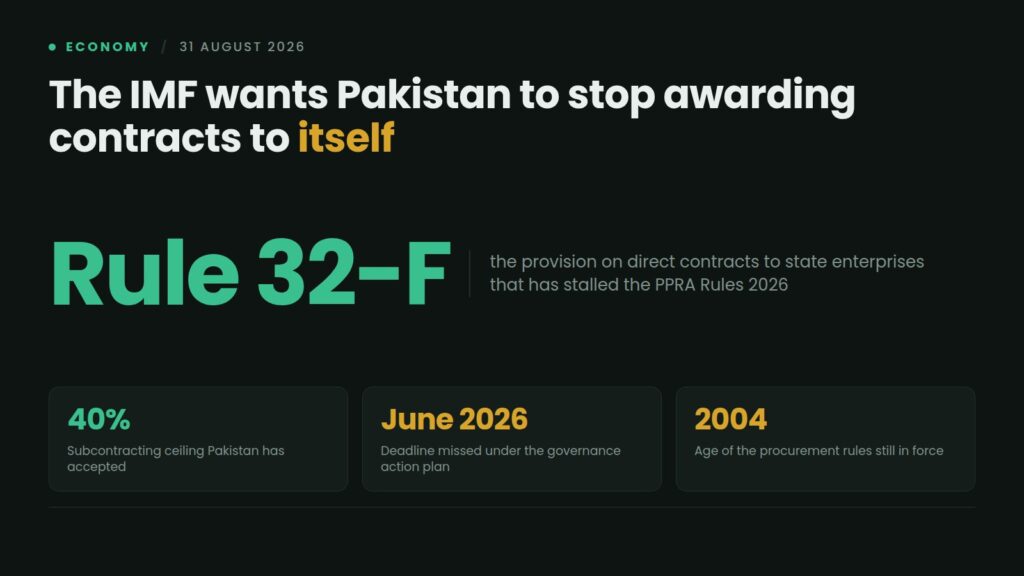
Pakistan’s new procurement rules have been stuck since June over a single provision: whether government bodies may award contracts directly to state-owned enterprises without competitive bidding.
The IMF wants Rule 32-F of the proposed PPRA Rules 2026 confined to exceptional cases — urgent work, or projects that are geographically scattered or remote. Pakistan wants more latitude. The disagreement has held up replacement of procurement rules dating from 2004.
The June deadline, set under the Governance and Corruption Diagnostic Assessment action plan, was missed.
What direct award actually means
Competitive procurement exists to discover a price. Several bidders compete, the process reveals what the work is worth, and the buyer is protected from paying more than the market rate.
Direct award removes that discovery. A ministry hands the contract to a state enterprise at a negotiated price, with no competing bid to test it against. Both parties belong to the same government, which means the cost is a transfer within the public sector — and there is nobody in the transaction with a commercial interest in the price being low.
The defence for it is real in narrow cases. Some work genuinely has no competitive market — remote sites where no private contractor will mobilise, emergency response where a tender takes longer than the situation allows, or specialised capability that exists in only one place. That is exactly the carve-out the IMF has offered.
The dispute is not about whether exceptions should exist. It is about who decides what counts as one.
Where each side has landed
Pakistan has accepted a 40 percent ceiling on subcontracting — a state enterprise receiving a direct award may pass no more than 40 percent of the work to outside firms.
That concession matters more than it sounds. Without a cap, direct award becomes a pass-through: the state enterprise wins the contract, subcontracts nearly all of it to private firms of its choosing, and collects a margin for arranging what a tender would have arranged transparently. Competitive selection is bypassed, and the public pays an intermediary for the privilege.
Two points remain open. Pakistan wants authorities able to adjust financial thresholds over time, which the IMF has not endorsed — a threshold that can be revised upward at official discretion is not much of a threshold. And the IMF wants greater disclosure when direct contracts are approved, which is the cheapest of all the safeguards and the one being resisted.
The telecom industry’s objection
The sharpest domestic criticism came from an unexpected quarter. Telecom operators have argued that awarding government contracts directly to state enterprises risks creating more PIAs.
The comparison is pointed and fair. A state enterprise with a guaranteed pipeline of government work has no competitive pressure to control costs, improve service or invest. It has a captive customer and an implicit guarantee, which is precisely the structure that produced the losses now being unwound through privatisation.
The sector making the argument has standing. Pakistani telecom is one of the few genuinely competitive markets in the economy — three national networks, price-sensitive consumers and no state guarantee behind any of them. Operators competing for private customers watching state enterprises receive contracts without bidding is a legitimate grievance rather than merely a rhetorical one.
Why the IMF is right on the substance
Set the ideology aside and look at what Pakistani procurement has actually produced.
This month alone, the Power Division found coal plants had not been buying from the supplier offering the best contracted discount — a Rs380 million annual leak discovered only because somebody examined the data. The Supreme Court upheld a penalty against an industry association for collective price-setting that went unresolved for seventeen years. Privatisation proceeds for the whole of FY26 came to Rs4.065 billion, a rounding error against Rs23 trillion of expenditure.
None of that describes a system with spare capacity for discretion. Rules from 2004 governing procurement in 2026 need replacing on any view, and the version that gets notified will shape how public money is spent for years.
The cost of the deadlock
While this is unresolved, procurement continues under two-decade-old rules. The status quo is not neutral — it is the older, weaker framework, and every month of disagreement extends it.
It also lands at an awkward moment. Pakistan is heading into a programme review already carrying an FBR revenue shortfall of Rs975 billion, while asking Washington for a $10 billion stabilisation facility and having just been upgraded to B3 by Moody’s on the strength of improved fiscal management.
A missed governance deadline over the right to award contracts without bidding is not the item you want on the agenda in that meeting.
Related: Pakistan Wants a $10 Billion Backstop From Washington. Nobody Has Said the Price.