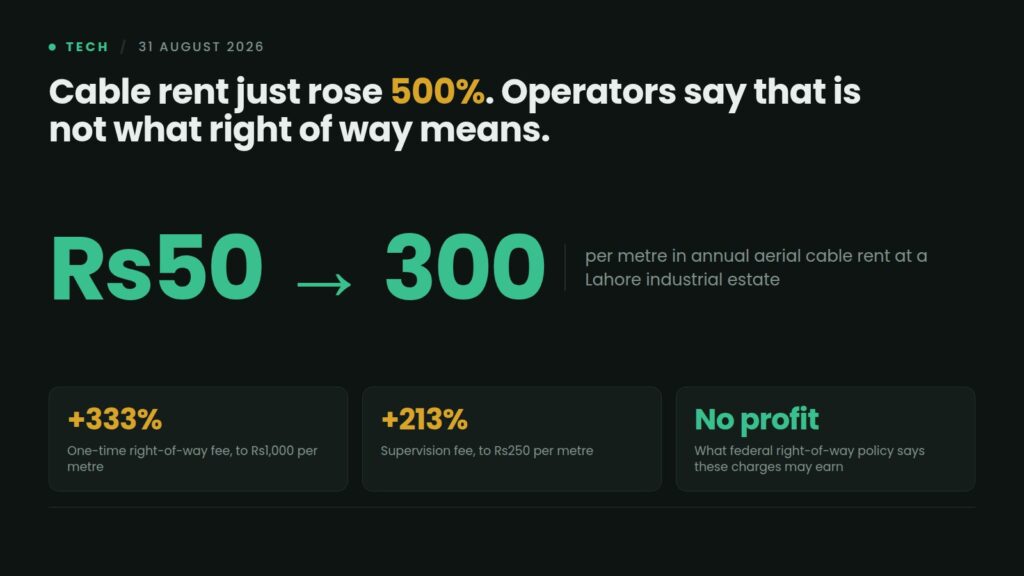
A local authority in Lahore has raised the annual rent on aerial telecom cable from Rs50 to Rs300 per metre — a 500 percent increase.
The underground charges moved with it. Right-of-way fees at Quaid-e-Azam Industrial Estate now run:
- One-time right of way — Rs300 to Rs1,000 per metre, up 333%
- Annual rent — Rs100 to Rs300 per metre, up 200%
- Supervision fee — Rs80 to Rs250 per metre, up 213%
The Pakistan Telecom Access Providers Association has warned that higher infrastructure costs could eventually put pressure on the cost of internet and telecom services.
Why a per-metre charge matters so much
Right-of-way is the permission an operator needs to run cable through land it does not own — along a road, across an industrial estate, under a footpath. Fibre is only useful in continuous lengths, so the charge applies to every metre of the route rather than to a connection or a customer.
The arithmetic scales unpleasantly. A single kilometre of aerial cable at the old rate cost Rs50,000 a year in rent. At the new rate it costs Rs300,000. An operator running twenty kilometres across an industrial estate goes from Rs1 million to Rs6 million annually, before laying a single new strand.
These are recurring costs on infrastructure already in the ground. Nothing about the network changed; the rent did.
The legal argument is the strong one
PTAPA’s objection is not simply that the charges are high. It is that they are unlawful.
The federal Right of Way Policy operates on a no-profit-no-loss principle: a land-owning authority may recover what it costs to administer and supervise the access, and no more. It is a cost-recovery mechanism, not a revenue stream.
A 500 percent increase in one step is difficult to reconcile with cost recovery. Administering a cable route does not become five times more expensive in a year. The operators also point out they are being charged separately for infrastructure they already pay to use through approved electricity pole tariffs — paying twice for the same span.
What this looks like from the outside is a local authority discovering that telecom operators are a captive source of income. They cannot move the cable, they cannot serve customers without the route, and the alternative to paying is switching off.
One estate, or a template
The immediate financial impact is contained. QIE is a single industrial estate, and charges there will not move national broadband pricing by themselves.
The risk is replication. Pakistan has hundreds of bodies that control land telecom cable must cross — industrial estates, cantonment boards, development authorities, municipal corporations, motorway operators. Each sets its own charges. If one raises rates 500 percent and collects, the others are watching a proven revenue model.
That fragmentation is the structural problem. An operator building a national fibre network negotiates separately with every landholder along the route, and a single authority demanding an unreasonable rate can hold up a corridor serving an entire region.
It lands on an industry already squeezed
The timing is poor for a sector the government has just decided needs relief rather than penalties.
Operators bought 5G spectrum in dollars at the March auction and have committed $178.6 million to a rollout that has reached 1.3 million users across 23 cities. They earn in rupees and buy equipment in dollars, which is why coverage economics are harsher here than subscriber numbers suggest. Having imposed Rs3.41 billion in service quality penalties over four years, the government recently ruled out further fines on exactly this reasoning — that money is better spent on networks.
A local authority raising cable rent 500 percent takes back with one hand what federal policy just conceded with the other. Consolidation has left three national networks rather than four, and the merged Telenor-Ufone entity under PTML now sits within a rounding error of Jazz — a market in the middle of an expensive integration is not one with spare margin for new rent.
Who ends up paying
PTAPA’s warning about consumer prices is the standard industry response to any cost increase and should be read with that in mind. Pakistan’s broadband market is competitive enough that operators cannot simply pass costs through; the more likely response to a charge of this kind is to not build.
That is the real cost, and it does not appear on anyone’s bill. Areas where right-of-way is expensive get served later, or not at all — which in a country where large numbers of people still cannot get reliable 4G is the outcome that matters.
The federal policy exists precisely to stop landholders pricing access at what the traffic will bear. Whether it is enforced against a provincial industrial estate is the question this dispute will answer.
Related: Pakistan Has 1.3 Million 5G Users. Plenty of People Still Cannot Get 4G.