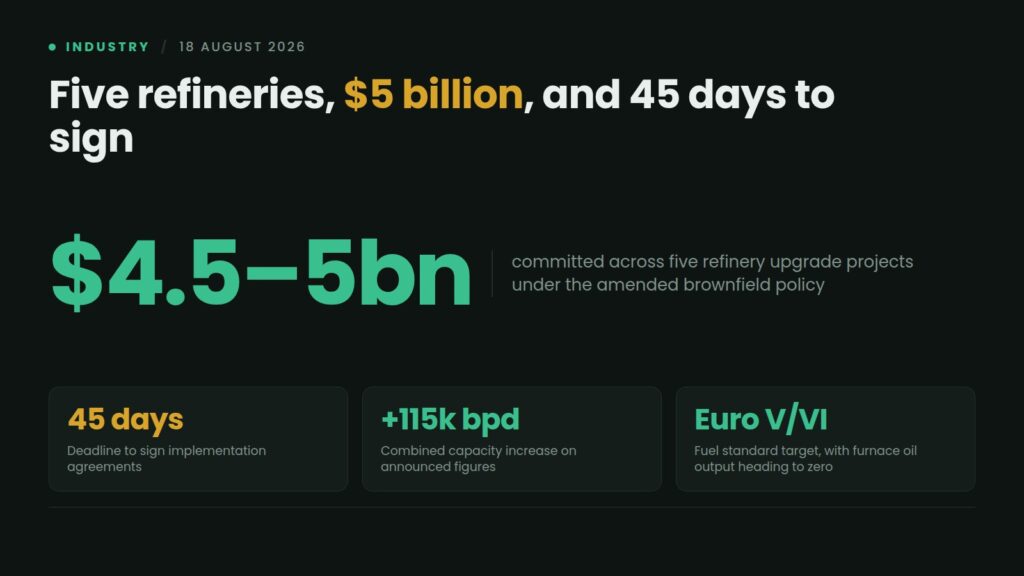
Five Pakistani refineries are committing between $4.5 and $5 billion to upgrade plants that currently produce a fuel almost nobody wants to buy.
Implementation agreements must be signed within 45 days under the amended Brownfield Refineries Upgradation Policy, with a signing ceremony planned with Prime Minister Shehbaz Sharif. After years of a policy that existed on paper and produced nothing, there is now a deadline.
Who is spending what
- Pakistan Refinery Limited — $1.8–$2 billion, bottom-of-barrel project; capacity from 50,000 to 100,000 barrels per day
- Cnergyico Pakistan — $1.2 billion; capacity from 156,000 to around 200,000 bpd
- PARCO — $600 million green fuel project
- Attock Refinery — $600 million upgrade
- National Refinery Limited — $300–$800 million hybrid project; capacity from 50,000 to 70,000 bpd
The stated objectives are the same across all five: eliminate furnace oil production, move to Euro V and VI fuel standards, and increase motor gasoline output. PARCO aims to cut furnace oil from 20 percent of its output to 10–11 percent initially, and eventually to zero.
Why furnace oil is the problem
Pakistan’s refineries were built decades ago around simple distillation, which splits crude into products in fixed proportions determined by chemistry rather than by demand. A meaningful share of every barrel comes out as furnace oil — heavy residual fuel that used to have a guaranteed domestic buyer in the power sector.
That buyer has gone. Pakistan’s generation mix has shifted decisively toward LNG, coal, hydro, nuclear and renewables, and furnace oil plants now run rarely. The refineries kept producing it anyway, because the process gives them no choice.
The result is a structural trap. A refinery must either sell furnace oil into a collapsed domestic market at a loss, export it at a discount, or throttle back overall throughput — which means importing more finished petrol and diesel to cover demand it could otherwise have met. All three outcomes are bad, and there is no operational fix. Only capital equipment that converts the heavy fraction into lighter products resolves it.
The one bright spot in the meantime has been repurposing: petroleum exports hit a record $939 million in FY26, driven largely by very low sulphur fuel oil for the marine bunker market. That is refineries finding a home for output the domestic grid stopped taking — clever adaptation, not a solution.
What the upgrades actually buy the country
Three things, in descending order of certainty.
Fewer imports. Pakistan imports a large volume of finished petrol and diesel because domestic refining cannot meet demand for the products people actually consume. Converting residual output into motor gasoline substitutes domestic production for imported fuel and retains foreign exchange. On the announced numbers, combined capacity rises by roughly 115,000 barrels per day.
Cleaner fuel. Euro V and VI specifications cut sulphur content dramatically. In cities where vehicle emissions are a principal source of particulate pollution, that is a direct public health gain — and one that requires no behaviour change from anyone.
Refineries that survive. Least discussed and most fundamental. A refinery producing an unsellable share of output is not a viable business. Without upgrading, the trajectory ends in closure and complete import dependence for refined product.
The 45-day clock is the news
The reason this has taken years is not that anyone disputed the diagnosis. Everyone agreed refineries needed upgrading. The disagreement was over who pays.
Upgrade projects at this scale need certainty on tariff protection, on the deemed duty arrangement that funds the investment, on pricing formulas and on tax treatment over a payback period measured in decades. Refineries would not commit capital without guarantees; the government would not grant guarantees that lock in consumer costs. The policy was amended, disputed, and amended again while nothing was built.
A 45-day deadline for implementation agreements, with the Prime Minister attending the signing, is the government forcing the question closed. That is genuinely different from previous announcements.
What it does not tell us is what was conceded to get there. The incentive terms are where the public interest sits in this deal — tariff protection is ultimately paid at the pump, and a guarantee generous enough to unlock $5 billion of private capital is a guarantee with a price attached. Nothing published so far sets out what that price is.
What to watch
Signed agreements within 45 days would be the first hard evidence in a decade. Then financial close, which is a separate and harder milestone — $5 billion across five companies requires lenders willing to fund long-dated Pakistani industrial projects, and a signature is not funding.
Watch the ranges too. National Refinery’s figure is quoted between $300 million and $800 million, which is not a costed project. Where each lands within its band will indicate how much of the announced scope is actually committed.
Related: Fuel Dealers Wanted Rs26 a Litre. They Got Rs9.98 — and Called Off the Strike.
One comment
[…] Five Refineries, $5 Billion, 45 Days to Sign. The Target Is Zero Furnace Oil. […]
Comments are closed.