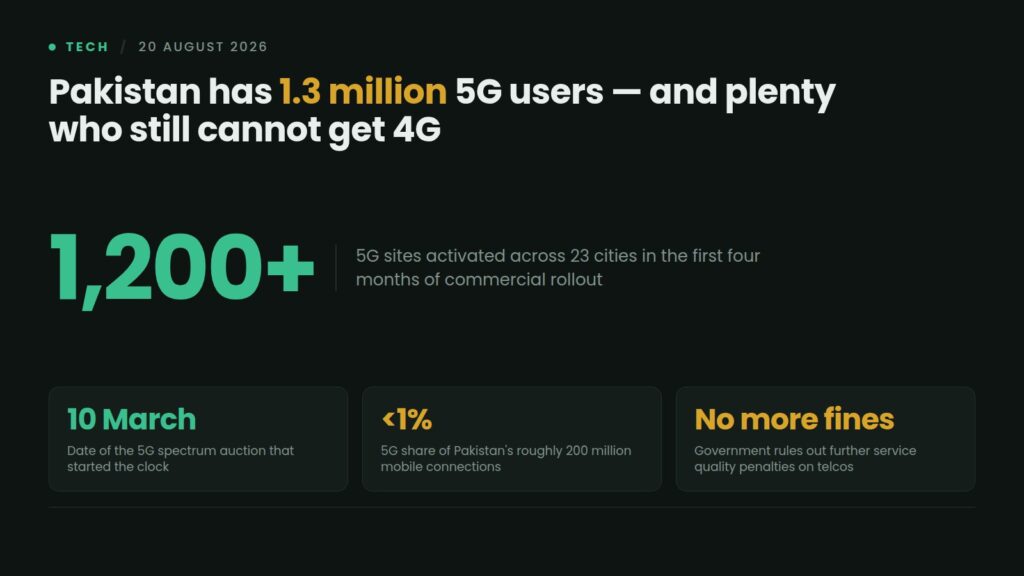
Pakistan has 1.3 million 5G users across 23 cities, served by more than 1,200 activated sites, four months into commercial rollout.
The spectrum was auctioned on 10 March 2026. Getting from allocation to 1,200 live sites in that time is not a slow start by regional standards.
Against Pakistan’s roughly 200 million mobile connections, though, 1.3 million is well under one percent. Reader reaction to the announcement was blunt: people reporting they cannot get consistent 4G where they live.
Both things are true
The complaint and the milestone are not in conflict, and understanding why explains most of what is happening in Pakistani telecom.
5G rollout begins in dense urban cores because that is where the economics work. A 5G site covers a smaller radius than a 4G site at comparable power, so the technology is inherently suited to places with many users per square kilometre. Operators deploy where the revenue per site justifies the equipment.
4G coverage gaps exist in exactly the opposite places — low-density areas where a site serves few subscribers, each generating modest revenue. Those sites do not pay for themselves, which is why they were not built when 4G rolled out and why they are not being built now.
So a customer in an underserved area watching 5G launch in 23 cities is not misreading the situation. Capital is going to the places that already had service. That is rational for the operator and unsatisfying for everyone else.
The regulator just changed its posture
Two things happened this week that belong together.
On Tuesday it emerged that PTA had imposed Rs3.41 billion in penalties on telecom operators over four years for failing service quality standards, alongside 20 warning letters and 86 show cause notices, backed by over 500 quality-of-service surveys.
Days later, the government ruled out further fines on telcos for poor service.
The logic behind the shift is defensible. Every rupee taken in penalties is a rupee not spent on network equipment, and Pakistan needs operators investing in coverage more than it needs the fine revenue. Operators have argued for years that they are being penalised for quality problems partly caused by conditions outside their control — spectrum costs paid in dollars, electricity supply at tower sites, and the taxation of a sector that carries some of the heaviest levies in the economy.
The risk is what replaces enforcement. A regulator that has stopped fining needs another instrument, or service quality obligations become advisory. The stated answer is that recent spectrum auction conditions and revised Next Generation Mobile Services licences already mandate higher quality benchmarks, expanded 4G and 5G rollout obligations, and phased network modernisation.
Licence conditions are in principle stronger than fines — a penalty is a cost of doing business, while a licence obligation is a condition of holding the licence. Whether that proves true depends entirely on enforcement, and the enforcement mechanism is what was just set aside.
What 1.3 million users are actually buying
For most consumers, 5G is a faster version of something that already worked. The applications that genuinely need it — low-latency industrial control, dense sensor deployments, fixed wireless access replacing fibre to the home — are enterprise cases, not phone cases.
Fixed wireless is the one worth watching in Pakistan. Laying fibre to residential buildings is slow and expensive; delivering broadband over 5G to a receiver in the home is neither. In a country where home broadband penetration lags mobile by a wide margin, that is a more consequential use than faster phones.
It also changes the revenue case for a site. A tower serving households as their primary internet connection generates far more than one serving phones alone — which is the mechanism by which 5G economics could eventually reach beyond the 23 cities.
The dollar problem underneath the rollout
There is a currency mismatch at the heart of Pakistani telecom that shapes every deployment decision.
Operators earn in rupees. They buy base stations, antennas and core network equipment in dollars, and they paid for spectrum in dollars — the March auction raised a sum the government booked in foreign currency. Every rupee of depreciation raises the cost of building a site without raising what a subscriber pays to use it.
That mismatch is why coverage economics in Pakistan are harsher than subscriber numbers imply. A site that would be marginally viable at a stable exchange rate becomes unviable when the equipment bill is denominated in a currency the operator cannot earn.
It is also the strongest argument the industry has against penalties, and the reason the government’s decision to step back from fines is more coherent than it first appears.
The number to watch is not subscribers
Subscriber counts in a rollout’s first year measure handset upgrade cycles more than anything else. A user with a 5G phone in a covered area is counted whether or not the service changed their life.
Site count is the honest metric, and 1,200 is the figure to track. So is the geographic distribution of the next 1,200 — whether they densify the same 23 cities or extend to places that have been waiting since 4G.
The spectrum auction raised money the government needed and the rollout has been faster than sceptics expected. Whether it narrows Pakistan’s connectivity divide or widens it is a question the second year answers, not the first.
Related: Pakistan Is Reviewing Eleven Digital Institutions at Once. One of Them Is the Regulator.
One comment
[…] Pakistan Has 1.3 Million 5G Users. Plenty of People Still Cannot Get 4G. […]
Comments are closed.