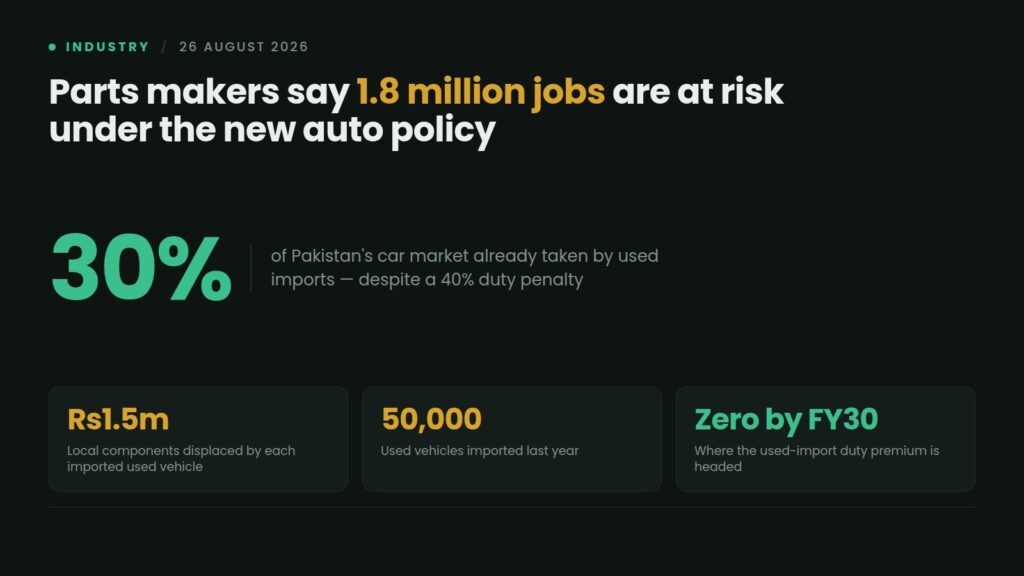
The Pakistan Association of Automotive Parts & Accessories Manufacturers has written to the Prime Minister warning that 1.8 million jobs tied to domestic auto-parts manufacturing are at risk under the Auto Policy 2026-31.
The mechanism PAAPAM describes is specific: every imported used vehicle displaces roughly Rs1.5 million of locally made components.
Industry associations lobbying against import liberalisation is not new, and their numbers usually deserve scrutiny. This one has an arithmetic core worth examining separately from the advocacy.
What is actually changing
Two policy shifts sit behind the warning.
Under the National Tariff Policy 2025-30, the duty premium on used-car imports — currently around 40 percent above the rate applied to new vehicles — is being reduced progressively to zero by FY30. Separately, the 2026-27 budget cut customs duty on new completely-built-up vehicles of 850cc or below to 30 percent.
The immediate dispute is narrower. PAAPAM wants a proposed one-year non-transfer condition retained on vehicles imported under overseas facilitation schemes. Remove it, the association argues, and commercial traders use a channel meant for returning overseas Pakistanis — importing to sell rather than to drive.
That specific point is hard to argue with. A scheme designed to let an individual bring their own car home does not need onward sale in the first year, and a lock-in is the standard way of stopping a personal allowance becoming a trade route.
The numbers, checked
Used-car imports reached an estimated 50,000 units last year — close to 30 percent of the domestic market.
Multiply 50,000 by Rs1.5 million of displaced components and you get roughly Rs75 billion of local parts output not produced. That is a substantial number for the sector and a modest one against national employment, which is where the 1.8 million figure needs care.
1.8 million is almost certainly the total employment associated with auto-parts manufacturing — direct, indirect and induced — not the number of jobs that disappear. Those are different claims. The honest version is that a sector supporting 1.8 million livelihoods faces a shrinking share of a market it currently supplies.
The Rs200 billion “black-money ecosystem” PAAPAM attributes to informal import trade is an estimate from an interested party with no published methodology. It should be treated as an assertion.
The case against the parts makers
The counter-argument is strong and rarely stated as directly as the industry’s case.
Pakistan’s auto sector was built behind tariff walls to substitute imports. Decades later, localisation remains shallow, volumes are small by regional standards, and consumers pay materially more for cars than buyers in comparable markets — with waiting lists and own-money premiums a routine feature. Hybrid prices rose 15.2 percent this month alone, some models adding over Rs2 million.
Protection was granted in exchange for an industry that would eventually compete. That bargain has not been delivered, and the 30 percent share used imports have already captured is the clearest measure of it: buyers are choosing second-hand foreign vehicles over new local ones despite a 40 percent duty penalty.
That is a market verdict on price and quality, not a smuggling problem.
Where the policy is trying to go
The government has been explicit that it wants the sector to shift toward exports rather than serving a protected domestic market, and it has put infrastructure behind that — a 150-acre auto import-refurbishment-export zone approved at Port Qasim this month, targeting $500 million in annual exports.
Tariff reduction is the pressure that is meant to force the adjustment. The logic is that an industry which cannot survive without a 40 percent penalty on its competition will never export, because exporting means competing on cost in someone else’s market.
The risk is sequencing. Removing protection before a sector has the capability to compete does not produce a competitive industry; it produces a smaller one. Parts manufacturers with 1.8 million livelihoods attached are being asked to become internationally competitive on a timeline set by a tariff schedule rather than by their own investment cycle.
What a reasonable answer looks like
PAAPAM’s narrow request — keeping the one-year non-transfer condition — costs the government nothing and closes a channel that was never meant to be a trade route. There is no good reason to refuse it.
Its broader request, that tariff protection be maintained, is the argument that has already been running for thirty years and produced the industry that exists today.
The version that serves everyone is a declining tariff on a published, non-negotiable schedule — so manufacturers can plan against a certain date — paired with support for the capability the sector actually lacks. What it does not need is another extension of the deadline.
Related: Port Qasim Is Getting a 150-Acre Auto Zone. The Target Is $500 Million in Exports.