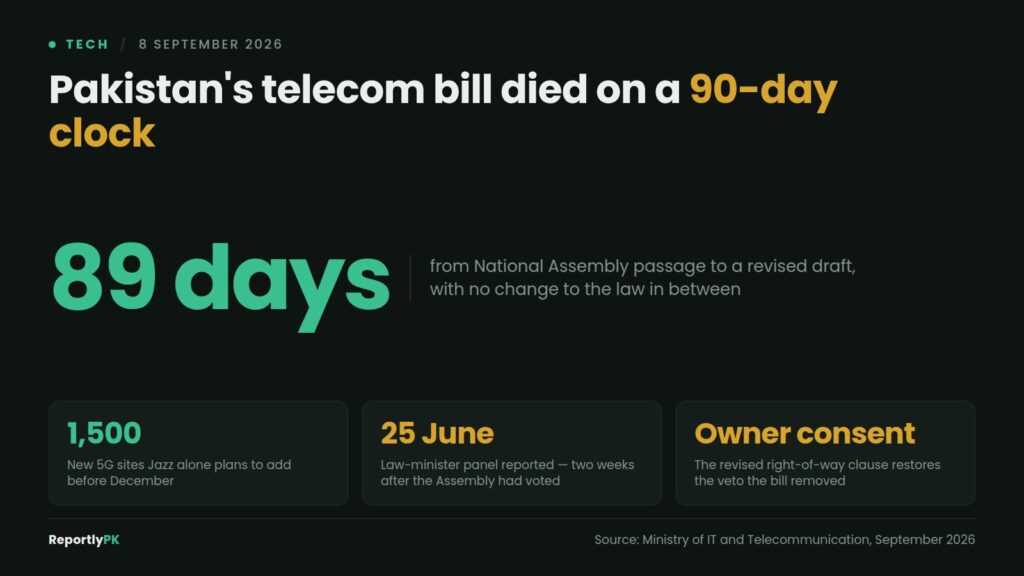
The Pakistan telecom bill meant to settle who may run a fibre cable across private land is back at the drafting stage. On 8 September 2026 the Ministry of IT and Telecommunication confirmed it had prepared a revised draft of the Pakistan Telecommunication (Re-organisation) Amendment Bill, 2026 — eleven days after the government pulled the previous version out of the Senate, and eighty-nine days after the National Assembly had already passed it.
Nothing in the law has changed in those eighty-nine days. What has changed is the language the ministry now hopes will survive a vote. On the central question — whether an operator can build on private property without the owner’s agreement — the revision moves back towards the position the bill was written to move away from.
What the bill was actually for
Right of way is the most tedious cost in Pakistani network construction. Laying fibre or raising a tower means clearing permissions from a cantonment board, a development authority, a housing society, a municipal committee, a highways department, and often the individual owner of the strip of ground the cable crosses. Each sets its own fee and its own timetable. There is no national schedule of charges and no statutory deadline for a decision.
The amendment bill was the attempt to put all of that under one law: a defined process, defined charges and a defined obligation on landholders to allow access. That is exactly what made it valuable to operators and what made it politically dangerous.
The review panel reported two weeks after the vote
The National Assembly passed the bill on 11 June 2026. It reached the Senate on 15 June and was referred to the Standing Committee on IT and Telecom, which objected that the drafting had lumped fundamentally different things together — buried optical fibre and above-ground towers — inside a single clause.
A review committee headed by Law Minister Azam Nazeer Tarar reported on 25 June 2026. Its recommendations were substantive rather than cosmetic:
- Separate the clauses covering optical fibre from those covering towers
- Distinguish explicitly between above-ground and underground infrastructure
- Spell out how the law applies to government-owned property, buildings and cooperative housing societies
- Require owner consent for any use of or access to private property
That sequence is worth stating plainly. The lower house approved the text two weeks before the government’s own legal review concluded the text needed major changes.
A clock ended it, not an argument
The bill was withdrawn from the Senate on 28 August. The reason the ministry gave was procedural, not political: the ninety-day constitutional window for the Senate to act was running out, and a joint sitting of both houses — the mechanism that would have broken the deadlock — was not going to be convened in time. Rather than let it lapse, the government took it back and promised fresh legislation retaining what it called the essence of the original.
The objections were real enough. PTI opposed the bill outright. PPP senator Sherry Rehman said her party would not back IT legislation that had not been thoroughly scrutinised and amended. Allegations circulated that the bill amounted to forced acquisition of private land, which the government denied. But none of that is what killed it. The calendar did.
The revised text gives back what the bill took
The committee’s formulation, as reported, is that no action involving the use of or access to private property may be taken without the owner’s consent and mutual agreement.
Read as a property-rights safeguard, that is unobjectionable. Read as telecom policy, it is close to a restatement of the existing position. The reason right of way is slow in Pakistan is precisely that every affected party holds a veto and can price it. A law that confirms the veto and adds a consultation requirement does not shorten a deployment schedule. It formalises the delay.
There may well be more in the draft than that one clause — a national fee schedule, a statutory decision window, an appeal route to the PTA. Any of those would still be a material improvement. None of it has been published, and the ministry has not said when it will be.
What 1,500 more sites need
The cost of getting this wrong is measurable. On the same day the revised draft surfaced, VEON chief executive Kaan Terzioglu and JazzWorld chief executive Aamir Ibrahim met PTA chairman Major General (r) Hafeez Ur Rehman. Jazz confirmed it has passed 1,000 active 5G sites and intends to be above 2,500 by the end of 2026.
That is more than 1,500 new sites in under four months, from a single operator, and the other networks are building too. Each site needs a location, a power connection, a backhaul link and permission from whoever owns the ground. Whatever regime governs those approvals between now and December, it will not be this bill.
What happens next
The ministry says it will consult coalition partners before reintroducing the revised bill in the National Assembly’s next session. That is a fair reading of the last attempt: the government lost this bill in the Senate because it had not counted the votes there before spending the Assembly’s time.
It also means the sequence restarts — National Assembly, Senate, standing committee, and a fresh ninety-day clock. The realistic outcome is that Pakistan enters 2027 building 5G under the same fragmented right-of-way rules it was building 4G under.
Related: Pakistan Is Reviewing Eleven Digital Institutions at Once. One of Them Is the Regulator.