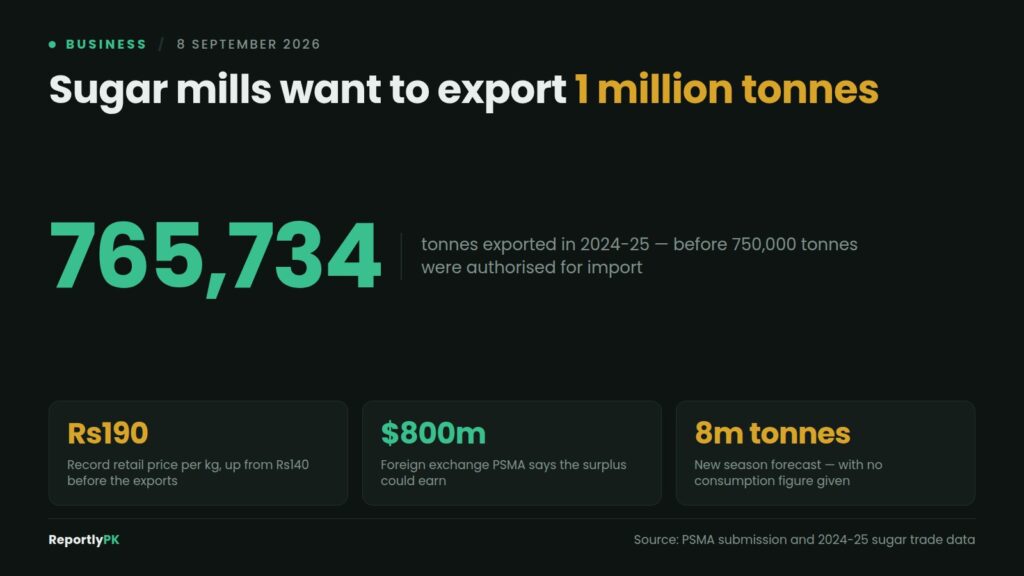
The Pakistan sugar export question is back in front of the government, and the arithmetic that answers it is already on the record. The Pakistan Sugar Mills Association says the industry is holding roughly 1 million tonnes of unsold stock with a new crushing season about two months away, and wants permission to ship the surplus abroad. It puts the foreign exchange on offer at $700 million to $800 million.
Pakistan ran almost exactly this experiment two seasons ago. It is worth looking at what it cost before the same decision is taken again.
What the mills are asking for
The PSMA case is a liquidity case rather than a price case. Mills say capital is locked in unsold inventory while bank markup accrues against it, and that within weeks they must fund plant maintenance, machinery repairs, employee salaries and — the politically sensitive item — payments to growers delivering the new cane crop.
They cite rising sugarcane procurement prices, higher taxes and wages, and dearer imported processing chemicals, against a domestic sugar price they say sits below cost of production. Storage is a constraint too: the new season is projected at around 8 million tonnes, and there is nowhere to put it while last year’s million tonnes is still in the warehouse.
The association says the government has acknowledged the surplus in several meetings but has not decided.
The last time Pakistan did this
In the 2024-25 cycle the government allowed exports on a near-identical surplus argument. Over eleven months of that fiscal year Pakistan shipped out 765,734 tonnes of sugar, earning about Rs114 billion — a rise of roughly 2,200 percent on the previous year.
Then the domestic market tightened. Retail sugar had been near Rs140 per kilogramme before the exports began. The government fixed a price of Rs164 in March 2025, which the market ignored, and by mid-year retail had reached a record Rs190 per kilogramme.
In June 2025 the government authorised the import of 750,000 tonnes — 250,000 tonnes of raw sugar and 500,000 tonnes of refined — while the food security ministry maintained that domestic stocks were sufficient.
The round trip, in numbers
Set the two figures next to each other. Pakistan exported 765,734 tonnes and authorised the import of 750,000 tonnes inside the same fiscal year. Net movement of physical sugar: roughly 16,000 tonnes, on a country-scale balance sheet. Net movement of the retail price: up 36 percent, from Rs140 to Rs190.
The mills received Rs114 billion in export revenue. Consumers paid the higher domestic price. The country bought back what it had sold, in a different market and at a different moment in the global price cycle. Whether the net foreign exchange position improved depends entirely on where the export and import prices landed, and no consolidated accounting of that has been published.
This is the pattern that gets called the sugar merry-go-round, and it is not an accusation of bad faith. It is what happens when a surplus estimate is accepted without a published consumption assumption behind it.
Where the surplus claim is thin
The PSMA submission gives a carryover stock and a production forecast. Together those imply about 9 million tonnes of available supply for the coming year. What it does not give is the consumption number that turns supply into surplus.
That omission matters more than it sounds. A surplus of one million tonnes and a surplus of two hundred thousand tonnes look identical from the mill gate — both are unsold sugar accruing markup — but they justify very different export volumes. The 8 million tonne production figure is also a forecast made before the cane has been crushed, and cane yields in Pakistan have been volatile enough in recent seasons to move an estimate by more than the surplus itself.
The cane price is the actual problem
Strip out the export question and what remains is a margin dispute. Mills say cane procurement costs have risen faster than the sugar price they can realise. Growers, with provincial support prices behind them, say the mills are the ones who have historically underpaid and delayed.
Export permission is being offered as the solution to that squeeze, but it is a transfer rather than a fix. It moves the shortfall onto domestic consumers through a higher price, which is what happened in 2025. A fix would involve the cane support price mechanism, the mill margin formula, or both — neither of which is on the table this month.
What a decision should carry with it
There is a defensible version of this approval. It would state a published consumption estimate and derive the exportable volume from it rather than accepting the industry figure. It would cap the quantity rather than opening the tap. It would set a domestic retail trigger price at which shipments stop automatically, so that the decision does not have to be revisited politically after prices have already moved. And it would commit the mills to a written undertaking on grower payment timelines, since farmer liquidity is the reason being given for the request.
None of those conditions appear in what has been reported so far. The industry is asking for the same permission it received last time, on the same reasoning, and the last time it was granted the country ended the year importing sugar at a record domestic price.
Related: Wheat Rose 87%. A Global Trader Just Built 40,000 Tonnes of Storage in Multan.