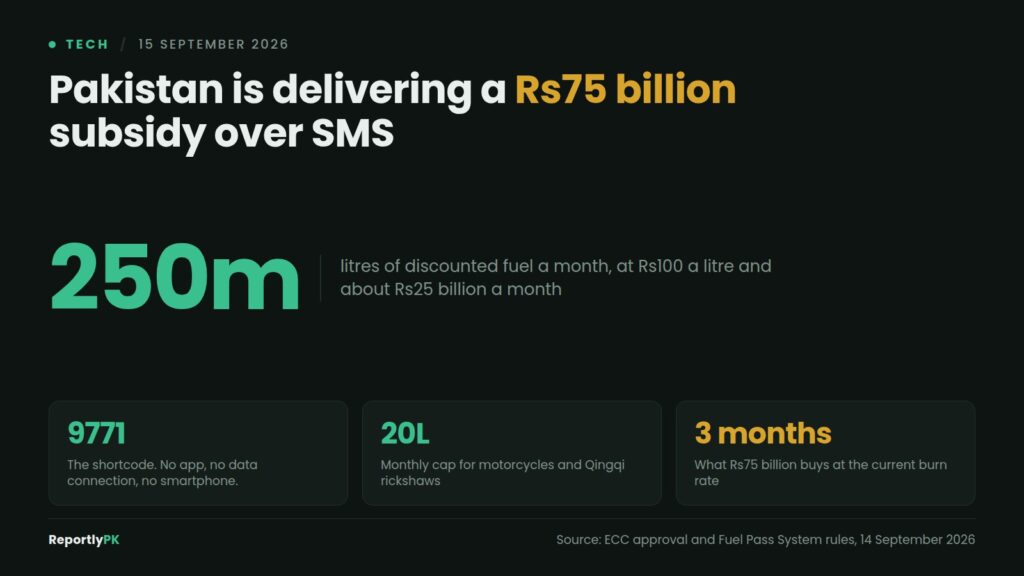
The Fuel Pass System will move Rs75 billion of fuel subsidy to Pakistani motorcyclists and small-car owners without an app, a smartphone or a data connection. Registration and redemption both run through a single SMS shortcode, 9771. The Economic Coordination Committee approved the money on 14 September, and the Ministry of IT and Telecommunication is running the platform.
Pakistan has a long record of building digital delivery systems that assume a phone most beneficiaries do not own. This one does not, and that decision is worth more than it will get credit for.
How it works
Registration is one message sent from a SIM registered in the user’s own name to 9771, in the form REG [CNIC] [plate number] [province code] [registration date]. Province codes are single letters — I, P, S, K, B, A and G. The system verifies the pairing against NADRA records, telecom subscriber data and provincial transport and excise databases.
To buy fuel, the user texts TOK to the same number and receives a unique token to present at the pump. The discount is Rs100 per litre, within monthly caps:
- Motorcycles — 20 litres a month
- Qingqi rickshaws — 20 litres a month
- Cars up to 800cc — 30 litres a month
Eligibility is non-commercial only and limited to one vehicle per person. Islamabad went live at midnight on 14 September; the rest of the country, including Azad Jammu and Kashmir and Gilgit-Baltistan, follows at midnight on 16 September.
Why SMS is the right channel
The target user here is a rickshaw driver or a motorcyclist buying two hundred rupees of petrol at a time. A meaningful share of them are on feature phones, on prepaid connections with no data bundle, in areas with patchy coverage. An Android app with an onboarding flow and a 40MB download would have excluded a large part of the population it was written for.
SMS works on every handset sold in Pakistan, needs no data, degrades gracefully on a weak signal and requires no literacy in app navigation — only the ability to copy a message format. It is the lowest common denominator, and for a subsidy aimed at the bottom of the income distribution the lowest common denominator is the correct engineering target.
The identity binding is also stronger than it appears. Pakistani SIMs are issued against biometric verification tied to a CNIC. Requiring the message to originate from a SIM registered in the applicant’s own name is therefore not a weak assertion of identity — it is a biometric enrolment that already happened, reused at no marginal cost. That is what reusing public digital infrastructure is supposed to look like.
250 million litres a month
The reported monthly spend is about Rs25 billion. At Rs100 a litre of subsidy, that funds 250 million litres of discounted fuel every month.
If every litre went to motorcycles at the 20-litre cap, that is 12.5 million vehicles served. The real number will be lower, because 800cc cars draw 30 litres each. Either way this is a scheme sized for tens of millions of people, and the Rs75 billion approved covers roughly three months at that burn rate.
The published numbers reconcile
Worth checking, because it often does not. The ECC described the benefit as Rs500 a week for two- and three-wheelers and Rs1,000 every ten days for cars up to 800cc. The consumer-facing rules describe litre caps instead.
Rs500 a week at Rs100 a litre is five litres a week, or twenty a month — the motorcycle cap exactly. Rs1,000 every ten days is ten litres per ten days, or thirty a month — the car cap exactly. Two ministries describing the same scheme in different units arrived at the same numbers. That is a small thing and a good sign.
Where it can leak
The weak point is not enrolment. It is the last two feet, between the token on a screen and the fuel in the tank.
A token is a number the user shows to a pump attendant. Nothing in what has been published describes how a token is bound to the specific transaction that consumes it, whether it expires, how the station confirms redemption back to the system, or how issued tokens are reconciled against litres actually dispensed and claimed. Those are the controls that decide whether a fuel subsidy costs Rs75 billion or considerably more.
It is entirely possible the Fuel Pass System has all of this and none of it was reported, because reconciliation logic makes for poor copy. But a scheme spending Rs25 billion a month should publish its control design, not only its registration syntax.
The per-person cap has a softer limit too. One vehicle per CNIC is enforceable; one vehicle per household is not, and a family with four adult CNICs can register four vehicles. That is not fraud. It is simply what per-person targeting means, and the budget should assume it.
What happens in December
Rs75 billion at Rs25 billion a month runs out around mid-December. No duration has been announced, and fuel subsidies are considerably easier to start than to stop — the constituency is created on day one and does not dissolve when the grant does.
One last detail, noted without comment. This scheme explicitly extends to Azad Jammu and Kashmir and Gilgit-Baltistan. Pakistan’s satellite broadband licensing framework, finalised by a different arm of the same state, explicitly excludes them.
Related: Pakistan Is Building a Live View of Every Digital Merchant. Nobody Mentioned the FBR.