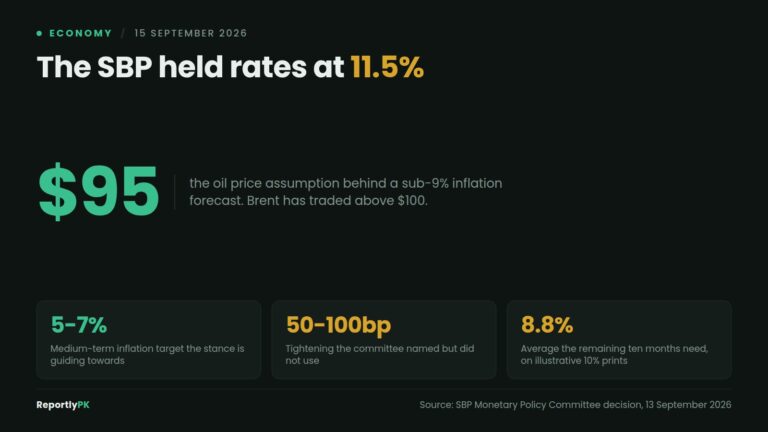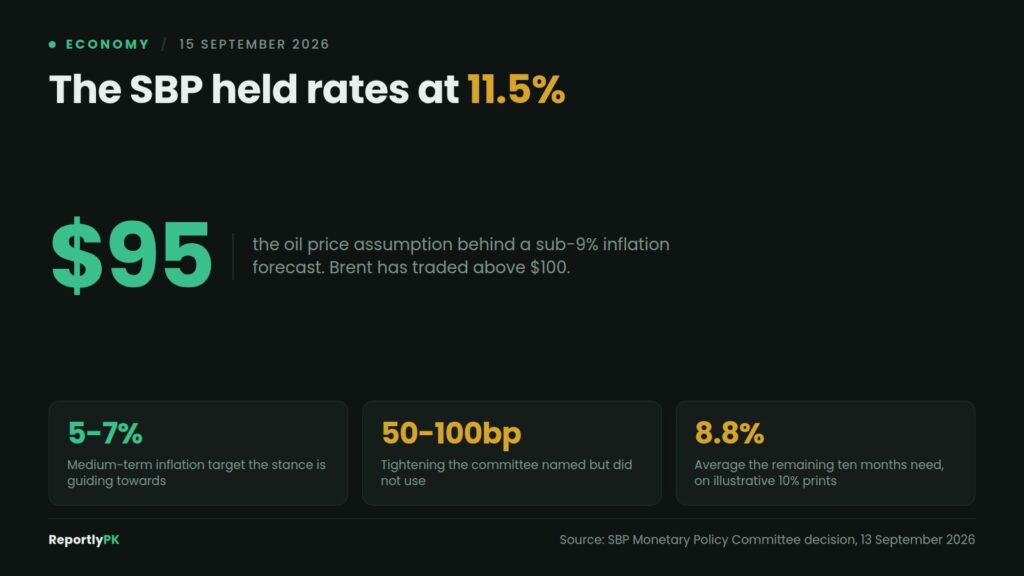
The SBP policy rate stays at 11.5 percent. The Monetary Policy Committee held on 13 September, as the market expected, and said the current stance remains appropriate to guide inflation towards the target range of 5 to 7 percent over the medium term.
The decision is defensible. The forecast underneath it rests on an assumption about the price of oil, and that assumption has already been tested this month.
What the committee is working with
The MPC’s supporting conditions are the external ones. Reserves are improving, the current account is contained, and the $3 billion Eurobond raised earlier this month strengthened the external outlook. Remittances running at $7.3 billion across July and August are part of the same picture.
Against that, the committee identified elevated global oil prices and regional uncertainty as upside risks to inflation, and indicated that a further 50 to 100 basis points of tightening could follow if commodity inflation or geopolitical tension persists.
The forecast has an oil price in it
Analyst projections of a sub-9 percent average inflation rate for FY2026-27 are conditioned on oil at around $95 a barrel.
Brent traded above $100 earlier this month on Middle East tensions. If it stays there, the assumption behind the benign inflation path has already broken, and the 50-to-100-basis-point warning stops being a hypothetical.
This is not a criticism of the forecast. Every central bank conditions its projections on a commodity path and every such path is wrong within weeks. The point is that readers should treat the single-digit number as a statement about oil rather than a statement about Pakistan, because that is what it is.
What a single-digit average requires
Pakistani headline inflation returned to double digits in August. A full-year average below 9 percent is not inconsistent with that — averages absorb spikes — but the arithmetic is tighter than it sounds.
Take an illustrative case. If July and August each printed around 10 percent, those two months contribute 20 points to a twelve-month total that must stay under 108 for the average to sit below 9. That leaves the remaining ten months needing to average under roughly 8.8 percent.
In other words the forecast does not merely require inflation to stop rising. It requires it to fall below current readings and stay there for the rest of the fiscal year, while oil sits above the level the forecast assumed.
A hold that sounds like a hike
Central banks holding rates usually signal patience. This one held while naming a specific tightening range it might use.
That is a hawkish hold, and it is doing work that a rate move would otherwise have to do. By publishing the size of the hike it is contemplating, the committee tightens expectations without tightening policy — borrowers price in the possibility, and the SBP keeps the actual 50 to 100 basis points in reserve for a month when it needs them more. It is a reasonable use of communication, provided the threat is eventually either executed or withdrawn. Repeated indefinitely, it stops being believed.
The subsidy moves inflation into the budget
One development the same week complicates the reading. The Economic Coordination Committee has approved Rs75 billion for a fuel relief scheme paying Rs100 a litre to motorcyclists and small-car owners, at a run rate of about Rs25 billion a month.
A subsidy of that size mechanically softens the fuel component of the consumer price index for the households it reaches. It does not make energy cheaper to import. It moves the cost from the price level to the fiscal accounts.
That makes the single-digit inflation target easier to hit and the deficit harder to hold, and it means the CPI over the next quarter will be measuring a subsidised price rather than a market one. When the Rs75 billion runs out around mid-December, the suppressed increase does not disappear. It arrives.
Where the real rate sits
At 11.5 percent nominal against inflation somewhere near 9 or 10, the real policy rate is positive but thin — somewhere in the range of one and a half to two and a half points.
That is enough to keep rupee savings marginally rational and not much more. It leaves no cushion. An oil-driven surprise of two points on inflation turns the real rate negative without the SBP doing anything at all, which is precisely why the committee named a hike range it has not yet used.
The things to watch are Brent against that $95 assumption, the September CPI print, and whether the fuel scheme is extended past December. The third will tell you more about the inflation path than the second.
Related: Inflation Is Back in Double Digits. Wheat Is Up 87% and Petrol Carries Rs116 in Tax.