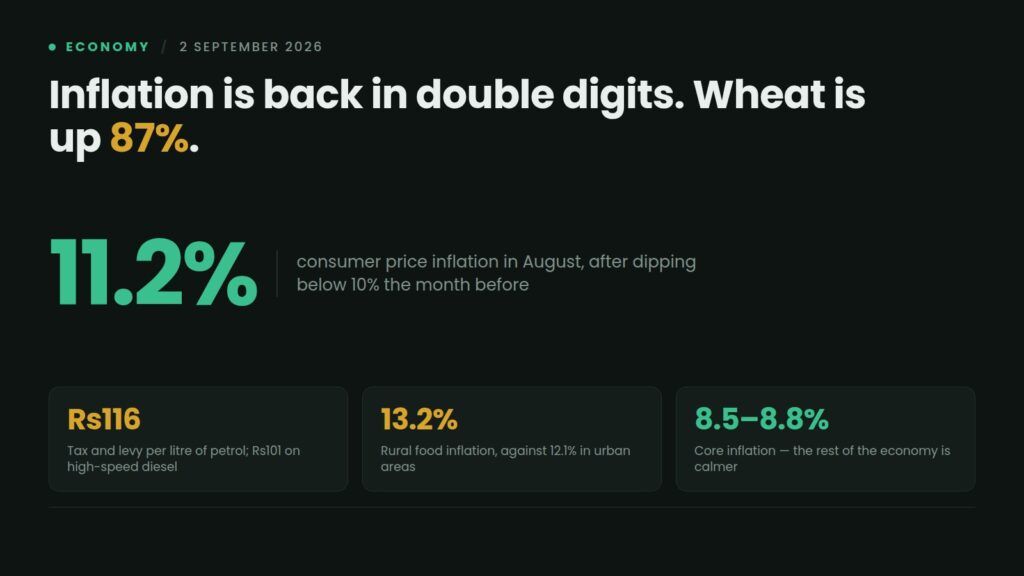
Pakistan’s consumer price index rose to 11.2 percent in August, back into double digits after dipping below 10 percent the month before.
The State Bank’s FY27 target is 5 to 7 percent.
Two items did most of the damage, and both trace back to decisions rather than to markets.
Wheat is the number that should alarm
Wheat prices rose 87 percent against August 2025. Wheat flour rose 73 percent.
Tomatoes and onions moved further — 128 and 125 percent — but vegetable prices in Pakistan swing violently with the season and mean far less than they appear to. Wheat does not behave that way. It is the staple, it is stored, and an 87 percent increase in a year is a structural failure rather than a bad harvest week.
Food inflation is running at 12.1 percent in urban areas and 13.2 percent in rural ones. That gap matters: rural households spend a larger share of income on food and earn less, so the higher rate lands on the people with least capacity to absorb it.
It also sits alongside a set of agricultural stories from the past fortnight that point the same way. Tobacco growers offered Rs350 against an official Rs740 the state cannot enforce. Cotton arrivals at roughly half their 2023 level. The government exporting 108,000 tonnes of sugar it imported the previous year. Pakistan’s agricultural price mechanisms are not producing stable supply.
The fuel component is a policy choice
Motor fuel prices rose 25 percent year-on-year. The composition of that price is the part worth reading closely.
Petrol carries Rs116 per litre in taxes and levies. High-speed diesel carries Rs101 — petroleum levy, carbon levy and customs duty, layered on top of the international price. Diesel in dollar terms is reported to be the most expensive in South Asia.
That is not the world market setting Pakistani prices. It is the world market plus a domestic tax structure, and the tax structure is the larger variable.
The reason is visible in the fiscal accounts. The Petroleum Levy raised Rs1.567 trillion in FY26, beating even its revised target, and the FY27 target has been raised again to Rs1.676 trillion. With the FBR missing its IMF-agreed collection target by Rs975 billion, fuel is where the revenue gap gets closed.
Transport inflation at 20.2 percent is that decision arriving in the index. In a country where almost everything moves by road, diesel tax is a tax on the price of everything.
Core inflation says the rest of the economy is calm
Core inflation — stripping out food and energy — is running at 8.5 to 8.8 percent. Non-food inflation is 9.4 percent urban and 11.3 percent rural.
The gap between core at 8.5 and headline at 11.2 is the whole story. Underlying demand pressure is not what is driving this. Two specific inputs are.
That distinction usually argues against a monetary response, since interest rates do not fix a wheat supply chain or reverse a petroleum levy. But core at 8.8 percent is itself well above the 5 to 7 percent target band, and rural non-food at 11.3 percent suggests fuel costs are already feeding through into everything trucked.
The policy rate stands at 11.5 percent. Falling rates are what produced this year’s credit revival — SME lending past Rs1 trillion, auto loans at a record Rs386 billion, housing approvals up 94 percent. A print like this makes the next cut harder to justify.
What is coming next
August’s number does not yet include what September is carrying.
The petroleum dealers’ margin increase to Rs9.98 per litre takes effect on 1 September. The finance minister has warned that the US-Iran war threatens both growth and inflation, with the Strait of Hormuz carrying roughly a fifth of global oil before the conflict escalated. Diesel crack margins already hit $60 to $70 against low double digits in normal conditions.
And the government has shown what it does when the formula produces an intolerable number: it asked refineries to absorb Rs32.63 a litre rather than let the pass-through stand. That is not a mechanism that survives a sustained shock.
The bill for the deficit
Pakistan closed FY26 with a fiscal deficit of 2.6 percent of GDP, a 22-year low, and was upgraded to B3 by Moody’s on the strength of it.
This is part of what that cost. Cost-recovery pricing and heavy indirect taxation on fuel are how the revenue side was held together while the FBR missed its target — and indirect taxes fall hardest on households that spend most of their income.
A rural household facing 13.2 percent food inflation is paying for the deficit number in a way the deficit number does not show.
Related: The Finance Minister Named the Threat and Raised the Forecast in the Same Speech.