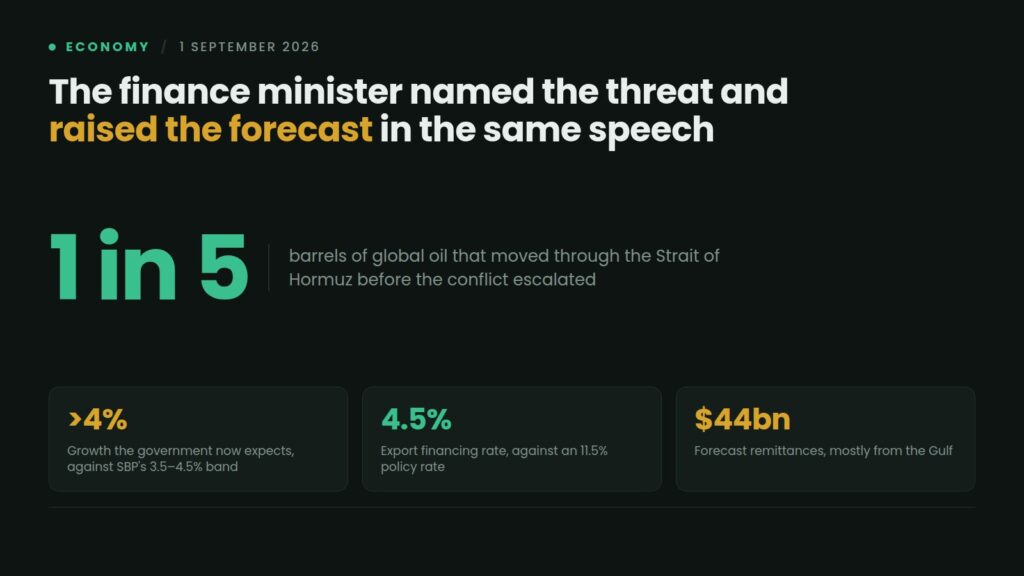
Finance Minister Muhammad Aurangzeb has said Pakistan’s growth and inflation outlook could come under pressure from the US-Iran war, with the Strait of Hormuz blockade threatening energy flows that carried roughly a fifth of global oil supply before the conflict escalated.
He also said the government expects growth above 4 percent this fiscal year.
Both statements were made at the same event, and they are harder to hold together than they sound.
Why Hormuz matters more to Pakistan than to most
Pakistan imports the overwhelming majority of the oil it consumes, and most of it comes from Gulf producers whose exports transit that strait. There is no domestic substitute at scale and no alternative route that does not add cost.
The transmission into the domestic economy is not gradual. Fuel prices in Pakistan are set on a formula that passes through import parity, and the country moves almost everything by road — which means diesel does not stay in the transport line of the inflation index. It sets freight costs, and freight costs set food prices.
That mechanism has already been demonstrated this month. Diesel crack margins reached $60 to $70 against low double digits in normal conditions, and diesel rose Rs72 a litre after the switch to daily pricing before the government negotiated a Rs32.63 reduction directly with refineries.
That episode is the warning. The formula transmitted a genuine global shock, the outcome proved politically intolerable within weeks, and the government resolved it by asking refineries to absorb the difference. A sustained disruption is not something that can be settled by another request.
The second channel nobody mentioned
Oil is the obvious exposure. The larger one is remittances.
Remittances exceeded $41 billion last year and are forecast at $44 billion — more than twice Pakistan’s foreign exchange reserves of $18.4 billion, and roughly twenty times annual foreign direct investment. The external account is financed by them.
That money comes overwhelmingly from Pakistani workers in the Gulf. A regional conflict that disrupts Gulf economies, construction activity or labour demand hits the single largest source of foreign exchange the country has — and it does so through employment decisions taken by foreign employers, which no Pakistani policy can influence.
Rising oil prices cut both ways here, and the net effect is genuinely uncertain. Higher crude revenues can support Gulf spending and labour demand, offsetting some of Pakistan’s import bill. A conflict severe enough to close shipping lanes does not produce that outcome.
The government has just removed the subsidy that kept remittance transfers cheap, leaving banks to absorb roughly $256 million in processing costs with a warning that the charge could reach senders. That is a poorly timed change to make to the channel carrying $44 billion.
What has just been given up
The measures Aurangzeb cited as the growth strategy all reduce revenue or subsidise borrowing:
- Super tax on businesses reduced
- Advance tax provisions eliminated
- Export financing at 4.5 percent against a policy rate of 11.5 percent
The export financing gap is the item to note. Seven percentage points below policy rate is a substantial subsidy, and somebody carries it — either the State Bank through its own balance sheet or the budget through compensation to lenders.
The case for it is reasonable: exports are the structural weakness every assessment identifies, and cheap working capital is a direct lever. Moody’s listed a small export base first among the vulnerabilities keeping Pakistan seven notches below investment grade.
The difficulty is fiscal room. The FBR missed its IMF-agreed target by Rs975 billion in FY26. Cutting business taxes into that shortfall, ahead of a programme review, requires the growth to actually materialise.
The buffer that has just been asked for
There is a piece of context that makes the timing of this warning legible.
Pakistan has asked Washington for a $10 billion Bilateral Exchange Stabilisation Support Facility, with maturity of up to five years, and expects a reply within weeks. Officials have framed it as a confidence signal rather than a loan — a backstop that changes how markets price the rupee without necessarily being drawn.
An external shock originating in the Gulf is precisely the scenario such a facility is designed for, and naming that shock publicly while the request sits with the US Treasury is not accidental. A country asking for a backstop has an interest in explaining what it would protect against.
That does not make the risk less real. Hormuz carries a fifth of global oil, Pakistan imports nearly all of what it burns, and reserves stand at $18.4 billion. It does mean the warning is doing diplomatic work alongside the economic assessment.
Above 4 percent is the optimistic reading
The State Bank’s own FY27 forecast is 3.5 to 4.5 percent, against 3.7 percent delivered in FY26. Aurangzeb’s “above 4 percent” sits at the upper end of the central bank’s band.
A finance minister forecasting more optimistically than his central bank is unremarkable. Doing it while naming an external shock as a threat to the same forecast is the part worth marking.
Even 4.5 percent falls short of what Pakistan’s demographics require. Population growth of around 2 percent a year, with the labour force expanding faster, means absorbing new workers rather than merely holding employment needs growth in the 6 to 7 percent range.
The diversification argument — that Pakistan must widen its export base across products, services and markets — is correct and has been the correct answer for two decades. A conflict in the Gulf is a reminder of why concentration is dangerous, not a reason it went unaddressed.
Related: The State Bank Expects 3.5–4.5% Growth in FY27. Pakistan Already Did 3.7%.