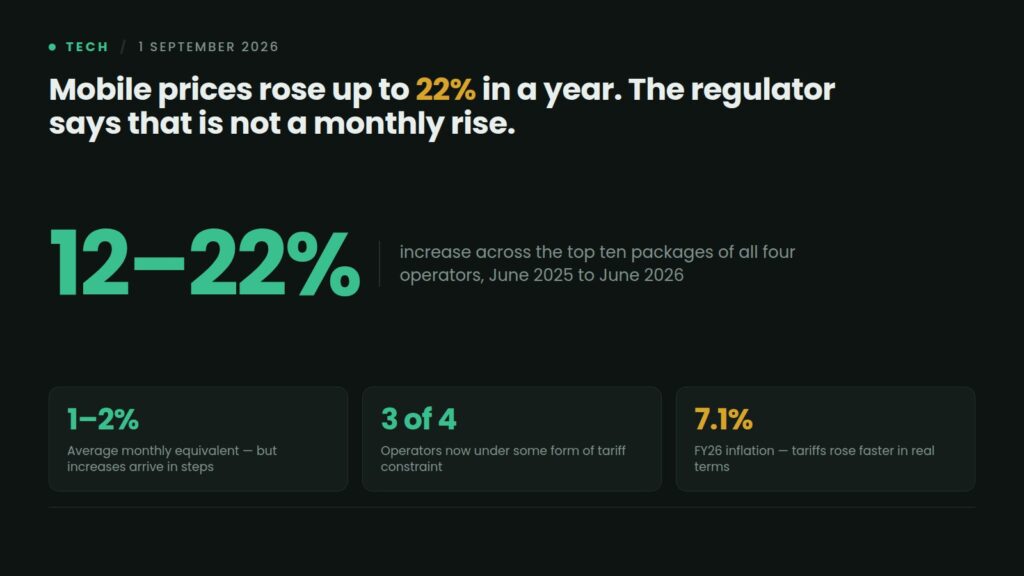
Mobile tariffs in Pakistan rose between 12 and 22 percent over the twelve months to June 2026, across the top ten packages of all four operators. The government confirmed it in a written reply to the Senate.
The reply also contained a rebuttal. Responding to complaints of far steeper rises, the PTA stated there is no evidence of 10 to 20 percent monthly increases by the companies.
Both statements are true, and the gap between them is where the consumer complaint actually lives.
Why it feels worse than 22 percent
Spread across a year, 12 to 22 percent works out to roughly one to two percent a month. Nobody notices a two percent move in a monthly bundle.
That is not how the increases arrive. Operators do not raise prices by two percent every month; they repackage. A bundle is withdrawn and replaced by one at a higher price, or with less data at the same price, or with a shorter validity period. The customer meets the whole year’s increase in a single step at the moment their usual package disappears.
An annual average is the right way to measure a market and the wrong way to describe an experience. Both the complaint and the PTA’s rebuttal are accurate descriptions of the same thing.
The reduction in bundle value is also invisible in a price series. A package that costs the same but carries less data has risen in price per gigabyte without appearing in any tariff comparison.
Not every operator is equally free
The regulatory position varies by operator, and it explains a good deal about what happens next.
- Jazz is designated a Significant Market Power operator and faces stricter tariff oversight
- Telenor and Ufone are regulated under the November 2025 merger order that permitted their combination
- Zong, as a non-SMP operator, sets tariffs on commercial judgement
Three of the four now operate under some form of price constraint, and only one is fully free. That is an unusual structure, and it follows directly from consolidation — conditions were attached to the merger precisely because reducing four networks to three raises the risk of firmer pricing.
Telenor and Ufone are now one operator under PTML, sitting at a combined 36.03 percent of the market against Jazz’s 36.09 percent. Pakistan has two operators of near-identical scale and one challenger, where it recently had four competitors.
What is pushing costs up
The government reply lists what the PTA weighs when approving tariffs — consumer interests, inflation, prevailing economic conditions and market competition — without setting out what drove this particular rise. The cost side is not hard to identify.
Operators earn rupees and buy in dollars. Spectrum from the March auction, base stations, core network equipment and international bandwidth are all dollar-denominated, and every rupee of depreciation raises the cost of running the network without raising what a subscriber pays.
They have also committed $178.6 million to a 5G rollout that has reached 1.3 million users across 23 cities on more than 1,200 sites. That is capital spent now against revenue that arrives later.
And the input costs keep arriving. Annual aerial cable rent at one Lahore industrial estate rose 500 percent this month, from Rs50 to Rs300 per metre, with the operators’ association arguing the charge breaches federal cost-recovery policy.
Against what people earn
Pakistan has had some of the cheapest mobile data in the world, and that is the context in which a 22 percent rise has to be judged. Prices increasing from a very low base is not the same as prices becoming expensive.
It is also true that a mobile package is not discretionary spending for most users. It is how people bank, receive remittances, find work and reach government services — 92 percent of Pakistan’s 3.7 billion quarterly retail transactions now run through digital channels, and every one of them needs connectivity.
Inflation averaged 7.1 percent in FY26. Tariffs rising 12 to 22 percent means mobile service got more expensive in real terms, in the same year the state made digital access a condition of participating in the formal economy.
The instrument the regulator lost
There is one more thing worth putting alongside this. The PTA imposed Rs3.41 billion in service quality penalties on operators over four years. The government has since ruled out further fines, on the reasoning that money is better spent on networks than on penalties.
That is a defensible trade. It also means consumers are now paying 12 to 22 percent more for a service whose quality the regulator has stopped penalising, with licence conditions rather than fines as the remaining enforcement route.
Higher prices in exchange for better coverage is a reasonable bargain. It only holds if the coverage arrives.
Related: Jazz Leads Pakistan’s Mobile Market by 0.06 Points. The Merger Did That.