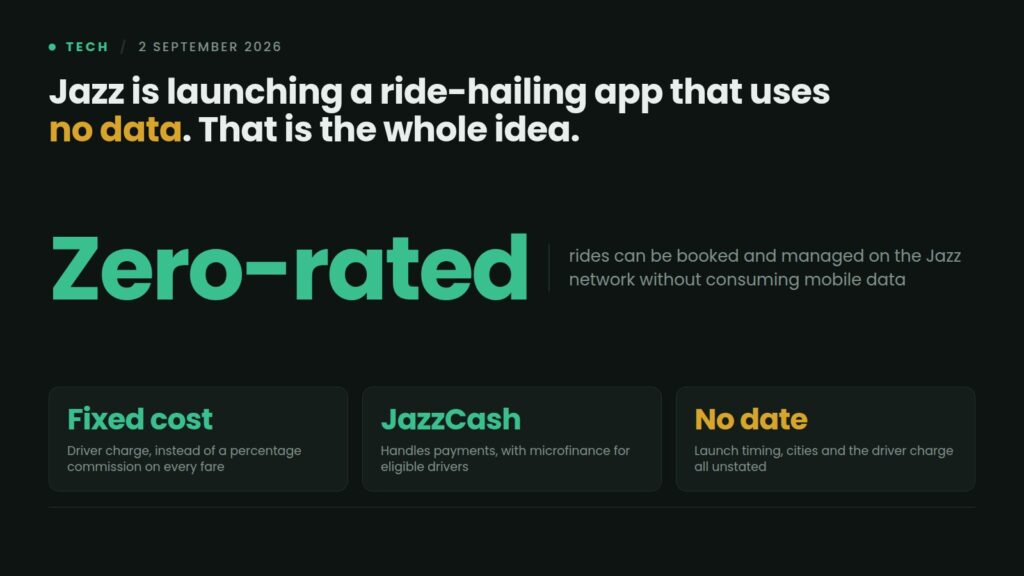
Jazz and iTecknologi are launching Drivver, a ride-hailing platform covering cars, motorcycles and rickshaws, with one feature that is genuinely unusual: rides can be booked and managed on the Jazz network without consuming mobile data.
Drivers will pay a fixed cost rather than a percentage commission, and JazzCash handles payments.
Ride-hailing in Pakistan is a graveyard. Both of those design choices are aimed squarely at why.
Zero-rating is the real product
A driver working a twelve-hour shift keeps a ride-hailing app open the entire time — location streaming, ride offers, maps, status updates. That is a continuous data cost paid out of the driver’s own earnings, every day, whether or not rides come through.
For a rickshaw driver working on thin margins, it is a meaningful line item. Zero-rating removes it entirely.
Passengers benefit too, and the timing is pointed: mobile tariffs rose 12 to 22 percent in the year to June 2026 across all four operators. An app that does not consume data is worth more this year than it was last year.
This is an advantage only a telecom operator can offer, and it is the same logic behind Zong putting a bank inside its own app with Z-Wallet last month. Operators have worked out that the valuable asset is not the app — it is control of the pipe the app runs on.
The commission model is the other bet
Percentage commission is the standard ride-hailing structure worldwide and the standard source of driver grievance. A platform taking a fifth to a quarter of every fare takes more as the driver works harder, and the driver sees the deduction on every trip.
A fixed cost inverts that. The driver pays a set amount and keeps everything above it, so incremental volume is entirely theirs. It is closer to a taxi rental than to a marketplace fee, and in a market where drivers routinely run several apps and switch on economics alone, it is the sharpest available recruiting tool.
It also transfers risk. A percentage commission earns the platform nothing on a slow day; a fixed charge is owed regardless. Drivers on a quiet week end up paying a larger effective share of a smaller income. Whether that holds through a downturn is the question the model has not yet been asked.
Why this market has eaten its predecessors
Pakistan’s consumer internet has already run this experiment.
Careem did the genuinely hard work — normalising app-based mobility in a cash economy where nobody had used one — and exited ride-hailing anyway. Airlift raised heavily, scaled a capital-intensive model and shut down when funding tightened. inDrive is growing and Yango has entered, both arriving after somebody else paid for category creation.
The pattern is consistent: the companies that spent to build the habit largely did not survive to monetise it.
Drivver enters after that work is done, with distribution it does not have to buy and a cost structure competitors cannot match. That is the strongest position anyone has started from in this market.
Where the money is meant to come from
Not rides. iTecknologi’s chief executive says the platform is not being built as another ride-hailing application, and the financial layer explains what he means.
JazzCash processes the payments. Eligible drivers get access to microfinance products. That is the same structure now visible across Pakistani telecom: transaction services acquire the customer at near-zero cost, and lending pays for everything.
A ride-hailing platform is an unusually good lender. It knows exactly how much a driver earns, how consistently they work and whether they show up — a credit signal for people no bureau has ever scored, verified daily by the platform’s own data.
That is the opportunity and the concern in the same sentence. Nano lending done well brings first-time borrowers into formal credit. Done badly it produces high effective rates on short tenors, extended to drivers whose earnings the lender controls the flow of.
What is missing
No launch date beyond “the near future”. No cities. No fare structure, and no figure for what the fixed driver cost actually is — which is the number the entire driver proposition rests on.
There is also a question the announcement does not address. Zero-rating gives an advantage to users on one network, in a market where Jazz holds 36.09 percent and the merged PTML entity sits at 36.03 percent. A service that works better depending on which SIM the driver carries is a competitive weapon, and regulators elsewhere have taken an interest in exactly that arrangement.
Careem proved Pakistanis will use these apps. Nobody has yet proved somebody can make money doing it. A platform that does not pay for data, does not pay for customer acquisition and earns from lending is the most credible attempt so far.
Related: Zong Just Put a Bank Inside Its Own App. 22 Million Users Are Already There.