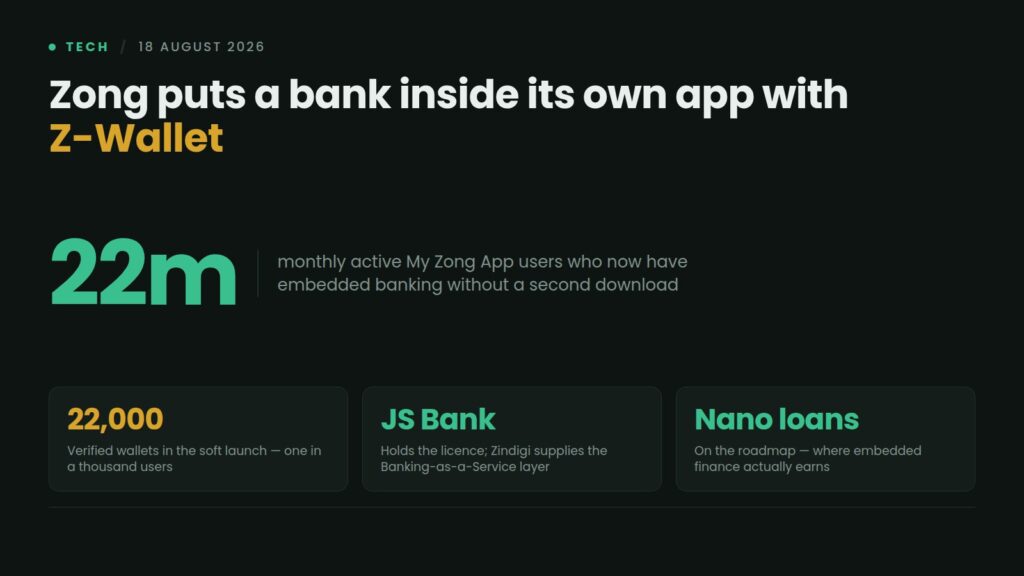
Zong has put a bank inside its own app. Z-Wallet, built with Zindigi and powered by JS Bank, launches inside the My Zong App — which reports more than 22 million monthly active users and around 500,000 new downloads a month.
No separate banking app to download. No second login. Interbank transfers over Raast, utility and internet bills, mobile top-ups — all behind a single login and PIN, inside an app the customer already opens to check their balance.
The soft launch produced roughly 22,000 verified wallets and over 12,000 transactions in a few weeks. Those are small numbers. The distribution behind them is not.
The problem this actually solves
Pakistan’s financial inclusion numbers have improved dramatically — roughly 132 million mobile banking and wallet registrations, about half of all bank accounts linked to an app or wallet, and Raast moving trillions of rupees a quarter.
The stubborn part has never been building the rails. It has been getting an app onto a phone and getting it used.
Every step in the traditional funnel loses people: find the bank’s app, download it on a phone with limited storage over an expensive data connection, complete onboarding, remember a separate password, and then have a reason to open it again next month. For a user whose relationship with formal finance is thin to begin with, each of those is a real point of failure.
Embedded finance removes the funnel rather than optimising it. The customer is already in the app, already authenticated, already opening it monthly to top up. Adding a wallet inside that habit skips acquisition entirely — which is the single most expensive line in retail banking.
Who is actually doing what
The structure matters, because the regulatory boundary is where these arrangements either work or come apart.
Zong is a telecom operator. It cannot hold customer deposits, and it is not attempting to. Zindigi supplies Banking-as-a-Service infrastructure under JS Bank’s licence and within the State Bank’s regulatory framework. The money sits with a licensed bank; the telco supplies the customer relationship and the screen.
That split is the sound version of this model. Zindigi co-founder Noman Azhar described it as embedded finance at scale, putting financial services directly into the customer journey — which is accurate as far as it goes, though the interesting question is what happens to margins when the party owning the customer is not the party holding the licence.
For JS Bank the trade is deposits and transaction volume it would not otherwise reach, in exchange for surrendering the customer-facing brand. For Zong it is a way to make a commoditised telecom app stickier without becoming a regulated institution.
Where the money is
Bill payments and top-ups do not generate meaningful revenue. Raast transfers are free at the point of use by design. On the launch feature set, Z-Wallet is a cost centre.
The roadmap says where this is going: nano lending, a Z-Debit Card, and Zong-specific bundles.
Nano lending is the line to watch. Small, short-duration loans to customers with no credit history are unlendable by conventional underwriting — unless the lender has an alternative signal. A telco has one of the best available: years of top-up frequency, recharge amounts, payment regularity and handset data. It is a genuine credit signal for people no bureau has ever scored.
This is how the model works elsewhere: transaction services acquire the customer at near-zero cost, and lending pays for everything. It is also where the risk sits, in both directions. Nano lending done well brings first-time borrowers into formal credit. Done badly it produces high effective rates on very short tenors, extended to people with no track record and limited ability to compare terms.
Every operator will now have to answer this
Zong is not the first Pakistani telco to reach into financial services — mobile wallets attached to operators have existed here for over a decade, and one of them substantially defined the category.
What is different is the direction of travel. The earlier generation built standalone wallet brands and then spent heavily persuading customers to adopt them as separate products. Z-Wallet inverts that: no new brand to establish, no new app to install, no acquisition spend — the financial service is a feature of something the customer already uses.
For a rival operator, that is an uncomfortable comparison. If embedded distribution converts at any meaningful rate, matching it does not require building a bank — only a partnership with one holding a licence and a Banking-as-a-Service layer. The barrier to entry is now a commercial agreement rather than a capital raise.
Twenty-two thousand against twenty-two million
The gap between the soft-launch number and the addressable base is the whole story.
22,000 wallets out of 22 million monthly actives is a conversion of about one in a thousand. That is what a controlled rollout should look like, and reading it as either success or failure this early would be wrong.
The number worth tracking is not wallets opened but wallets used in month three. Onboarding a customer who is already inside your app is easy; the barrier that made it easy also makes the signup low-intent. Pakistan’s wallet sector has a long history of registered accounts that transacted once.
If Zong converts even a small percentage of 22 million into genuinely active wallets, it becomes a significant financial institution by user count without ever having been licensed as one. If the other operators follow — and on this logic they will — Pakistan ends up with retail financial distribution controlled by telecom companies and the balance sheets held by banks that customers never see.
That is a reasonable outcome for financial inclusion. It is a more complicated one for the regulator, whose supervisory relationship is with an institution that no longer owns the customer.
Related: Pakistan Wants to Tokenise Real Estate. The Land Records Aren’t Ready.

One comment
[…] Related: Zong Just Put a Bank Inside Its Own App. 22 Million Users Are Already There. […]
Comments are closed.