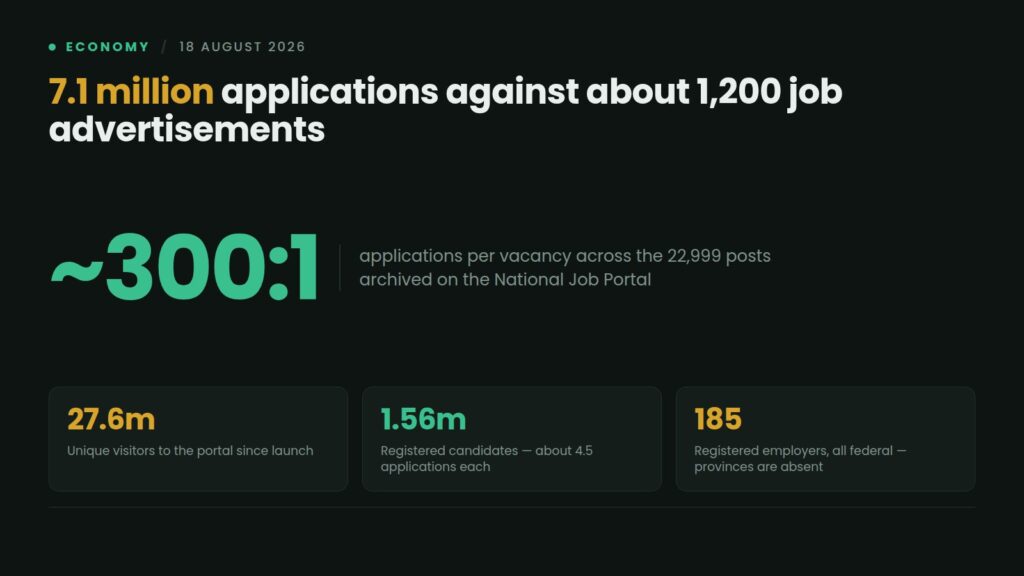
Pakistan’s National Job Portal has received 7.1 million applications against roughly 1,200 job advertisements.
That works out to about 5,900 applications per advertisement. The portal has drawn 27.566 million unique visitors and registered 1.562 million candidates, against 185 registered employers.
The figure is being reported as evidence the platform works. It is better read as a measurement of something else.
What the ratio does and does not say
One caveat first, because the headline arithmetic is looser than it looks.
A job advertisement is not a job. A single government advertisement routinely covers multiple posts — twenty clerks, forty constables, a dozen junior engineers. The portal separately reports 22,999 vacancies archived since launch, which on the same 7.1 million applications gives a ratio closer to 300 applications per vacancy.
Three hundred to one is the more defensible number, and it is still extraordinary. A private employer receiving 300 applications for one position would consider the response overwhelming. This is the entire federal government’s recruitment pipeline running at that intensity continuously.
Applications also are not applicants. Against 1.562 million registered candidates and 7.1 million applications, the average registered user has applied to roughly four and a half positions. That pattern — people applying to everything they are plausibly eligible for — is itself the signal. It is what a labour market looks like when candidates do not expect any single application to succeed.
Why government, specifically
The volume is not really a statement about how many people want work. It is a statement about what kind of work is worth queuing for.
A federal government post in Pakistan carries things the private labour market largely does not offer: tenure that survives an economic downturn, a pension, medical cover, and an income that does not depend on whether an employer’s order book holds. After three years in which real incomes were compressed by inflation running in the high twenties, and in a formal private sector that employs a small fraction of the workforce, that package is not merely attractive. For most applicants it is the only version of secure employment available.
The 27.5 million unique visitors is the number that should give pause. That is a substantial share of Pakistan’s working-age population passing through a single federal recruitment portal.
The demographics behind it
This connects directly to the growth arithmetic the State Bank published last week.
Pakistan grew 3.7 percent in FY26 and is forecast at 3.5 to 4.5 percent for FY27. Population is expanding at roughly 2 percent a year and the labour force faster still, as a large young cohort reaches working age. Absorbing new entrants — not merely holding existing employment — is generally reckoned to need growth in the 6 to 7 percent range.
Seven million applications is what the gap between those two numbers looks like from the applicant’s side. Every year the economy grows below the rate that absorbs new workers, the queue lengthens — and the queue does not reset. Last year’s unsuccessful applicants are in this year’s numbers.
The portal itself is a real improvement
None of this is a criticism of the platform, which was built by the National Information Technology Board and does something genuinely useful.
Before a central portal, federal recruitment ran through fragmented departmental processes: vacancies advertised in individual newspapers, applications submitted physically or by post, fees paid at bank counters, and no way for a candidate in a smaller city to know what had been advertised elsewhere. That system quietly favoured applicants who lived near the capital or knew someone who did.
A single searchable portal removes the geographic filter. Part of the seven million is people who would previously never have seen the advertisement — which is the platform succeeding, not the labour market deteriorating.
The 185 registered employers against nearly 23,000 archived vacancies suggests coverage of federal bodies is now reasonably broad. Whether provincial governments — which employ far more people — join is the obvious next question, and nothing indicates they will.
The data nobody is publishing
The portal is sitting on the most detailed picture of Pakistani labour supply that has ever existed, and none of it has been released.
Its database knows the qualifications of 1.5 million job seekers, where they live, what they studied, what they are willing to do and what they will accept being paid. That is the evidence base for deciding which degrees produce unemployable graduates, which districts have skills the economy is not using, and where vocational training would actually pay.
Pakistan’s labour force statistics are otherwise assembled from periodic surveys with long lags. Here is a live, self-reported dataset covering a meaningful share of the educated workforce, and the only figure released from it is a headline about application volume.
Publishing an anonymised breakdown — qualifications, districts, age bands, applied-for grades — would cost nothing and would tell the country more about its employment problem than another quarterly growth estimate. That it has not been done is the most striking thing in this story.
Related: The State Bank Expects 3.5–4.5% Growth in FY27. Pakistan Already Did 3.7%.