Finance Minister Muhammad Aurangzeb met Pakistan Digital Authority chairperson Dr Sohail Munir on 13 August to discuss, among other things, an enabling framework for digital assets and asset tokenisation — starting with real estate.
Tokenisation means representing ownership of an asset as a transferable digital record. Applied to property, the pitch is compelling in a country like Pakistan: split a plot into fractional units, let people buy a share rather than a whole file, settle transfers in minutes instead of months, and open the largest store of household wealth in the country to investors who could never afford a full ticket.
Pakistani real estate is estimated to hold the bulk of national household savings, and it is almost entirely illiquid. On paper, few markets need this more.
There is a problem, and it is not a technical one.
A token is only as good as the title behind it
Tokenisation does not create ownership. It represents it. The digital record points at a legal claim that exists somewhere else — in a land registry.
In Pakistan, land records sit with the provinces, in systems of widely varying quality. Punjab and Sindh have digitised meaningful portions of their revenue records; coverage elsewhere is thinner, urban and rural regimes differ, and cantonment, cooperative housing society and development authority land each run on separate documentation. Title disputes are common enough that buyers routinely commission private verification before purchase, and litigation over land is one of the heaviest categories on Pakistani court dockets.
Put a blockchain on top of that and you get a fast, immutable, fractionalised record of a claim that may still be contested in a civil court for the next decade. The technology does not resolve the dispute. It distributes it — across every holder of a token.
The jurisdictions where property tokenisation has actually worked share one feature: authoritative, government-backed title registries where the state guarantees who owns what. Pakistan has not finished building that layer. Tokenisation is a settlement upgrade; the missing piece is the source of truth it settles against.
Who would regulate it is also unsettled
A tokenised property interest is a novel object in Pakistani law, and it lands in several regulators’ territory at once.
If it is a security, it belongs to the SECP. If it is a payment or settlement instrument, the State Bank has a claim. Following the passage of the Virtual Assets Act in 2026 and the establishment of the Pakistan Virtual Assets Regulatory Authority (PVARA) — which has been reported to require prior approval for virtual asset pilots and partnerships — there is now a third body with jurisdiction over digital asset activity. Land itself remains provincial.
Four overlapping authorities and one asset class is a recipe for a framework that takes years, or one that ships with gaps wide enough to matter. The meeting produced no timeline, no consultation paper and no named lead regulator — which is a fair signal of how early this is.
The rest of the agenda is more immediately useful
Tokenisation was the eye-catching item. The other things discussed are closer to shipping and would move more money.
The meeting covered simplifying customer onboarding, strengthening data-sharing across financial institutions, improving interoperability between banks and capital markets, and streamlining account opening to widen participation in the capital market.
That last point addresses a real constriction. Pakistan has tens of millions of active bank and wallet users and a stock market with a retail investor base measured in the low hundreds of thousands. The bottleneck is not appetite; it is the friction of opening and funding a brokerage account. Making that a few taps inside an app people already use is a solvable problem with a measurable payoff.
The digital rails are genuinely there now
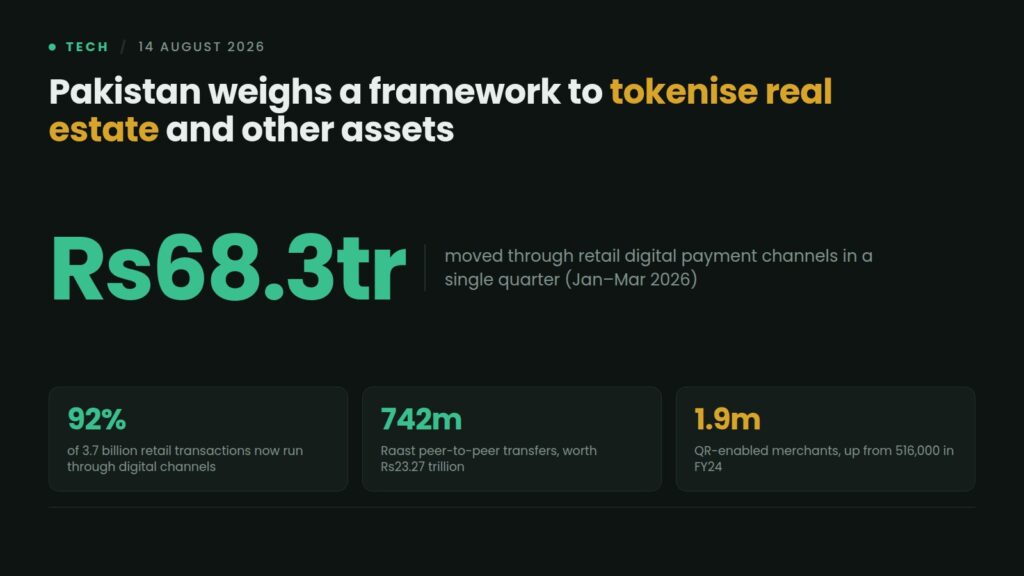
Whatever happens with tokenisation, the underlying payments infrastructure has changed faster than most people realise. State Bank data for January to March 2026:
- 3.7 billion retail payment transactions in the quarter, up 9 percent on the previous one
- 92 percent of them routed through digital channels
- Rs68.3 trillion in digital transaction value
- 132 million mobile banking and wallet registrations, up 37 percent year-on-year
- ~134 million of roughly 268 million accounts linked to a mobile app or wallet — half the total
- 742 million Raast peer-to-peer transfers worth Rs23.27 trillion
- 1.9 million QR-enabled merchants at the end of 2025, up from 516,000 in FY24
The QR figure is the most striking. Merchant acceptance points more than tripled in roughly eighteen months — the hardest part of any payments build, because it requires persuading millions of small businesses one at a time.
Raast doing Rs23.27 trillion in a quarter, free at the point of use, is a public payments rail operating at genuine national scale. That is the foundation on which anything else — tokenised assets included — would eventually have to settle.
The right order of operations
Aurangzeb’s own framing was that initiatives must be practical, scalable and aligned with broader digital transformation objectives. Applied honestly, that standard argues for a specific sequence.
Finish provincial land record digitisation and establish authoritative title. Settle which regulator owns tokenised assets. Fix brokerage onboarding, which needs no new law at all. Then tokenise.
Run it in the other order and Pakistan gets a modern settlement layer sitting on top of a contested ownership record — which is a faster way to trade a dispute, not a way to resolve one. Talking about the framework early is reasonable. Building it before the registry is ready would not be.
Related: Pakistan Just Got Its First NVIDIA H200 GPU Cluster. Here’s Why That Matters.
3 Comments
[…] Pakistan Wants to Tokenise Real Estate. The Land Records Aren’t Ready. […]
[…] Related: Pakistan Wants to Tokenise Real Estate. The Land Records Aren’t Ready. […]
[…] Related: Pakistan Wants to Tokenise Real Estate. The Land Records Aren’t Ready. […]
Comments are closed.