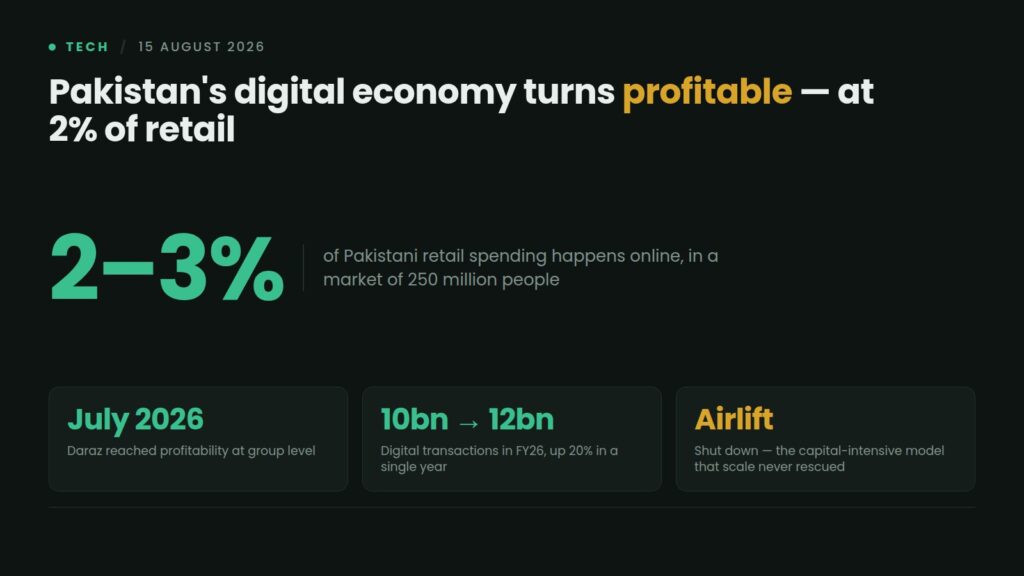
Daraz, the largest player in Pakistani e-commerce, reached profitability at group level in July 2026.
For anyone who watched the 2021 funding boom, that sentence is the end of an argument. Pakistan’s consumer internet spent a decade being told it would eventually make money, and spent most of that decade proving the opposite.
The number sitting underneath it is the one that should temper the celebration. Online commerce still accounts for roughly 2 to 3 percent of Pakistani retail.
Profitable at 2 percent penetration
Those two facts together define what actually changed.
In a market of more than 250 million people, 97 to 98 percent of retail spending still happens offline — in shops, in cash, face to face. The digital economy did not become profitable by capturing the market. It became profitable by giving up on capturing the market quickly.
The old model was to buy penetration: subsidise delivery, discount aggressively, absorb losses on every order and trust that scale would eventually make the unit economics work. That model needed one input above all others — cheap foreign capital — and that input disappeared when global rates rose.
What replaced it is unglamorous. Sustainable growth now depends less on acquiring users and more on delivery economics, payment reliability, customer retention and disciplined execution. Serve the customers you already have, profitably, and stop paying for the ones who only appear when there is a discount.
The graveyard is instructive
Pakistan’s consumer internet has already run the experiment on which models survive.
Airlift raised large sums, expanded fast on a capital-intensive quick-commerce model that required owning inventory and dark stores, and shut down when funding tightened. Its costs scaled with every new customer.
Careem did the genuinely hard thing — it normalised app-based mobility in a cash economy where nobody had used one before — and then exited ride-hailing anyway. Creating a category and profiting from it turned out to be separate problems.
Foodpanda established online food delivery and is still operating. inDrive is growing and Yango has entered the market — both arriving after the expensive category-creation work was already done by someone else.
The pattern is consistent: the companies that spent to build the habit largely did not survive to monetise it. The ones operating now inherited a market that already knew how to order online.
Why the payments side matters more than it looks
The single biggest structural cost in Pakistani e-commerce has always been cash on delivery.
Cash on delivery means a rider collecting notes at the door, reconciliation across thousands of drops, working capital tied up until the money is banked, and refusal rates on arrival that turn a delivered order into a returned one. Every step is expensive and none of it exists in a card market.
That is precisely the cost that digital payments erode, and the payments infrastructure has moved faster than the retail shift. State Bank data shows digital transactions rising from 10 billion to 12 billion in FY26. Retail payment volumes are now overwhelmingly digital, Raast moved Rs23.27 trillion in peer-to-peer transfers in a single quarter, and QR-enabled merchants passed 1.9 million at the end of 2025.
Profitability arriving now, rather than in 2022, is not a coincidence. The rails got cheap enough for the economics to close.
The headwinds have not gone anywhere
Three pressures are working against the sector at the same time.
Funding. Global capital for frontier-market consumer internet remains tight. Companies are being valued on cash generation rather than growth, which rewards the discipline described above and punishes anyone trying to scale.
Household spending. Inflation has eroded real incomes and raised price sensitivity. A shopper comparing an online price against the shop downstairs is a shopper who notices when the delivery subsidy disappears — which is exactly what disciplined execution requires removing.
Taxation. Higher tax costs land disproportionately on formal, digitally-recorded transactions. A platform sale is visible and taxable in a way a cash sale in an undocumented shop is not. The tax system currently prices formality as a disadvantage.
That last point is the structural one. Pakistan wants a documented economy and taxes the documented part hardest. Until that asymmetry is addressed, the 2 to 3 percent penetration figure has a ceiling built into it that no amount of operational discipline will lift.
What profitability actually buys
A profitable platform is not dependent on the next funding round to keep the lights on. It can invest from its own cash flow, plan beyond an eighteen-month runway, and survive a downturn that would have ended it three years ago.
That is the whole prize, and it is a real one. The sector has stopped being a bet on foreign capital and started being a business.
But 2 to 3 percent of retail is not a digital economy. It is a beachhead. Getting from here to the double-digit penetration common across the region needs logistics that reach beyond major cities, delivery costs that work for a Rs800 basket, and a tax regime that does not penalise the recorded transaction. None of those are solved by better execution at the platform level.
The sector has proved it can make money. Whether it can grow while doing so is the question the next three years will answer.
Related: Pakistan Wants to Tokenise Real Estate. The Land Records Aren’t Ready.