The federal government is moving to set up a Construction Industry Development Board (CIDB) — a single body to regulate standards, oversee quality and give the construction sector something it has never really had: a regulator that is also responsible for developing it.
The decision came out of a high-level meeting chaired by Federal Minister Ahad Cheema, attended by Minister of State for Finance Bilal Azhar Kayani, representatives of the Construction Association of Pakistan and senior officials. The framework goes to the Prime Minister for final approval.
Buried in the same package is a change that will do more to the industry than the board itself.
One year to three, and eventually five
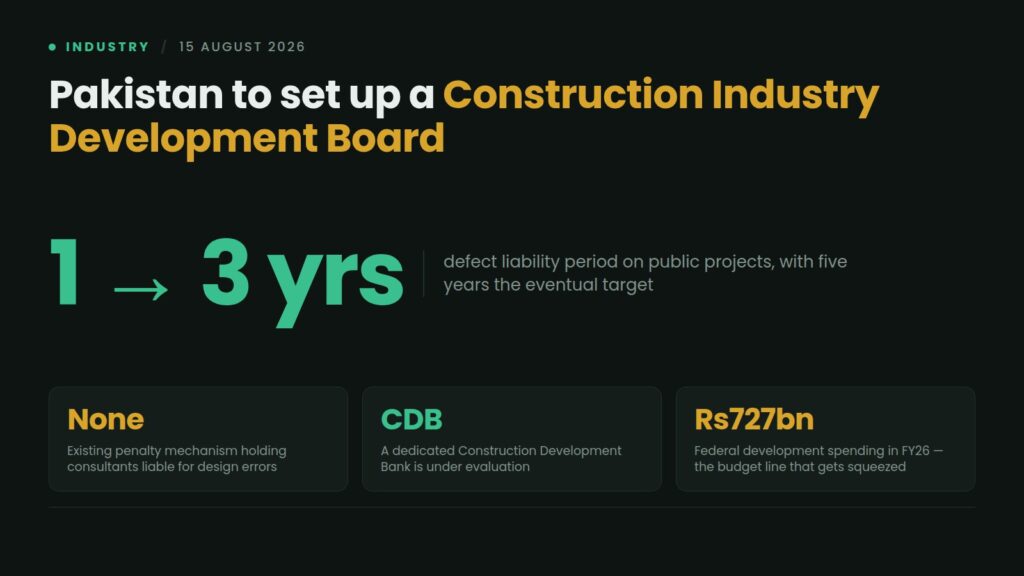
The Defect Liability Period on public projects is being extended from one year to three, with a stated intention to reach five.
The DLP is the window after handover during which the contractor must return and fix defects at its own cost. At one year, a contractor has to survive twelve months and one monsoon. Most of what goes wrong with badly built Pakistani infrastructure — road surfaces breaking up, drainage failing, settlement cracking, water ingress — shows up in year two or three, by which point the liability has expired and the repair bill has quietly transferred to the public.
Tripling that window changes the economics of bidding. A contractor pricing a job now has to carry three years of remedial risk on its own balance sheet, which means either building to a standard that survives three years or pricing in the cost of coming back.
Expect headline tender prices to rise. That is not a flaw in the policy — it is the policy working. The current low bids are cheap partly because the cost of premature failure is not sitting with the bidder. Moving that cost back onto the contractor makes the true price visible at tender rather than at repair.
The risk sits with smaller firms. Three years of retention money and contingent liability is a working capital burden a large contractor can absorb and a small one may not. Consolidation toward bigger players is the predictable side effect, and it is worth watching whether the CIDB framework does anything to offset it.
Consultants have had no accountability at all
Cheema made a second point that deserves more attention than it will get: there is currently no legal framework or penalty mechanism holding consultants responsible for design errors and technical flaws.
That is a significant gap. On a public project the consultant specifies the design, sets the technical standard and certifies the work as it proceeds. When a structure fails, the failure can originate in the design as easily as in the execution — and under the present arrangement the contractor carries the liability either way.
An unaccountable designer supervising a liable builder produces exactly the incentives you would expect: conservative certification, defensive contracting, and disputes that end up in arbitration rather than in repair.
Extending contractor liability to three years while leaving consultants outside any penalty regime would make that imbalance worse, not better. The two reforms only work together.
A construction bank is also on the table
The package includes evaluating a dedicated Construction Development Bank. The Minister of State for Finance has been directed to open formal discussions with the State Bank of Pakistan and the Pakistan Banks Association on feasibility and financial viability.
The underlying problem is real. Construction is a working-capital business — mobilisation costs, materials bought ahead of certification, payment cycles measured in months and government receivables that can stretch far longer. Commercial banks in Pakistan have historically preferred government paper to lending against a contractor’s receivable from a provincial department.
Whether a new institution is the answer is a separate question. Pakistan’s record with sector-specific development banks is not encouraging, and the more direct fix for contractor liquidity is the government paying its bills on time. A bank that lends against public-sector receivables is, in effect, a mechanism for financing the state’s own payment delays at interest.
The package also covers rationalising import and export policy for the sector and targeted tax reforms, neither of which has been detailed.
The context nobody mentioned
Construction is among the largest employers of low-skilled labour in Pakistan and the demand engine behind cement, steel and a long tail of allied manufacturing. When construction stalls, cement despatches fall, steel furnaces idle and day-wage employment disappears first.
It is also the sector most directly squeezed by the fiscal consolidation now being celebrated elsewhere. Federal development spending in FY26 came in at Rs727.447 billion — the line that gets compressed whenever a deficit target needs meeting.
A regulator improves the quality of what gets built. It does not create anything to build. Standards reform and a shrinking development budget arriving together means a better-governed industry with less work in it.
What is still missing
No timeline for the CIDB’s establishment. No indication of whether it will be a statutory body or an administrative one, how it will be funded, or what enforcement powers it will actually hold. No detail on the consultant penalty mechanism beyond the intention to create one. No date for the DLP extension taking effect.
Construction is a provincial subject in large part, which raises the harder question the announcement does not address: whether provincial procurement departments will adopt a federal board’s standards at all.
The diagnosis is right. The DLP extension is the most consequential thing in the package and could genuinely change how public infrastructure is built. Whether any of it survives contact with implementation is the usual question.
Related: Pakistan’s Fiscal Deficit Hit a 22-Year Low. Cheaper Debt Did Most of the Work.