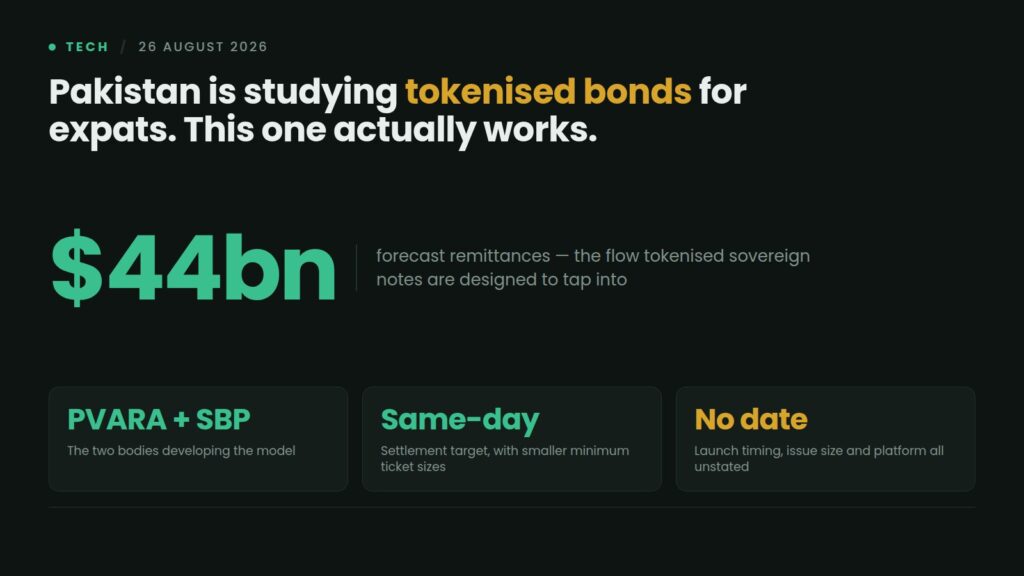
The Pakistan Virtual Assets Regulatory Authority and the State Bank are studying a model for tokenised sovereign bonds aimed at the diaspora — digitally native government notes issued on regulated blockchain infrastructure, with same-day settlement and interoperability with the existing financial system.
PVARA chairman Bilal Bin Saqib said the model could reduce investment ticket sizes, shorten settlement times and increase transparency around securities ownership.
Two weeks ago the finance ministry was discussing tokenising real estate. This is a considerably better idea, and the reason is worth setting out.
Why bonds work where property does not
Tokenisation does not create ownership. It represents a claim that exists somewhere else, and the token is only as reliable as that underlying record.
For real estate in Pakistan, that record is a provincial land registry — digitised unevenly, with cantonment, cooperative society and development authority land each documented differently, and title disputes common enough that buyers commission private verification before purchase. Put a blockchain on top and you get a fast, immutable record of a claim that may still be litigated for a decade.
A government bond has no such problem. The issuer is the record. There is no registry to reconcile, no competing claimant, no provincial revenue department. When the state issues a security and records it on a ledger it controls, the token and the underlying obligation are the same object.
This is the version of tokenisation that works in a country whose institutional records are incomplete, because it does not depend on those records at all.
The ticket size point is the substantive one
Of the three benefits named, reducing minimum investment size matters most in this specific market.
Pakistan already offers the diaspora sovereign investment products through digital accounts, and they have attracted real money. What they have not done is reach the majority of overseas Pakistanis, because the people sending home a few hundred dollars a month are not the people with a few thousand spare to lock into a certificate.
Fractional units change that arithmetic. A worker remitting monthly could put a small, variable amount into a sovereign instrument as part of the same transfer, rather than choosing between sending money home and investing it.
The scale prize is obvious. Remittances exceeded $41 billion last year and are forecast at $44 billion — more than twice Pakistan’s foreign exchange reserves and roughly twenty times annual foreign direct investment. Capturing even a small share of that flow as investment rather than transfer would change the external position more than any FDI campaign has managed.
The timing is not accidental
This lands in the same week the State Bank confirmed that banks must absorb roughly $256 million in remittance processing costs after a government support scheme ended in July — with a warning that the charges could eventually reach the people sending the money.
Both stories are about the same anxiety. Pakistan’s external account depends on remittances, the formal channel is expensive to run, and the informal alternative is always available. Anything that gives overseas Pakistanis a reason to keep using regulated channels is worth more than its face value.
A tokenised bond that settles same-day and accepts small amounts is exactly that kind of instrument — provided it is cheaper and faster than what exists, not merely newer.
What has not been said
Almost everything that determines whether this happens.
No launch date. No issue size. No indication of which blockchain infrastructure, or whether it is public, permissioned or operated by the State Bank itself — a decision that determines the entire security and governance model. No word on the legal status of a tokenised sovereign obligation under Pakistani securities law, or which regulator has primary jurisdiction. The Virtual Assets Act established PVARA; whether a government bond in token form is a virtual asset or simply a security is not obvious.
The phrase used was that authorities are studying a model. That is an honest description and a long way from issuance.
The question that decides it
Not the technology. Redemption.
An overseas Pakistani buying a dollar-denominated sovereign instrument wants to know they can get dollars out, on time, without a process. Pakistan has restricted outward flows during past balance-of-payments stress, and that history is the reason foreign investors price the country the way they do — Moody’s cited exactly this class of vulnerability while upgrading the rating to B3 this week.
Tokenisation makes settlement faster. It does nothing about whether the dollars are there. Same-day settlement of an instrument nobody trusts to redeem is a faster route to the same hesitation.
Get the redemption record right and the technology is genuinely useful. Get it wrong and the ledger just documents the problem more precisely.
Related: Pakistan Wants to Tokenise Real Estate. The Land Records Aren’t Ready.