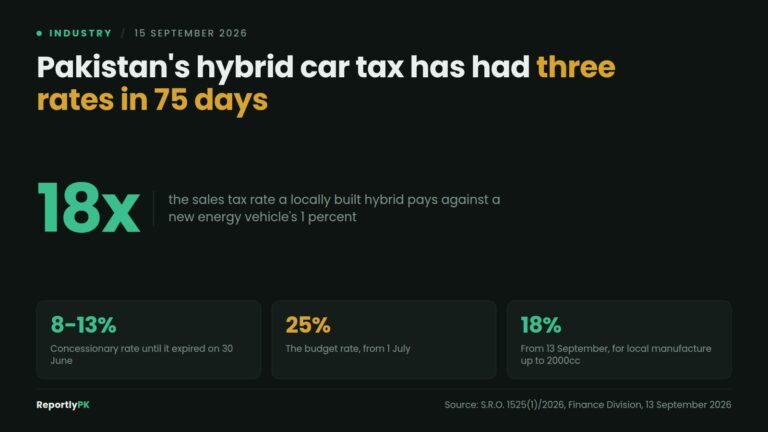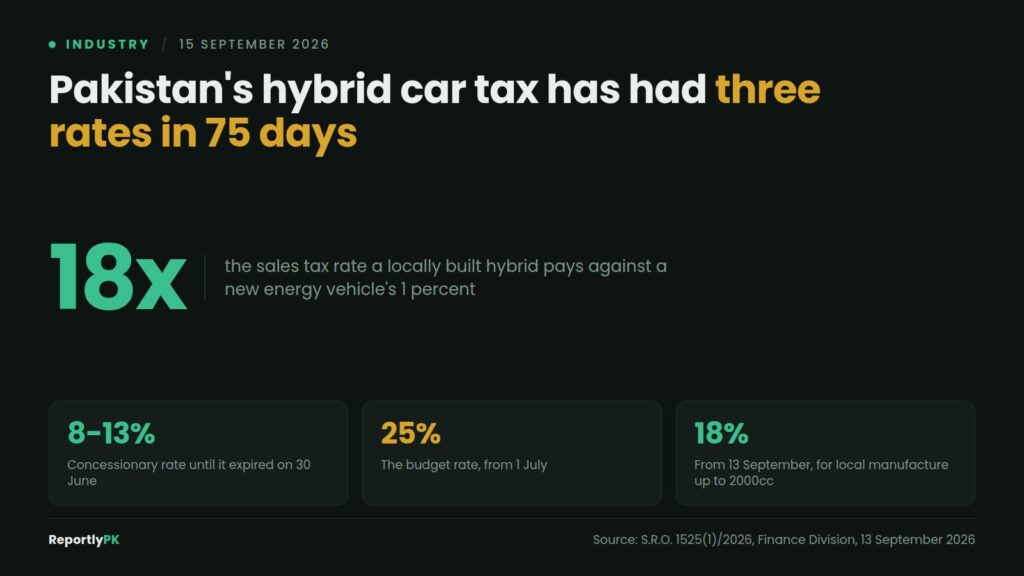
The HEV sales tax on locally manufactured hybrid vehicles up to 2000cc has been cut from 25 percent to 18 percent, through S.R.O. 1525(1)/2026 issued by the Finance Division on 13 September. It is the third rate this vehicle class has carried in seventy-five days.
The cut itself is sensible and the condition attached to it is the right one. The problem is the sequence it sits in.
Three rates in seventy-five days
The recent history of this single line in the tax code:
- Until 30 June 2026 — concessionary rates in the region of 8 to 13 percent, under the notification that then expired
- From 1 July 2026 — 25 percent, roughly a doubling, effective with the budget
- From 13 September 2026 — 18 percent, for locally manufactured units up to 2000cc
A buyer who ordered a hybrid in June, took delivery in July and compared notes with a neighbour in September paid three materially different prices for the same car. An assembler planning production volumes across that window was pricing against a number that moved twice.
Volatility is the barrier, not the rate
Pakistan has spent two decades asking why local manufacturers do not deepen localisation, and the usual answers are scale, component ecosystems and financing costs. All are real. None is as binding as this.
A decision to localise a hybrid powertrain component is a seven-to-ten-year capital commitment. It requires a view of unit volumes across that period, and unit volumes depend on retail price, and retail price depends on a sales tax rate that has moved three times in a single quarter. No discounted cash flow survives an input with that variance. The rational response is to import, assemble the minimum required, and keep the capital liquid — which is precisely what the industry does, and is then criticised for.
A durable 22 percent would generate more localisation than an 18 percent that might be 25 percent again in the next finance bill. Certainty is worth more than the concession.
A hybrid pays eighteen times what an EV pays
Set the new rate beside the treatment of new energy vehicles, which carry a flat 1 percent sales tax. A locally manufactured hybrid now pays eighteen times the sales tax rate applied to an NEV.
There is a coherent argument for favouring pure electric vehicles: they displace imported fuel entirely rather than partially, and a transition needs a direction. But the gap is difficult to defend at that width in Pakistani conditions specifically.
A hybrid needs no charging point, no three-phase connection and no grid availability. It works in a city with load-shedding, refuels through the fuel retail network that already exists, and delivers most of the efficiency gain on day one to a buyer who cannot install a home charger. In a country where charging infrastructure is thin and the grid is the constraint, the technology that requires none of it is being taxed at eighteen times the rate of the technology that requires all of it.
The state is meanwhile committing about Rs25 billion a month to subsidising petrol for small vehicles. That relief does not reach the hybrid segment, so it is not a direct offset. But the combined direction of the two policies — cheaper petrol at one end, a tax penalty on the most fuel-efficient mass-market option at the other — is not the direction the fuel import bill needs.
The condition attached is the right one
Two features of the notification deserve credit rather than criticism.
The relief applies to locally manufactured units only. That is a localisation condition attached to a concession — exactly what critics of the NEV regime have been asking for, which grants its benefit regardless of where the vehicle was built. A week ago a former chairperson of the automotive parts association was arguing publicly that concessions should carry localisation and employment requirements. This notification does the first half of that.
The 2000cc ceiling is also well chosen. It confines the relief to the mass-market segment and excludes large luxury hybrids, avoiding the criticism that has attached to the NEV concessions — that a percentage-of-price relief delivers the largest transfers to the most expensive vehicles.
What has not been published
No revenue estimate accompanied the notification. There is no published figure for annual HEV sales volumes, no projection of the tax expenditure the seven-point cut represents, and no stated review date or sunset.
That last omission is the consequential one. The rate that expired on 30 June expired because it had been set by a notification with an end date and nobody replaced it in time. The same thing can happen to this one. Until an automotive tax schedule is published with rates fixed for a stated number of years, the industry will keep behaving exactly as it currently does — and the localisation targets will keep being missed for reasons the policy itself creates.
Related: Pakistan’s EV Tax Breaks Could Cost Rs150 Billion a Year. Higher Education Gets Rs35 Billion.