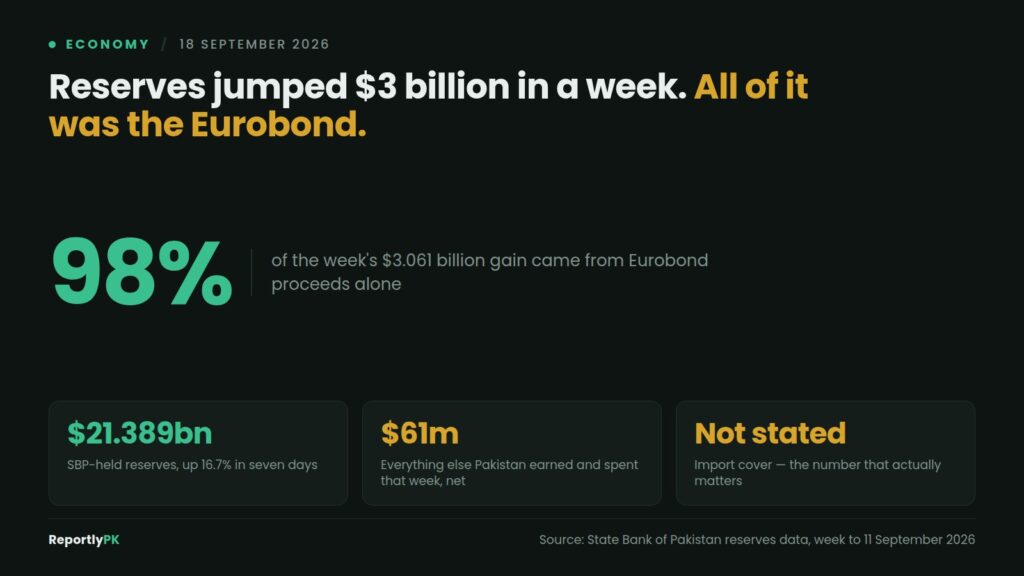
SBP forex reserves rose $3.061 billion in the week to 11 September, reaching $21.389 billion. Add the commercial banks’ net holdings of $5.402 billion and total liquid reserves stand at $26.791 billion.
The State Bank attributed the increase to receipt of Pakistan’s Eurobond proceeds. That bond raised $3 billion, which accounts for about 98 percent of the week’s gain.
Strip out the bond and the week was flat
Reserves entered the week at roughly $18.328 billion. They left it at $21.389 billion, a rise of 16.7 percent in seven days.
Of that, $3 billion arrived in a single wire from a syndicate of bond investors. The residual — everything Pakistan earned, received and spent in foreign currency across an entire week of trade, remittances, debt service and intervention — comes to about $61 million net.
That is not a criticism of the week. A roughly flat net position on the operating account is a reasonable outcome for Pakistan. It is a caution against reading a 16.7 percent jump as evidence that anything in the external economy changed.
Borrowed reserves and earned reserves
Both count identically in the headline. Only one has to be given back.
Reserves built from exports, remittances or foreign direct investment are money the country received and keeps. Reserves built from a Eurobond are money the country borrowed at a coupon, on a maturity, in a currency it does not print. The buffer is real while it sits there and it is a liability the entire time.
This is not a novel objection, and it is worth noting that the finance minister made a version of it himself when the bond priced. The reserve line does not distinguish between the two, which is why the distinction has to be made in words every time the number moves.
The buffer does real work
The case for borrowing to build reserves is stronger than the sceptical framing allows, and it should be put properly.
A country with thin reserves pays a risk premium on everything — every letter of credit, every rollover, every trade line. A larger buffer lowers the probability of a disorderly adjustment, supports the credit rating path that reopened market access in the first place, and reduces the coupon on the next issue. It also removes the scenario in which an oil shock forces import compression, which is the mechanism by which balance-of-payments problems become factory shutdowns.
Borrowing at a manageable coupon to avoid that is a defensible trade. Time has value, and this buys time.
The underlying position is not the problem
The operating account has actually been holding up. The current account deficit across July and August came to about $543 million — modest, and largely because remittances ran at $7.3 billion over the same two months.
So the picture is not a country plugging a haemorrhage with borrowed money. It is a country with a manageable external deficit choosing to build a larger cushion while markets are willing to lend to it. Those are very different situations and they get described in the same language.
What the two-thirds split tells you
Of the $26.791 billion in total liquid reserves, the State Bank holds $21.389 billion and the commercial banks hold $5.402 billion — roughly 80 percent and 20 percent.
Those two pools are not interchangeable and the combined figure invites people to treat them as though they were. The central bank’s holdings are the ones available to defend the currency, meet sovereign obligations and satisfy an IMF reserve floor. The banks’ holdings belong to the banks — they sit against customer foreign currency deposits, trade finance commitments and their own positions, and the State Bank cannot spend them.
Pakistani coverage routinely leads with the larger total because it is the more comforting number. The one that matters in a stress scenario is the smaller one, and it is the one that just moved.
The maturity nobody is discussing yet
A Eurobond is not a grant, and the proceeds sitting in the reserve line today are the mirror image of a repayment obligation on a fixed date.
Neither the coupon nor the tenor of this issue has been published in the reserve announcement, which means the market can see the asset and not the liability. Those terms determine whether this was cheap insurance or expensive breathing room, and they determine what Pakistan has to find, in dollars, in whichever year the bond comes due.
The honest version of this week’s headline is that Pakistan converted future obligations into present liquidity on terms it has not disclosed. That can be an entirely sensible transaction. It is not the same thing as the country having more money.
The number that was not published
Import cover. The reserve figure means nothing on its own; what matters is how many months of imports it buys, and that was not stated.
It is also the metric most exposed to what happens next. The State Bank held the policy rate at 11.5 percent last week and named elevated oil prices as the principal upside risk to inflation, with Brent trading above $100 against a forecast assumption nearer $95. An oil-driven import bill consumes reserves in exactly the way a bond issue replenishes them, only continuously.
The buffer was topped up at a good moment. Whether it is a floor or a peak depends on crude, and nobody in Islamabad controls that.
Related: Pakistan Raised $3 Billion. The Finance Minister’s Own Warning Is the Story.