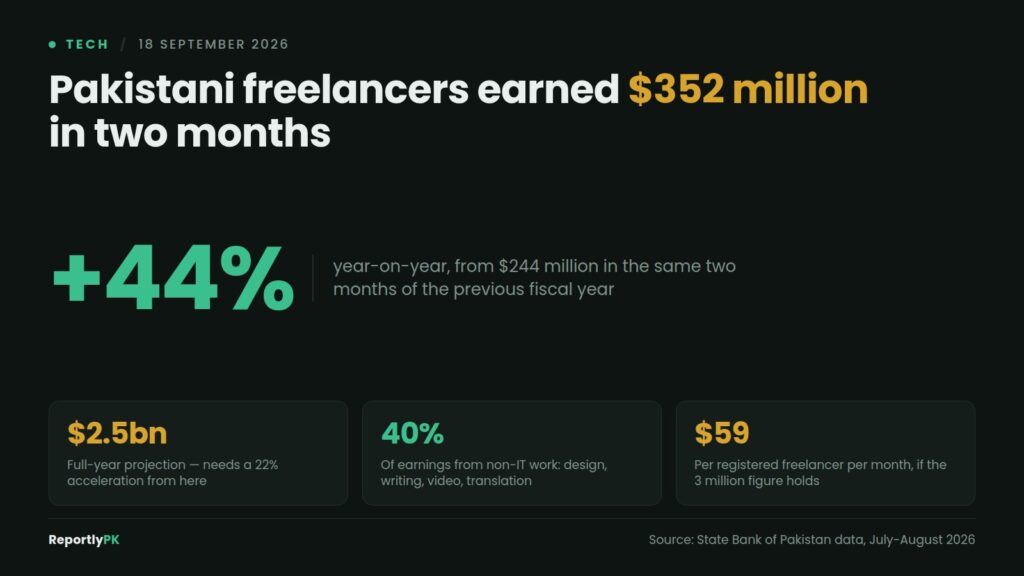
Pakistan freelancer earnings reached $352 million in July and August, the first two months of FY2026-27 — up 44 percent on the $244 million recorded in the same two months last year, according to State Bank data.
That is the fastest growth rate in any Pakistani export category this site has covered in six weeks. The full-year projection attached to it needs a closer look.
Where the money came from
- $212 million from IT services — about 60 percent of the total
- $139 million from non-IT services — about 40 percent
The second line is the one that gets ignored. Two dollars in every five earned by Pakistani freelancers come from work that is not software — graphic design, copywriting, video editing, translation, virtual assistance, bookkeeping. That is a large, low-capital services export built by people who did not need a computer science degree, and it barely features in the policy conversation about Pakistan’s digital economy.
One clarification the coverage tends to blur: the $212 million of freelance IT work sits inside Pakistan’s IT export receipts, not alongside them. It is roughly a quarter of that larger number, not an addition to it.
The $2.5 billion projection needs acceleration
Ibrahim Amin, chairman of the Pakistan Freelancers Association, projects full-year earnings of $2.5 billion.
Run the arithmetic. Two months at $352 million is a monthly pace of $176 million, which annualises to about $2.11 billion. To reach $2.5 billion, the remaining ten months must produce $2.148 billion — a monthly pace of $214.8 million, or 22 percent above where the sector is currently running.
That is not an unreasonable target for a category growing at 44 percent year-on-year. It is, however, a forecast that requires the growth rate to hold rather than a projection of the current run rate, and those are different claims. Reported as “on track for $2.5 billion”, it reads as the second when it is the first.
Individuals are outgrowing firms
The comparison that gives this number its significance is with the formal sector beside it. Pakistan’s IT export receipts grew about 17 percent across the same two months, and 18 percent in July alone. Freelance earnings grew 44 percent.
Individuals are expanding roughly two and a half times faster than the companies. That is not hard to explain. A freelancer carries no office lease, no bench cost, no corporate compliance burden and no sales team, and reaches a global client directly through a platform that handles discovery and escrow. The overhead a Pakistani software house must cover before it wins anything is precisely the overhead the freelancer does not have.
The uncomfortable half of that is what it does not build. A freelance economy generates foreign exchange without generating institutions. No firm-level intellectual property accumulates, no team scales past one person, nobody bids for the enterprise contract that requires fifty engineers and a signed service level agreement, and the accumulated know-how leaves with whoever moves abroad.
India built a services export sector worth hundreds of billions by growing firms, not individuals. Pakistan is currently doing the reverse, faster. It brings dollars in sooner and builds less that lasts, and both of those things are true at once.
Three million freelancers does not survive division
The association puts the number of Pakistanis providing digital and online services at nearly 3 million.
Divide $352 million by three million people and you get $117 each across two months — under $59 a month. Nobody builds a career on that, and nobody should conclude from it that Pakistani freelancers earn $59 a month. What it means is that at least one of three things is true.
- The three million figure counts registered or occasional participants rather than active earners
- Earnings are heavily concentrated in a much smaller group of full-time professionals
- A significant share of freelance income never reaches a Pakistani bank, and so never appears in State Bank data
The third possibility is the same measurement problem that runs through Pakistan’s remittance numbers. Freelancers are paid by foreign clients into whatever channel is cheapest and least frictional, and formal banking has historically been neither. Money routed through informal channels, foreign digital wallets or crypto is real income that the official figure cannot see.
Which means the $352 million is a floor, not a measurement — and part of the 44 percent growth may be money moving into view rather than money being newly earned.
The dollar that stays
Set $352 million against textiles, which exported $3.41 billion over the same two months. Freelancing is about a tenth the size, and on the headline numbers that is the end of the comparison.
It should not be. A dollar of textile export carries imported cotton, imported dyes and chemicals, imported machinery and imported energy. A meaningful portion of the gross figure leaves again to pay for those inputs. A dollar earned by a freelancer in Faisalabad carries an electricity bill and an internet connection. Almost all of it stays.
Nobody publishes net foreign exchange retention by export category in Pakistan, which is why gross export tables consistently understate what the services economy contributes to the external account.
What would help
The sector’s binding constraint is not talent and it is not demand. It is the cost and friction of getting paid — platform fees, correspondent banking charges, conversion spreads, and the time it takes for a foreign payment to clear into a rupee account.
Every point shaved off that stack pulls income from informal channels into measurable ones, which grows the official number without a single additional hour of work being done. That is a cheaper route to $2.5 billion than adding 22 percent to the run rate, and it is entirely within the State Bank’s control.
Related: Remittances Hit $7.3 Billion in Two Months. Four Countries Send Two-Thirds of It.