Pakistan’s nationwide 5G rollout will take another two years, Parliamentary Secretary for Information Technology Sabeen Ghouri told the National Assembly on Friday. The service currently reaches 24 cities, and work is focused on improving network performance before extending coverage further.
The complaints raised in the chamber were more revealing than the timeline. PPP member Noor Alam said consumers are paying for 5G without being able to use it. Nabeel Gabol reported complaints of slower connections. Members also raised unreliable service in Nawabshah and continuing dissatisfaction with 4G.
Paying for a signal that is not there
That specific complaint — billed for 5G, unable to use it — has a measurable basis, and it is the most important number in this story.
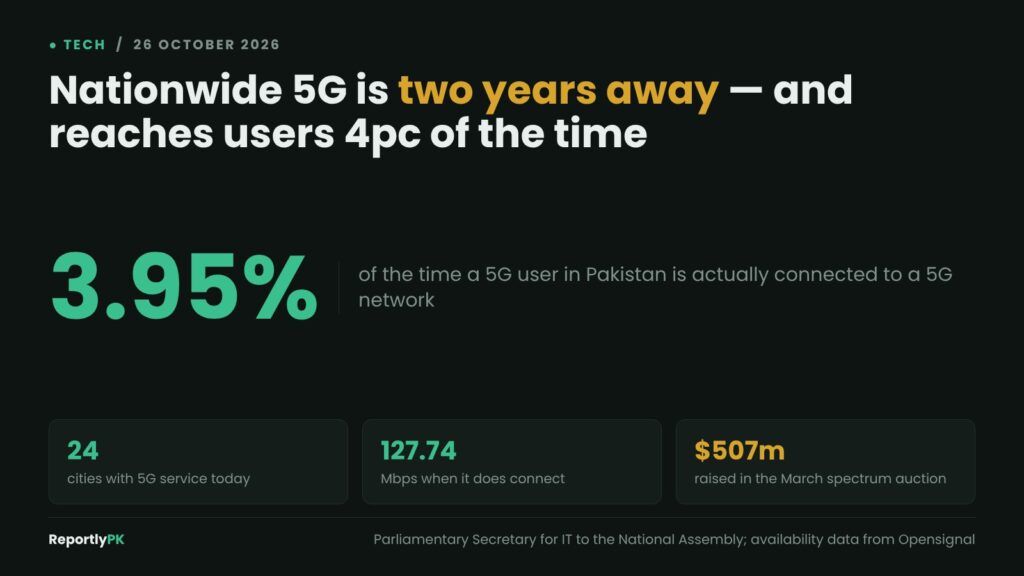
- 5G download speed where it connects: 127.74 Mbps
- 5G availability: 3.95 percent of the time
- Cities with 5G service: 24
- Spectrum auction proceeds: about $507 million, raised in March 2026
- Stated time to nationwide coverage: two more years
A 5G user in Pakistan spends about 96 percent of their time on something other than 5G. The 127.74 Mbps figure is real and genuinely fast; it describes the roughly one hour in twenty-five when the handset is actually attached to a 5G cell.
That is what a complaint about paying for an unusable service looks like in data. The customer is not imagining it, and the operator is not misreporting speed. Both statements are true because they describe different things: one describes performance when connected, the other describes how rarely that happens.
Related: Pakistan’s 5G runs at 127.74 Mbps but reaches users only 3.95pc of the time
Performance before coverage is the right order
The stated approach — improve network performance before expanding to more areas — sounds like an excuse for delay and is probably the correct engineering decision.
Adding 5G cells in new cities without the backhaul to feed them produces more sites with the same problem. A 5G radio delivers its advertised speed only if the fibre behind it can carry the traffic; on a microwave link sized for 4G, the radio is capable of 127 Mbps and the connection is not.
Pakistan’s tower fiberisation rate has been the recognised constraint on mobile performance for years. Extending a coverage map while that gap remains converts a problem affecting 24 cities into a problem affecting more of them.
The spectrum has been paid for
The auction that cleared the way for this rollout raised about $507 million in March. Operators have paid for licences on an asset that generates revenue only once the network using it is built.
That creates a commercial pressure the parliamentary discussion did not address. An operator carrying spectrum costs has an incentive to market 5G immediately, which is how subscribers end up on 5G tariffs in advance of 5G coverage. The regulator’s draft Telecommunication Competition Rules give it powers over pricing and transparency for operators with significant market power — and what a customer is told they are buying is squarely a transparency question.
No one has suggested applying those draft powers to 5G marketing claims. The connection is ours rather than the government’s, and it is the obvious place where the two policy threads meet.
What two years does not specify
Nationwide is doing a lot of work in that sentence. It could mean 5G available in every district headquarters, or along motorways, or to a stated percentage of the population. Each implies a different amount of construction and a different cost.
No target has been published for availability — the share of time a user is actually connected — which is the measure that would tell a subscriber whether the service they pay for has improved. A rollout that doubles the number of cities while leaving availability near 4 percent would satisfy the coverage promise and change nothing a customer experiences.
Nor has anyone said what the two years depends on: fibre deployment, further spectrum, imported equipment, or the electricity costs that operators have cited as a constraint on running sites in the first place.
Twenty-four cities is not nothing
The two-year figure reads as failure, and against the announcements that accompanied the spectrum auction it is a slip. Against what preceded it, 5G reaching 24 cities within months of the licences being issued is a faster start than Pakistan has managed with previous generations.
The pattern in most markets is that the first cities come quickly, because operators deploy where subscriber density makes the economics obvious, and the curve then flattens sharply. Covering Karachi and Lahore is a commercial decision; covering Nawabshah is closer to a policy one, and it is funded differently.
Which is why the complaint from Nawabshah is the one that matters for the timeline. The remaining two years are not about building out the easy half of the country — that part is largely done. They are about the places where the business case does not stand on its own, and nothing announced this week says who pays for those.
The 4G complaint is the larger one
Members raised continuing dissatisfaction with 4G alongside the 5G questions, and that is where the volume of Pakistani mobile users actually sits. The overwhelming majority of connections in the country are 4G, and they will remain so throughout the two years now forecast.
Improving 4G performance and improving 5G availability turn out to be the same project, because both depend on the backhaul and power supply behind the tower rather than on the radio bolted to it. Money spent on fiberisation lifts both.
That makes the two-year statement less discouraging than it reads. The alternative — a faster rollout of 5G cells onto infrastructure that cannot feed them — would produce better headlines and the same complaints.