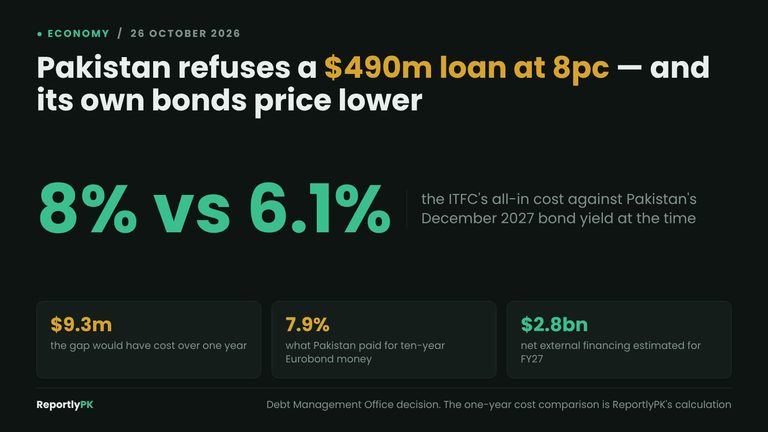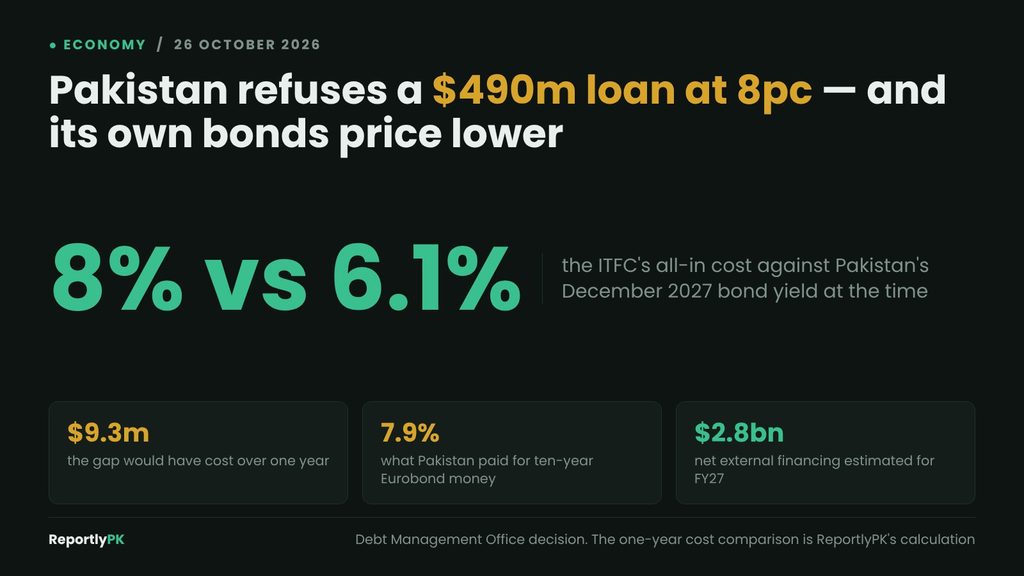
Pakistan has turned down money. The Debt Management Office rejected a high-interest loan of $490 million offered by the International Islamic Trade Finance Corporation, the trade finance arm of the Islamic Development Bank group, because the all-in cost of about 8 percent was too high.
The Finance Division had been looking for something closer to 6 percent. Its benchmark was not arbitrary: Pakistan’s own December 2027 bond was trading at 6.1 percent, which means the lender was asking roughly 190 basis points more than the market was charging for Pakistani risk of comparable tenor.
The pricing that made it refusable
- Offered: $490 million, one-year commercial facility from the ITFC
- All-in cost: about 8 percent
- Finance Division’s target: about 6 percent
- Pakistan’s December 2027 bond at the time: 6.1 percent
- Cost of accepting rather than matching the market: roughly $9.3 million over the year
Nine million dollars on a half-billion-dollar facility is not, on its own, a decisive sum for a sovereign. What makes the refusal interesting is the comparison the number invites.
A one-year loan priced above ten-year paper
In September, Pakistan raised $3 billion through Eurobonds — a 5.5-year issue at 7.5 percent and a 10-year at 7.9 percent.
The ITFC was asking about 8 percent for one year. That is above what international investors accepted for lending to the same sovereign for a decade, which inverts the normal relationship between tenor and price. Lenders charge more for longer commitments because more can go wrong; a one-year facility costing more than ten-year money is anomalous.
Read that way, the rejection is less a show of fiscal discipline than a recognition that the price was out of line with what Pakistan had just demonstrated it could borrow at. The government has asked the Economic Affairs Division to find a replacement facility at competitive rates, which may come from the ITFC itself or another lender — so this is a negotiation rather than a withdrawal.
Related: Pakistan to term out short-dated foreign debt while holding the $100bn stock flat
It is the stated policy, applied
Finance Minister Muhammad Aurangzeb said this month that Pakistan was not in a rush to issue bonds this fiscal year, and that the plan was to refinance short-dated external debt into longer maturities while keeping the overall stock near $100 billion.
A one-year facility at 8 percent is precisely what that policy says no to. It is short-dated, which adds to rollover risk rather than reducing it, and it is expensive. Refusing it is the first visible instance of the stated approach producing a decision rather than a statement.
Whether it holds is the test. The same discipline has not always been applied: in August Pakistan took a $300 million loan from United Bank Limited, and the government granted an income tax exemption on the bank’s profit from it — a cost that does not appear in the loan’s headline rate but is borne by the exchequer all the same.
The financing need is the constraint
Gross financing needs for FY27 are projected at Rs28.647 trillion, about 20 percent of GDP. Net external financing is estimated at Rs813 billion, roughly $2.8 billion, mostly from multilateral lenders.
Against a $2.8 billion net external requirement, a $490 million facility is a meaningful share — which is what gives a lender pricing power and makes the refusal more consequential than the sum suggests. The replacement has to come from somewhere, and the pool of institutions willing to lend to Pakistan at scale is not large.
Pakistan signed three loan agreements worth $603 million with the Islamic Development Bank earlier this year, so the relationship with the group is active and this is a disagreement over terms within it rather than a breakdown.
Why a trade finance body charges more
The 8 percent figure is an all-in cost rather than a coupon, and that distinction explains part of the gap. A bilateral facility carries arrangement fees, commitment fees and structuring costs that a bond does not, and comparing an all-in cost against a traded bond yield is not quite like for like.
Set against that, a bilateral loan should also be cheaper in other respects. It carries no roadshow, no underwriting syndicate and no public market risk, and a trade finance facility is typically secured against identifiable flows rather than being a general obligation of the sovereign. Security ordinarily lowers price.
Neither side has published the fee breakdown, so how much of the 190 basis points is credit judgement and how much is transaction cost cannot be established from outside. What can be said is that the Finance Division had a market reference point, used it, and declined — which is a better-informed negotiating position than Pakistan has often occupied.
A gap in the external arithmetic
One number in the background deserves more attention than it has received. The IMF projects Pakistan’s current account deficit at 1 percent of GDP, close to $4.5 billion. Pakistani authorities have estimated $2.5 billion to $3 billion.
That is a gap of at least $1.5 billion between the lender’s view and the borrower’s, and it is the kind of difference that determines whether a financing plan holds. If the Fund is right, the external requirement is materially larger than the one the government is planning against — and turning down available money becomes a harder call than it looks today.
Neither side has published the assumptions behind its figure. Until one does, the $490 million decision has to be judged against a financing need that is itself disputed by $1.5 billion.