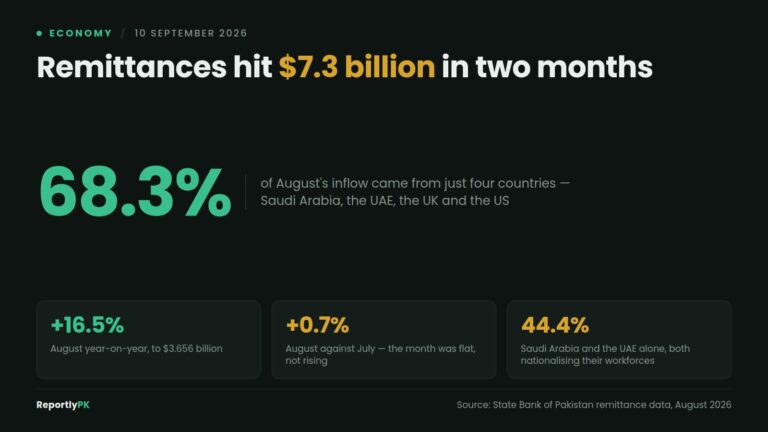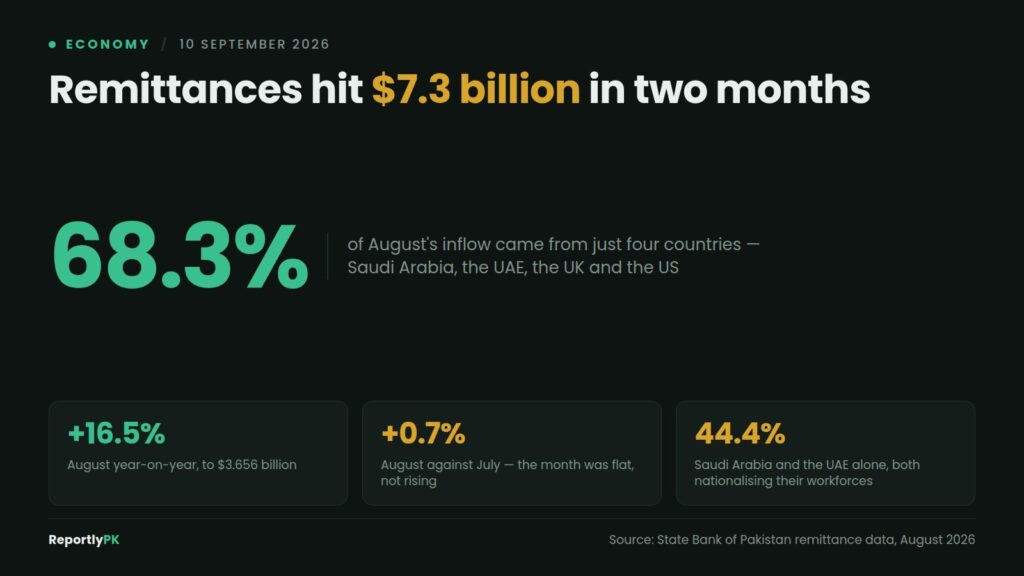
Pakistan remittances reached $7.3 billion in July and August combined, up from $6.4 billion in the same two months last year — growth of 14.7 percent, or roughly $900 million. August alone brought in $3.656 billion, a 16.5 percent rise on August 2025.
Those are good numbers and they are being reported as good numbers. Two things sit underneath them that are worth separating out before the figure is treated as a trend.
The month was flat, not up
August’s $3.656 billion compares with July’s $3.631 billion. That is a month-on-month increase of 0.7 percent — about $25 million on a base of three and a half billion.
The 16.5 percent headline is a year-on-year comparison against August 2025’s $3.138 billion. Year-on-year framing is the right way to handle a series with heavy seasonal swings, and remittances have them: Ramadan, Eid and the harvest cycle all move the monthly numbers around. But it measures distance from a point twelve months back, not direction now. Within FY2026-27 so far, the inflow is running sideways at about $3.64 billion a month.
At that rate the year annualises to roughly $43.9 billion. That would be a record. It would also mean the growth arrived before July rather than during it.
Four countries send two-thirds of it
The August breakdown by source is where the structural exposure sits:
- Saudi Arabia — $873.5 million
- United Arab Emirates — $749.8 million
- United Kingdom — $563.7 million
- United States — $308.9 million
Those four total $2.496 billion, or 68.3 percent of the month. Saudi Arabia and the UAE alone account for 44.4 percent.
Nearly half of Pakistan’s single largest non-debt foreign inflow therefore depends on the labour markets of two Gulf states, both of which have spent the past decade running explicit workforce-nationalisation programmes designed to move jobs from expatriate workers to citizens. Those programmes have not yet dented Pakistani inflows. The point is that the exposure is concentrated in exactly the two economies with a stated policy objective of reducing it.
The UK figure is also worth a second look. At $563.7 million, Britain sent nearly 1.8 times what the United States did, from a much smaller Pakistani-origin population base. That reflects an older, more settled diaspora with deeper family obligations — and older diasporas remit less as generations pass, not more.
Some of the growth is measurement
Banking expert Ibrahim Amin attributed part of the increase to improvements in banking systems and connectivity, which have moved remittances out of informal channels and into formal ones.
That is almost certainly correct, and it has an implication that rarely gets stated. Money that shifts from hawala to a bank transfer was already reaching Pakistan. It was simply invisible to the State Bank. To the extent formalisation is driving the numbers, recorded remittance growth overstates the growth in money actually being sent.
This is still a real gain — formal channels mean measurable reserves, taxable financial activity and a workable exchange rate policy. But it is a gain in visibility, not in earnings, and the two get reported as the same thing.
What the inflow is actually doing
Khurram Schehzad, adviser to the finance minister, said the inflows will strengthen external buffers and improve economic resilience. On the reserves arithmetic that is straightforwardly true: remittances are non-debt, non-repayable foreign exchange, which is the best kind a deficit country can get.
What they do not do is build export capacity. Remittances land mostly in household consumption and property, and consumption pulls in imports. A $43.9 billion annual inflow that finances an import bill is a different economic object from a $43.9 billion export sector that builds industrial capability, even though both show up the same way in the reserves line.
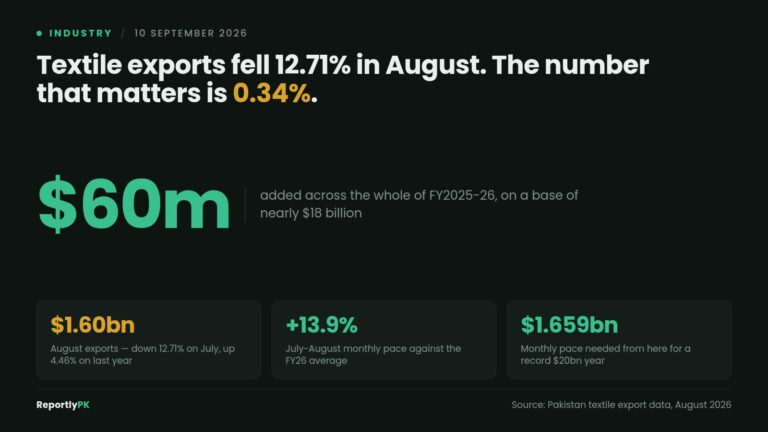
The comparison that matters is the one nobody makes in the same press release: Pakistan’s entire textile export sector, its largest, brought in $17.97 billion across all of FY2025-26. Remittances are running at more than twice that.
The cost side of the number
Formal-channel remittances are not free to attract. Pakistani banks operate under an incentive scheme that reimburses them for processing costs, and the associated liability has run into the hundreds of millions of dollars. Part of the shift from informal to formal channels has been purchased.
That does not make the policy wrong. Buying visibility into $44 billion a year of inflows is defensible at almost any price. But the net figure — inflows less the cost of attracting them — is not the one that gets announced, and it should be.
What to watch
Three things will tell you whether this holds. Whether the monthly figure breaks meaningfully above $3.65 billion rather than tracking sideways. Whether the Gulf share starts to slip as nationalisation policies bite. And whether the gap between the official and open-market exchange rates stays narrow — because the moment it widens, the formalisation gain reverses and the money goes back to the channels the State Bank cannot see.
Related: Banks Now Owe $256 Million to Collect Your Remittance. Somebody Pays That.